


In the pre-AI era, clients hired service providers for a familiar set of reasons: expertise, labor capacity, execution, and accountability. As we are seeing with software firms, AI — and, more to the point, agentic AI — is changing that calculus.
AI agents can increasingly execute workflows rather than simply assist employees. They can triage service requests, summarize documents, reconcile transactions, generate code, analyze data, draft responses, and coordinate multi-step processes across systems. As agentic AI takes on more of that work, clients will expect service providers to bring something different: sharper judgment, deeper industry context, proprietary data, workflow integration, and clearer accountability for outcomes.
Some services firms will use AI to strengthen margins, improve quality, and reach markets they could not previously serve. Others will face pricing pressure, lower barriers to entry, or decreased demand from clients that are bringing work in-house. Most will experience a combination of these forces, often across different service lines within the same company.
That shift has implications beyond services firms. If AI changes competition, delivery, pricing, and clients’ reasons for buying, investors will eventually see these changes reflected in growth, margins, and valuation.
What clients will still pay service providers for
The central questions for executives are what services or functions remain valuable, and how firms can continue to differentiate themselves when routine work becomes easier to automate.
Clients will continue to need providers that offer the ability to manage risk, integrate across functions, drive change, and apply judgment in ambiguous situations. They will need partners that understand the industry context behind a workflow and, importantly, that can stand behind outcomes and manage exceptions.
This is where services differ from software. Software companies scale through licenses, features, and product adoption. Services companies scale through people, processes, expertise, and relationships. AI is blurring the line between the two, as some services become more software-like and some software begins to perform service-like workflows.
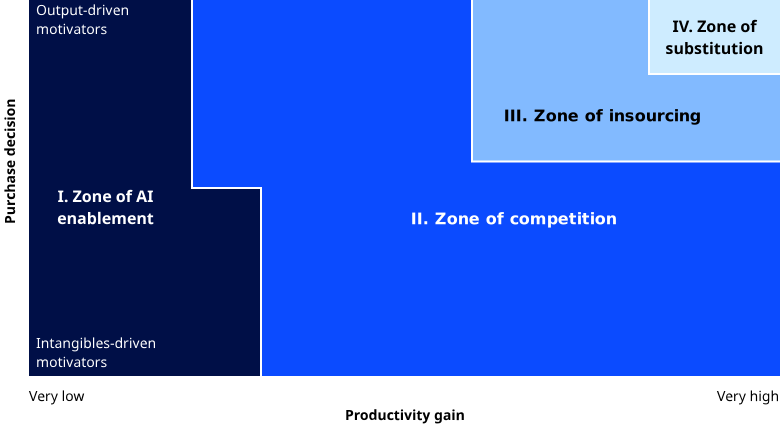
The impact on services depends on two practical questions: How much of the work can be automated, and why does the client rely on an external provider to do it?
In-person or relationship-led services may see AI primarily in support functions, such as scheduling, documentation, analytics, knowledge management, or reporting. Parts of healthcare, field services, specialty consulting, and relationship-led wealth advice are examples that could fall into this category.
Repeatable knowledge work, such as contact centers, first-line support, basic software development, document review, reconciliation, claims intake, and rules-based operations, are exposed the most to AI-driven automation.
When it comes to the second question about buying decisions, some services are bought mainly for capacity: The client needs work completed competently, efficiently, and at scale. Other services are bought for harder-to-replicate reasons, such as expert judgment, regulatory standing, proprietary data, risk transfer, brand, trust, or accountability.
Four ways AI is reshaping the landscape for service providers
As leaders answer these questions, their companies are likely to fall into one of four zones that will reshape the competitive landscape.
Zone of enablement — AI strengthens the existing service model
In some services, AI improves productivity without changing the basic reasons clients buy the service. Providers can automate parts of delivery, increase throughput, improve consistency, and reduce administrative burden while still competing on expertise, trust, brand, or specialized capability.
A banker advising clients on a complex M&A transaction may use AI to analyze financials, identify potential buyers, or prepare presentation materials. A defense attorney could turn to AI to quickly review case law in real time, summarize evidence, or draft motion notes. In both cases, the work gets done faster, but the client is still buying judgment, credibility, and accountability from the services firm.
The opportunity is margin expansion and better service quality. But providers should not assume they will keep all of the upside. As clients become more aware of AI-enabled productivity gains, they will ask how those gains show up in price, scope, speed, or service levels.
Zone of competition — AI lowers barriers and raises pressure
Where AI automates a meaningful share of delivery, competition intensifies. Lower-cost firms can move upmarket, AI-native entrants can launch with leaner teams, and smaller firms can compete on more equal footing.
For example, this dynamic could affect industries like IT, marketing, finance and accounting, compliance, managed services, and parts of human resources. It does not mean demand disappears. It means the basis of competition changes.
Historical advantages in labor arbitrage, process discipline, or delivery scale may matter less when automated tools make high-quality outcomes easier to achieve. Providers will need a clearer position. Some will defend premium pricing through expertise, proprietary data, trusted relationships, or deep integration into client workflows. Others will compete through scale, speed, automation, and cost.
The most exposed firms may be those stuck in the middle — too expensive to win on efficiency but not distinctive enough to justify a premium.
Zone of insourcing — AI enables clients to bring work in-house
Some services are outsourced because clients lack the people, time, or operational capacity to perform the work themselves. AI changes that equation. If internal teams can do more with fewer resources, some clients may reconsider what they need to outsource.
That does not mean insourcing will happen automatically. Clients may still lack business interest and the governance, expertise, technology infrastructure, risk appetite, or management capacity to run AI-enabled workflows effectively. Switching costs and competing priorities for internal AI investment can also keep work with external providers, even when insourcing becomes technically possible.
Still, the threat is real. Providers in this category need to offer something clients cannot easily replicate internally. That may include proprietary data, regulatory expertise, specialized talent, risk transfer, workflow orchestration, or accountability for outcomes.
Zone of substitution — AI turns services into software
At the highest levels of automation, the service becomes AI-enabled software. Standardized, rules-based, repeatable tasks are most exposed. Document processing, first-line support, routine reconciliation, claims intake, standard reporting, and basic review work can increasingly become software-like products rather than labor-based services.
Providers in this category may need to become the disruptor themselves. That could mean launching AI-native products, embedding agentic workflows into managed services, or using automated delivery as the entry point into higher-value advisory, transformation, exception management, or risk oversight.
For firms that move too slowly, the danger is that AI-native competitors or client-owned systems capture the workflow and push traditional providers into lower-margin execution roles. In some cases, a services firm may need to become, at least for part of its business, a software company.
How services firms can build advantage with AI
As services firms embed AI in their offerings, the ability to supply labor becomes a weaker source of differentiation. Other advantages become more important.
Client trust matters because relationships built over years are not easily replaced by a prompt. Proprietary data is a value-add because it can produce better insights. Regulatory credibility and domain expertise matter because AI-generated output still needs context, judgment, and application to real business problems.
Workflow ownership may become one of the most important advantages. Providers embedded in critical client processes are harder to displace, especially when they understand how work actually gets done across systems, teams, exceptions, and handoffs.
This is where AI can strengthen an incumbent’s position. A provider with proprietary data, trusted relationships, and deep workflow access may be able to use AI to deliver more value than either a generic tool or a client’s internal team.
The future of the services industry in an AI era
AI will significantly change what clients value, what they are willing to pay for, and who they consider capable of delivering it. In some areas, the winning service model will look more like software. In others, human judgment and trust may become even more important because AI raises the standard for routine execution.
Executives and boards need to understand where AI is changing the basis of competition across each service line, and whether the company is moving with enough focus to protect what remains defensible and reinvent what does not. Investors need to understand the same shifts because changes in client demand, delivery models, and competitive position will ultimately affect growth, margins, and revenue durability.