


Private equity investors had largely underwritten AI as a tailwind to software — supporting growth, expanding margins, and reinforcing already attractive unit economics. That framing is now breaking down.
This article is the first in our new “AI Enabled Value Creation” series, which explores how investors and software firms can navigate the rapidly shifting AI landscape.
Recent advances in agentic AI are shifting the role of software from a tool that augments human workflows to one that can increasingly execute them end-to-end. As that shift becomes tangible, public markets have begun to reprice software risk. Demand for software is not disappearing, but the economics underpinning the sector — seat-based pricing, expansion-driven growth, and durable product differentiation — are being called into question.
The implications for private equity are immediate. Valuation multiples are becoming more sensitive to perceived AI exposure. Deal processes are seeing greater scrutiny around technology risk. Lenders are asking harder questions about revenue durability and downside protection. Across portfolios, assets that once screened as “high quality” based on retention and growth may face structurally different trajectories under an AI-driven operating model.
Winners will be those that move most quickly to secure or rebuild defensibility, embed AI at the core of the product, and capitalize on their position — data, workflows, and customer access — before competitors do.
This is a shift in how value is created and captured across the software stack.
In this environment, traditional diligence is no longer sufficient. Investors need to assess not just market growth, competitive positioning, and execution but also a more fundamental question: How does AI change the role of this software in the workflow, and what does that mean for its long-term economics?
The answer will increasingly determine which assets sustain multiples, which require transformation, and which face structural pressure.
Why the SaaSpocalypse happened — AI as a SaaS workflow replacement
Software valuations gained share throughout 2025 thanks to interest rate cuts and optimism around AI as a value driver. Then, in early 2026, with agentic plug-ins demonstrating the ability to autonomously run multi-step enterprise workflows historically performed by humans inside software as a service (SaaS) applications, software stocks began to fall.
Software segments considered “safe” saw a smaller drop than “less safe” segments (Exhibit 1). But successive Claude launches brought shocks that impacted even otherwise “safe” segments (Exhibit 2), even if the logic wasn’t always totally clear.
How the market is reevaluating SaaS assets — repricing three core assumptions
The market isn’t worried that software demand will disappear, or that all jobs will become agents. The fear is that while software economics migrate, many SaaS companies are priced for a world that no longer exists. AI has caused the market to reprice three core assumptions that have underpinned SaaS valuations:
Then: Software is inherently protected because it’s hard to build.
Now: Software can be built cheaply and quickly by existing competitors, startups, or even customers themselves.
Then: Seat expansion and module expansion/pricing uplift are an enduring monetization model.
Now: AI agents do the work of people, reducing seat numbers and their value.
Then: Features and interface/familiarity create a moat.
Now: Agentic development commoditizes features, while agents may interface directly with the software.
While SaaS companies continue to predict a strong 2026, these drivers represent concern that the market has fundamentally overvalued — and potentially over-levered — these companies based on sticky, growing recurring subscription revenue. They represent uncertainty over the direction of travel.
This uncertainty is contagious. New AI launches can trigger broad selloffs even when the impact thesis is unclear, such as the impact of Claude Code Security on the cybersecurity sector, or when a well-written piece of doomsday fiction makes the rounds.
How AI is disrupting SaaS M&A, financing, and deal economics
With multiple companies under pressure and SaaS-funding falling out of favor, deal volume is likely to remain constrained in the short term. In the current market:
- Sellers are becoming more selective about which assets they bring to market.
- Buyers and their investment committees are asking a lot of questions about AI risk, leading to more dropouts in processes and wider bid-ask spreads — and better deals for the bidders who remain.
- Lenders are assessing the same AI-driven risks and are looking for comfort that buyers have done their homework and have a credible plan.
A slower deal market results in longer hold periods and slower Distributed to Paid-In-Capital (DPI) for financials. This is especially true for assets acquired during peak valuation periods, such as 2019-2022, with sellers more selective to capture return.
Software companies’ AI strategies will also be more closely scrutinized. Investors will be looking for signs that a company has hit on defensible, value-added AI offerings that drive real revenue. They’ll also examine the success of efforts to move away from per-seat subscription pricing — and what that means for revenue retention and predictability.
Early evidence of this shift is already emerging across both public and private markets.
- In customer support and CX software, platforms such as Genesys are seeing increased adoption of AI-driven automation, while newer players like Cresta are demonstrating how AI agents can handle a growing share of customer interactions, weakening the historical linkage between headcount and revenue.
- In creative and design software, companies like Adobe are embedding generative AI directly into core workflows, accelerating both automation and competitive pressure as capabilities that once differentiated products become increasingly commoditized
- In software development, generative coding tools such as GitHub Copilot are making the build versus buy question more frequent, particularly for narrower point solutions that can now be replicated more quickly and cheaply.
- Within deal processes, sponsors are increasingly encountering management teams repositioning their AI narratives mid-process, while lenders and ICs are pushing for deeper diligence on revenue durability — especially for businesses with exposure to labor-linked pricing models.
Taken together, these signals suggest the market is not waiting for full disruption to materialize but is already underwriting a different set of assumptions about how software companies grow and sustain value.
Four key ways AI is disrupting SaaS business models
Every SaaS investor and company should be asking themselves two main questions: How will AI disrupt this software, and is this software well positioned to win the disruption?
The answer starts with understanding where AI is exerting pressure. AI is not a single threat vector — it reshapes software economics through multiple overlapping mechanisms that challenge how SaaS products are built, priced, and defended. AI impacts software in four fundamental ways:
- Substitution. AI performs the core task that the software was intended to produce, for example generating images versus Photoshop.
- Competitive acceleration. AI speeds software development, increasing competitive intensity and enabling DIY software development, for example coding a point solution in-house versus buying.
- Agentic execution. AI executes the software, replacing human seats with AI agents, and/or replacing the interface with a chatbot and relegating the software to rails, for example AI agent customer service reps replace human reps.
- Indirect disruption. AI agents replace the jobs of humans that the software monetized even, without touching your workflow, for example AI replaces call center reps, decreasing HCM software spend.
Which software models face most AI exposure — and which are more resilient
Not all software assets are equally affected. The impact of AI is uneven, and increasingly predictable based on how a company creates and captures value.
More exposed:
- Seat-based, labor-linked SaaS models where revenue scales with human effort
- Thin UX or workflow layers that can be replicated or bypassed by AI agents
- Standalone point solutions with limited integration or control over the broader workflow
More resilient:
- Systems of record with deep workflow ownership and embedded decision-making
- Data-rich vertical SaaS with proprietary, continuously refreshed datasets
- Platforms that control execution within the stack, rather than just the interface
This divergence is already shaping how investors assess risk, underwrite growth, and prioritize capital across portfolios.
How to triage a SaaS portfolio for AI disruption
These disruptions are not inherently bad, but much depends on the software company’s starting position and strategy.
Defensibility is shifting away from polished workflows toward assets that remain hard to replicate, even when “code is cheap.” These assets can be intrinsic to the software itself, but they can also be a function of the market or domain.
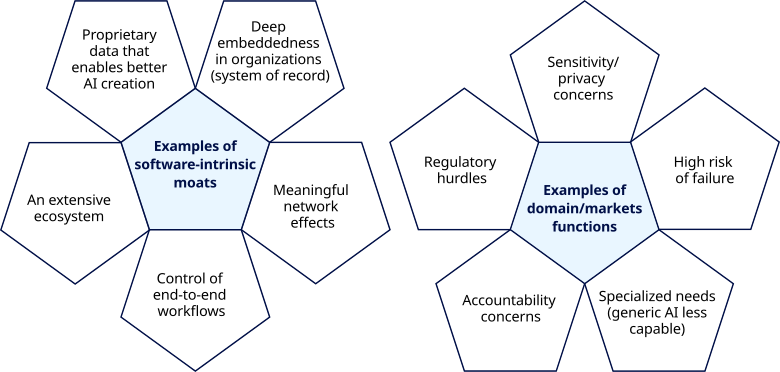
Whether software is horizontal or vertical does not necessarily matter. What does make a difference is where it sits in the stack, what it controls, and how it provides value to users.
Weak moats don’t have to doom a company. AI acceleration can help a company reposition itself and develop moats faster than ever before. AI migration assistants can lower barriers to grabbing share, while compelling AI agents and features can give customers a reason to switch.
At the same time, defensibility is not enough. It gives the software the foundation and right to win — not victory itself.
To succeed, companies need tools that build on and reinforce those moats. They also need to transform: Evolving from a software company with AI features into an AI-first software company. That requires new ways of thinking about development, pricing and go-to-market, metrics, and more.
How investors should evaluate SaaS assets in the age of agentic AI
Measuring AI risk versus opportunity is going to be critical to getting deals through the investment committee (IC), convincing partners to invest and lenders to lend, and ensuring that portfolio companies are positioned for success. This requires having an objective, quantified view of whether and how AI is likely to impact a specific software asset, whether the software is well positioned and has strong AI-ready moats, and how the software can win in its market.
Three questions to ask:
- Can AI perform the tasks the software does now?
- Are there barriers to AI adoption such as regulation or accountability?
- Is the software asset well positioned to win in the AI era?
Those answers will turn the conversation from “Is AI risk high?” to “How well positioned is this asset for defensible long-term growth?”
How to deploy AI evaluation as part of every deal
Every deal needs an AI risk versus opportunity assessment, which should also include evaluating the company’s AI strategy. This ensures that the company is best positioned to maintain its valuation multiple at exit.
These risk assessments inform valuations, value-creation plans, and IC approvals, and can also be shared with lenders to show that the asset is stable, and that the sponsors are actively looking around corners.
On the sell-side, a rigorous AI assessment helps drive interest in the process, maximizing exit valuations. The same is true for companies seeking credit: a structured assessment helps provide comfort to lenders around the certainty of the cash flows they’re being asked to underwrite, helping drive stronger refinancing.
Triage your portfolio for AI risk and take decisive action
Apply the AI evaluation approach to your entire portfolio to determine the right path for each asset. Prioritize across the following three areas:
- Resilient / AI tailwind. Assets well positioned for success — invest in AI transformation to turbocharge results.
- Reinforce and invest. Assets with upside potential that need additional investment to strengthen their positioning — focus first on moat building and defensive response, then on product and go-to-market upside.
- Structural disruption risk. Assets facing substantial risk due to high AI fit and limited moat, such as point solutions — carefully assess feasibility and ROI of AI strategy, and consider harvesting investment.
A cross-portfolio AI assessment will help you triage companies, identify drivers of risk versus opportunity, and prioritize actions accordingly. Design and execute “whole of company” AI-first transformations instead of tactical responses to ensure lasting success and support higher exit multiples.
AI risk is now a core part of diligence across commercial, product, and technology workstreams. This is the first in a series: next, we examine AI’s impact on services, followed by the benchmarks and structured frameworks we use to evaluate AI exposure — and distinguish between assets positioned to win and those facing structural pressure.
