


Healthcare systems worldwide are nearing a critical tipping point. Aging populations, rising chronic disease rates, labor shortages, and persistent cost inflation are threatening access and affordability. Without decisive action, global healthcare spending could almost double, from $11.8 trillion today to $23.1 trillion by 2040. Yet much of this surge could be avoidable through strategic productivity improvements.
Healthcare productivity means delivering more and better services using the same or fewer resources. It is not about cutting access or quality but maximizing the impact of labor, capital, and technology. Recent advances in artificial intelligence (AI), robotics, and quantum technologies offer a once-in-a-generation opportunity to reset healthcare productivity.
Understanding the healthcare spending challenge
Healthcare demand is rising globally, driven by an aging population and rise in chronic diseases, while labor shortages and complex administrative processes push unit costs up. Across advanced economies, the share of gross domestic product spent on health could rise from 9% to nearly 12% by 2040. Of the anticipated $11.3 trillion spending increase, nearly three-quarters reflect escalating inefficiencies and worker shortfall in healthcare rather than unavoidable costs.
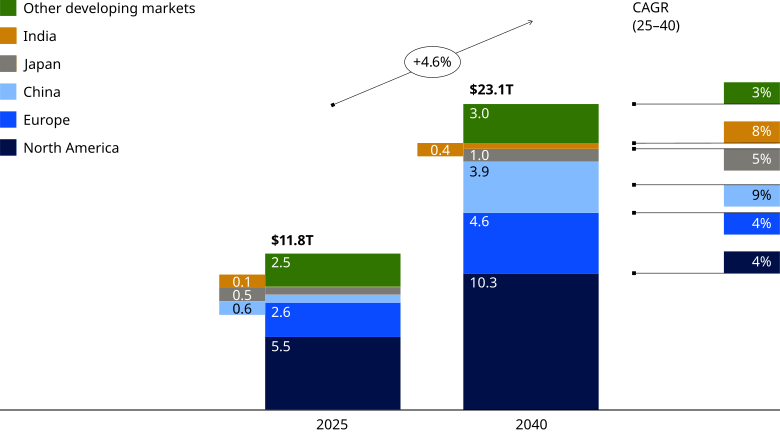
This unsustainable rise in spending demands more than incremental reforms or cost containment. Instead, healthcare systems must focus on achieving systemwide productivity gains by redesigning workflows, scaling technology-enabled care, and reducing administrative friction.
Using proprietary modeling and the Oliver Wyman Health Technology Use Case database (our structured dataset of modeled health‑technology use cases), our report Unlocking the Great Health Productivity Reset evaluates three adoption pathways through 2040 — varying in speed of adoption, depth of workflow integration, and discipline of reinvestment. The results show substantial potential: from $1.1 trillion in annual net savings by 2040 (a 4% cost reduction) in the incremental adoption scenario, to as much as $5.1 trillion per year (a 22% reduction) in the breakthrough scenario.
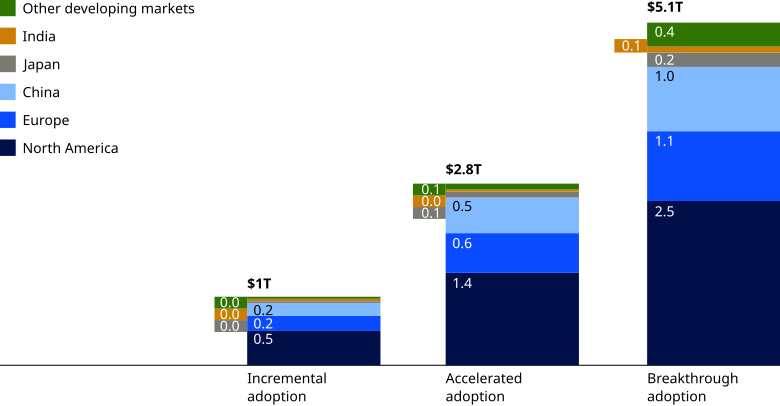
This is both an end-to-end cost-reset opportunity and a structural growth engine — especially for medical device and healthcare technology sectors. Beyond cost containment, these investments would catalyze new high-value innovation markets across AI platforms, robotics, medical devices, and data infrastructure.
How AI, robotics, and quantum tech can transform healthcare productivity
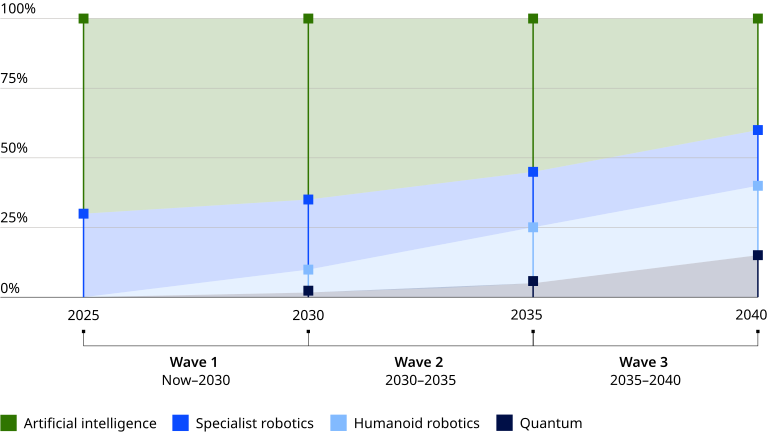
The report identifies three new technologies that could eliminate as much as $5.1 trillion of the projected spending increase by enabling fundamental health system-level redesigns. These include artificial intelligence shifting from task support to end‑to‑end workflow orchestration; specialized and humanoid robotics supporting new powerful ways of physical automation across most labor-centric processes; and quantum technology reducing computing costs, strengthening cybersecurity, and unlocking new diagnostic sensing capabilities.
The most immediate help could come from AI, which is moving from niche support tools in healthcare to powerful engines for managing workflow across clinical, administrative, and operational domains.
Robotics is also already having an impact on healthcare through specialist applications currently deployed in every arena of healthcare from surgical support to payment processing. Eventually, humanoid robots will work side-by-side with human employees, first starting in production and logistics and later taking over more complex routine daily tasks to provide staff more time to focus on care.
By 2035 and beyond, healthcare is expected to benefit from advances in quantum technologies, which could provide another step change in computing power, diagnostic sensing and cryptographic methods needed to keep personal data secured.
Together, these technologies multiply impact by automating routine work and supporting scarce human resources. Most importantly, they enable the redesign of care delivery systems rather than merely improving the efficiency of individual tasks. This convergence makes productivity gains scalable and durable across sectors within healthcare as well as in other industries.
Essential enablers for the productivity reset
But the development of technology alone does not guarantee impact and sufficient scale. Our research has found that to unlock the full potential of $5 trillion annual savings, major changes in our health systems are needed. Five critical enablers must accompany adoption to realize systemwide transformation:
- Tech investment. Providing adequate and timely technology investment with an almost one-quarter difference in savings between full-scale adoption and a more incremental approach.
- Workforce capability. Making the investment in upgrading capabilities and training workforces to build the operational, clinical, and engineering skills to deploy, govern, and continuously improve AI- and robot-enabled systems at scale.
- Aligned incentives. Changing reimbursement systems and liability rules to incentivize the use of automated strategies, with a focus on outcomes, avoided utilization, and shared accountability.
- Adaptive regulation. Modernizing regulatory frameworks to support adaptive, life cycle-based oversight that allows AI and connected devices to learn and evolve safely after deployment.
- Cultural readiness. Reinforcing a mindset shift that shows a labor-centric industry that technology is a workforce extension and stability tool rather than a threat.
Creating a people-centered productivity reset in healthcare
Healthcare is a fundamentally people-centered industry, powered by people for the well-being of people. For that reason, technology can never fully replace clinicians and other caregivers. Instead, the goal is to remove administrative burdens, augment clinical judgment, and provide clinical care workers more time with patients — enhancing genuine human connection where it matters most.
The future of healthcare affordability, access, and resilience relies on a deliberate, bold agenda for the adoption and deployment of AI, robotics, and eventually quantum technologies. The challenge is more institutional than technological, requiring the alignment of investment, regulation, capabilities, culture, and governance to enable systemwide change.
While the new technology cannot erase the entire anticipated increase, healthcare can bend its cost curve, expand capacity, and enhance outcomes with sufficient and sustained commitment and investment. Our report outlines the pathways and practical steps to unlock that future not just in the clinical care sector, but also medical devices, pharmaceuticals, insurance, and the public sector.
