


A powerful wealth shift is reshaping Asia. Global Chinese — those with roots in China whose lives and assets spread across borders — are growing in financial influence and complexity. They invest internationally, operate across jurisdictions, and expect more from their banking relationships.
This presents a major opportunity for banks in Hong Kong and Singapore. With the right strategy, Global Chinese clients could contribute up to 30% of net new money. But winning this segment requires more than new products or channels. It demands rethinking how banks operate, build relationships, and deliver value across borders.
Global Chinese wealth is rising fast and reshaping the regional banking landscape
We estimate that high-net-worth and ultra-high-net-worth individuals (UHNWIs) hold nearly 53% of total wealth across Asia Pacific — and that share is growing fast. The region is expected to see $9.7 trillion in additional wealth by 2028.
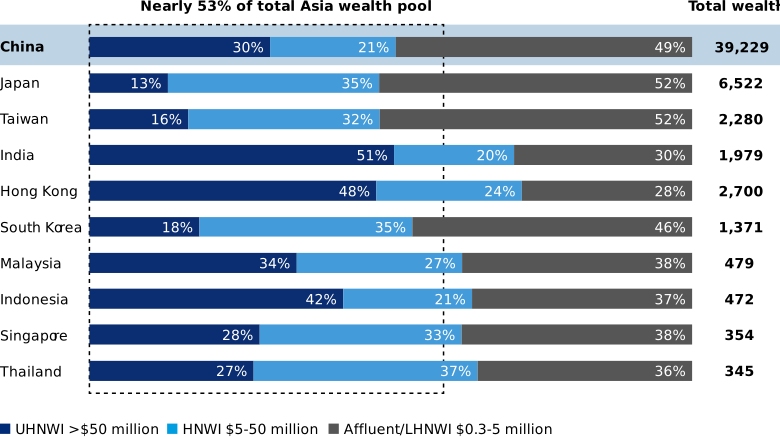
A growing share of Chinese wealth is already moving offshore, with 30% to 40% of it now flowing through Hong Kong, with Singapore becoming increasingly significant. Global Chinese investors are channeling capital into cross-border life insurance, exchange-traded funds, public investment vehicles, private markets, and alternative asset structures. Together, these trends signal a pivotal moment for banks equipped to serve a more mobile and discerning client base.
Accessing global assets remains complex, especially for investors with capital still held within China. While there are official channels that allow Chinese investors to allocate wealth overseas, these outbound investment programs remain tightly controlled, and the total assets under management in them are still relatively limited. Meanwhile, demand for cross-border options continues to grow.
Since the 2024 expansion of the Wealth Management Connect program — part of the mutual market access schemes linking Hong Kong, Macao, and the Mainland — southbound flows into Hong Kong have accelerated. One sign of this growing interest is the rise in life insurance purchases by mainland Chinese visitors in Hong Kong. Hong Kong’s life insurance industry is expected to grow from $62.6 billion in 2024 to $73.7 billion in 2029, with a 3.3% compound annual growth rate in direct written premiums, according to GlobalData. This reflects rising demand for comprehensive solutions spanning risk management, intergenerational wealth transfers, and, for some, a hedge against yuan depreciation.
Looking ahead, new developments are likely to reshape access even further. Hong Kong is preparing to roll out stable digital currencies and launch a pilot program for tokenized investments. At the same time, the Hainan Free Trade Port has initiated full island-wide customs operations — a structural shift that could redefine how financial services are delivered. In this evolving environment, investors will need trusted advisors to help them understand new options and reallocate capital globally with confidence.
Three strategies for banks to capture the Global Chinese segment
For banks in Hong Kong and Singapore, the Global Chinese segment is not just a growth story — it’s a defining strategic imperative. But capitalizing on it requires more than awareness. It demands clear, strategic action across three priorities: inter-generational wealth transition, parallel financial ecosystems, and tailored client propositions.
1. Bridge generational wealth priorities to secure long-term client loyalty
According to our analysis, by 2030, $2.7 trillion is set to transfer from first-generation wealth creators to their heirs across Asia Pacific. Among Global Chinese families, this handover often reveals deep generational contrasts. Founders, typically China-based entrepreneurs, tend to prioritize legacy, control, and stability. Their successors — globally educated and culturally agile — bring different values, placing greater emphasis on impact investing, philanthropy, and flexible governance models.
This transition is already reshaping how families approach everything from succession planning to investment strategy. For banks, the opportunity lies in bridging these differences, helping clients navigate complex dynamics and build continuity. Those who can position themselves as trusted advisors through this shift stand to form durable, multi-generational relationships.
2. Develop flexible financial solutions for Global Chinese clients' diverse needs
While Hong Kong and Singapore remain the core destinations for offshore Chinese wealth, Global Chinese families are increasingly turning to other financial hubs to diversify how they manage and structure their assets. Many are building parallel ecosystems that operate independently from both Chinese and Western systems. This parallel economy is often anchored in hubs like the United Arab Emirates (UAE) and Bermuda, where alternative currencies and offshore insurance are used to achieve risk diversification, tax efficiency, structural flexibility, and capital mobility.
Bermuda-based insurance products illustrate this shift. They account for 50% to 60% of the market and are valued for their lower costs, speed, and regulatory neutrality. In the UAE, such offerings allow high-net-worth individuals to bypass capital controls and tax constraints while gaining access to more flexible structures.
Supporting this evolution requires banks to go beyond traditional models. Success depends on delivering the right products from the right jurisdictions, backed by the infrastructure and expertise to move at the speed of their clients’ ambitions.
3. Use integrated technology to meet Global Chinese clients’ distinct expectations
Capturing the Global Chinese opportunity takes more than new products or digital upgrades. It calls for rethinking how banks operate, from decision-making to delivery. Governance needs to support faster cross-border coordination while giving local teams room to act, especially in markets where wealth flows are shifting quickly. Banks also need teams with the right mix of cultural fluency and technical skill. Advisors should understand not just the region’s regulatory landscape, but also the values and expectations of the clients they serve. Traditional performance metrics often miss the full value of these relationships. Banks should look at indicators like long-term retention, cross-border wallet share, and engagement across generations.
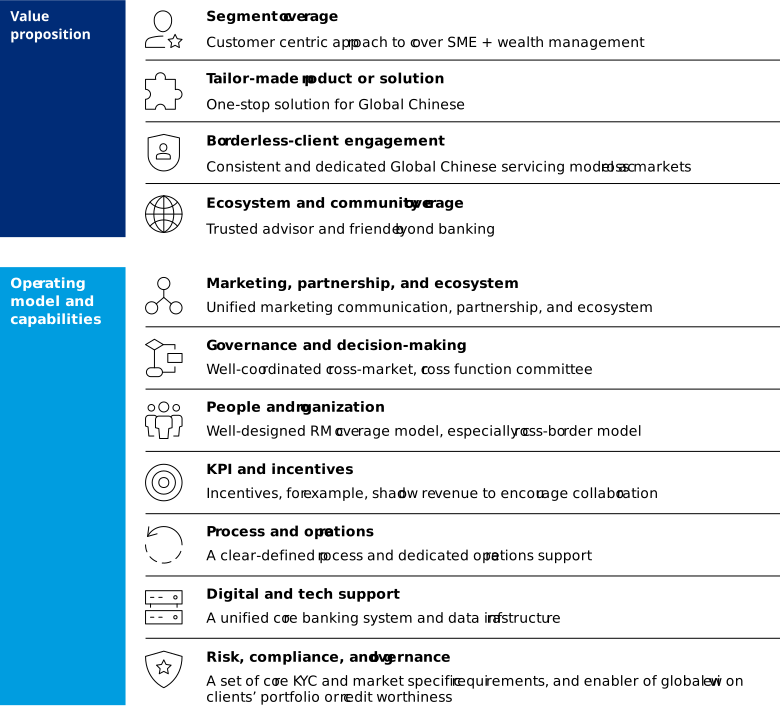
Operationally, execution must be seamless across markets. Backend systems should be consistent but flexible enough to meet local needs, from onboarding to compliance to reporting. Technology plays a central role. Scalable platforms are essential not only for digital engagement but also for enabling bankers to serve clients with speed and clarity. Tools like smart onboarding, multi-currency reporting, and integrated portfolio views help deliver the kind of experience this segment expects. Artificial intelligence is also accelerating impact, with banks seeing efficiency gains of up to 40% in client conversion tasks and 35% in administrative work.
Data analytics helps banks better serve Global Chinese clients across borders
To better understand and support the Global Chinese — especially across borders — banks should make smarter use of data analytics. Many clients are still overlooked, and reaching them calls for a more thoughtful, targeted approach. This could involve using alternative data to estimate a client’s wealth potential before assigning a relationship manager or applying behavioral signals to identify those who might benefit from a more engaged relationship or a specific event.
Data can also help banks tailor their advice to real client needs, whether it’s helping business owners separate family and business finances or guiding globally mobile retirees on generating stable income and planning for wealth transfer. With more personalized and timely engagement, banks can deepen relationships and grow their share of business.
Global Chinese clients are mobile, discerning, and clear about what they expect. For banks, this is a moment that demands focus and flexibility. Success will come to those willing to rethink how they serve across borders, generations, and priorities.
The opportunity is here. And it’s moving quickly.