


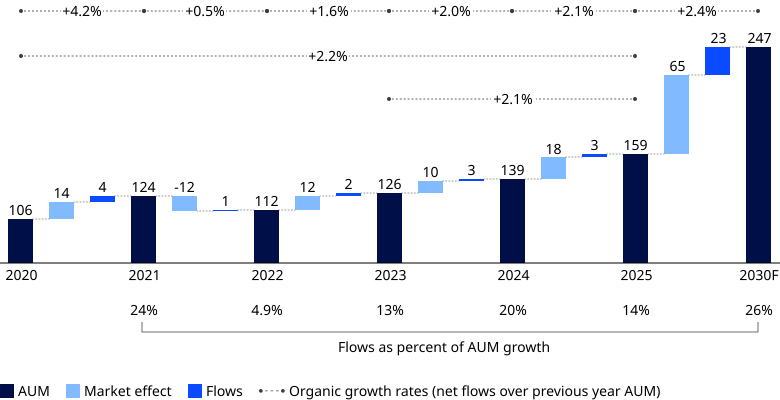
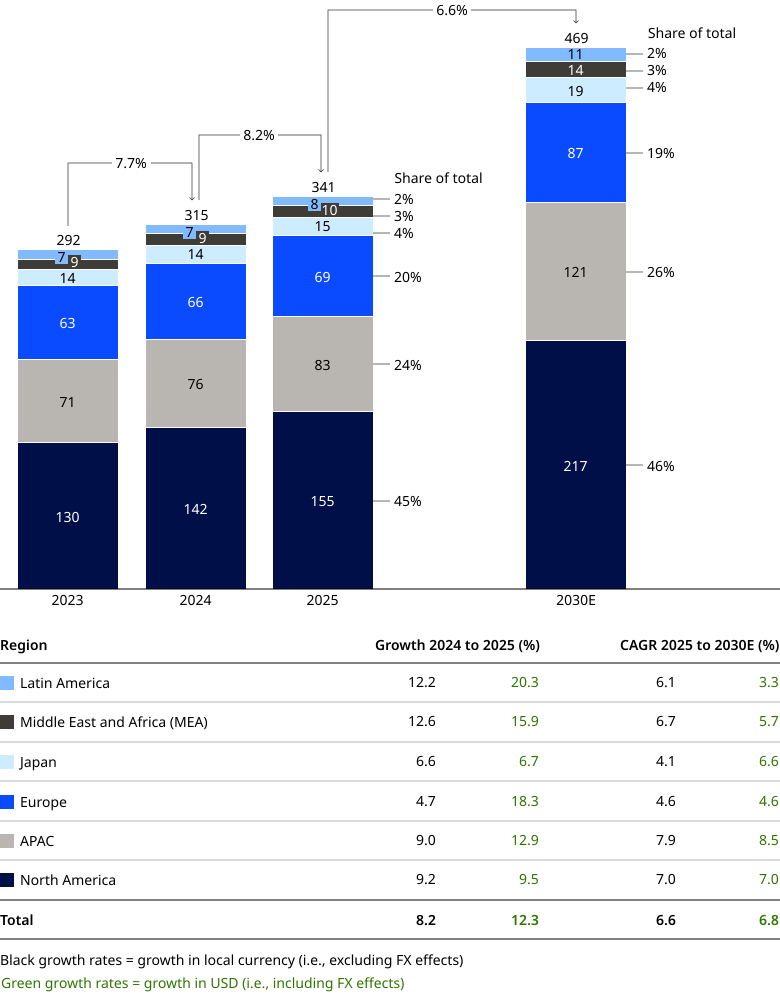
Asset and wealth managers entered 2026 with record numbers behind them: $159 trillion in global managed assets and $341 trillion in household financial wealth. We estimate those totals will keep climbing, with global assets under management (AUM) reaching roughly $247 trillion and household financial wealth approaching $469 trillion by 2030.
But those headline numbers obscure trends happening underneath the surface. More than 80% of AUM growth in 2025 came from market performance, while roughly two-thirds of the increase in household financial wealth came from markets and currency effects rather than net new money. Strong markets have made it possible for many firms within the pack to look healthy without winning share or converting growth into profit.
Those are key findings in our 2026 wealth and asset management report, Breaking from the Pack: The Race for Above-Market Growth, with Morgan Stanley. Economics are concentrating in a narrower set of products, client segments, and capabilities. Profits are separating from revenue. Artificial intelligence is moving from a collection of pilots and point solutions to being scaled across the enterprise which is forcing firms to rethink operating models. And tokenization is becoming real enough that firms need to make selective capability investments even while adoption remains measured.
Firms that break from the pack will do so by translating their deeper understanding of the major trends into the right strategic bets.
Why scale alone will not define success for asset managers
Scale will still matter for asset managers, but AUM alone won’t be sufficient to measure success. We expect industry revenues to grow about 7% a year through 2030, compared with roughly 9% growth in AUM, as average fees compress from 35 to 32 basis points.
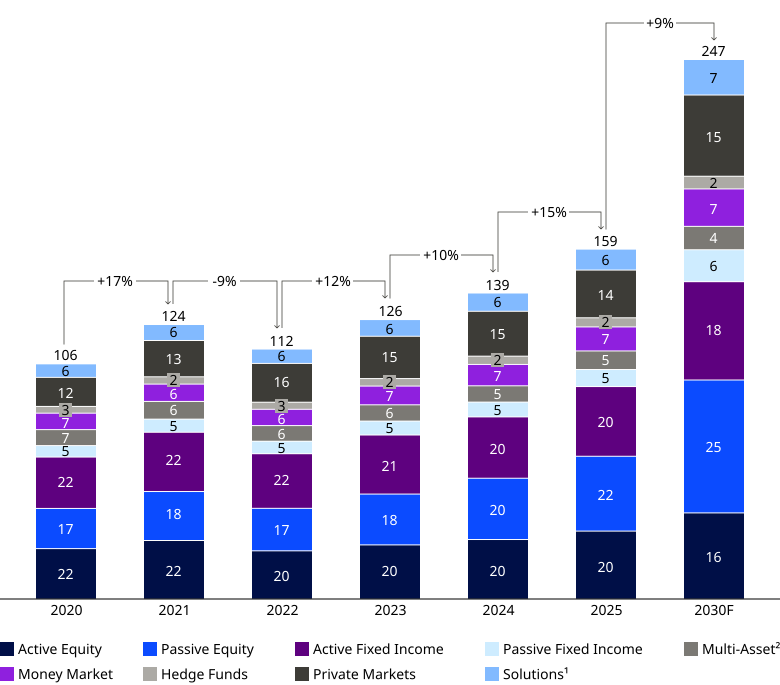
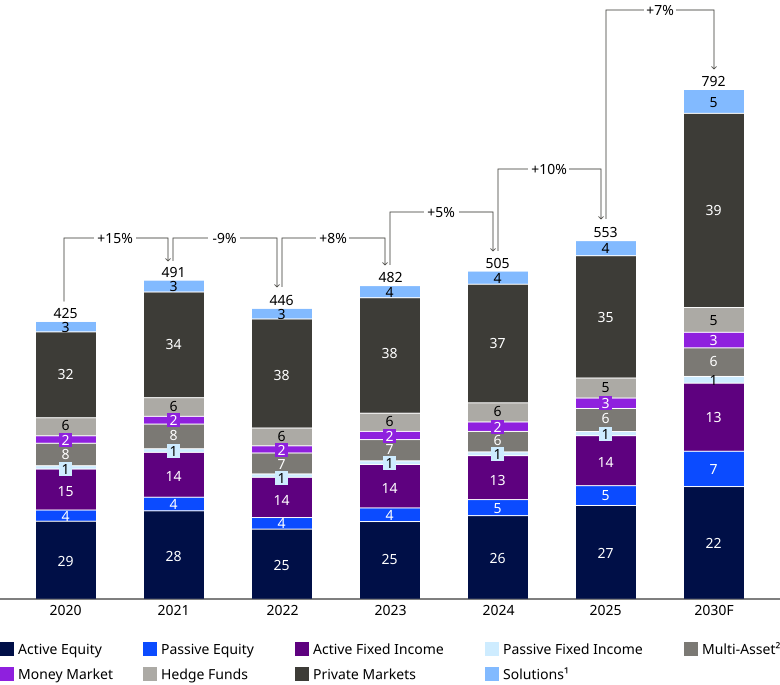
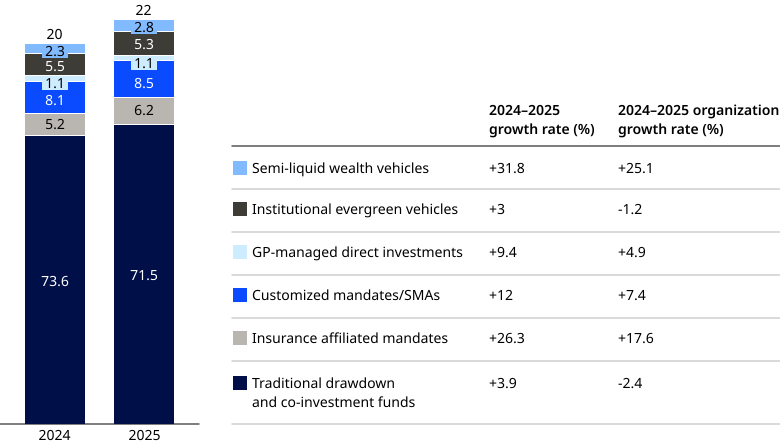
The best positioned firms will be those that are able to capitalize on evolving demand trends in private markets and deliver customized solutions at scale. With respect to private markets, that means aligning product and distribution capabilities to better serve faster-growing insurance and wealth demand. In 2025, insurance-affiliated mandates grew approximately 18% and semi-liquid wealth vehicles approximately 25%, while traditional drawdown funds saw net capital contraction of more than 2%.
Regarding customization, those managers that can deliver customized solutions at scale will be able to seize opportunities beyond the traditional confines of large institutions and ultra-high-net-worth clients. Case in point: in the US, externally managed custom-model assets in wealth channels rose from roughly $90 billion in 2023 to about $300 billion by the end of the first quarter of 2026, and we expect them to reach $750 billion to $1.6 trillion by 2030. Firms that can build the technology and deliver a connected workflow that carries client requirements through portfolio construction, implementation, monitoring, and reporting without rebuilding the process account by account with have the upper hand.
What is driving performance in wealth management
The wealth-management data show an even sharper separation between growth and performance. Our 2026 benchmarking database covers 75 institutions, including the 20 largest global wealth managers focused on high- and ultra-high-net-worth clients and 55 comparable mid-tier firms. Across the sample, revenue growth from 2023 to 2025 was remarkably similar: every peer group landed between 16% and 24%.
Profit growth was very different. Pretax profit for the top 20 compounded by 32% over the period, compared with 17% for the mid-tier. A six-firm winner cohort — selected based on cost conversion rather than scale or revenue growth — compounded pretax profit by 48%.
The winners did not gather better. Assets across the sample compounded 16% a year. What separated them was conversion: an 8-percentage point improvement in indexed cost-income ratio against 2 percentage points for the rest of the sample. They also bought capacity rather than stripping out support. Clients per advisor rose 27% at the winners against 9% elsewhere, assets per advisor 36% against 26%, and they let the support ratio rise 4%.
Across the benchmark, advisors manage roughly 27% more assets than two years ago, and the industry serves 12% more clients per employee, yet the cost-income ratio improved by less than 2 percentage points, suggesting that incremental efficiency gains are no longer enough.
Growth is also moving. North America should supply almost half the incremental wealth growth through 2030, while Asia Pacific is expected to grow fastest at 7.9%. Cross-border wealth should outpace the total pool at 7.4% a year to $24.7 trillion. In 2025, Hong Kong overtook Switzerland as the largest cross-border booking center, with $3.3 trillion compared $3.2 trillion.
Where AI is creating value in asset and wealth management
AI adoption is not an issue. In asset management, 55% of firms have integrated AI into at least one part of the investment process, and another 27% are piloting applications. The harder question is whether that adoption is is translating into measurable improvements in profitability. Half of asset and wealth management CEOs report either no AI-driven cost savings or that it’s still too early to assess them, and the same is true for revenue generation, according to an Oliver Wyman Forum and New York Stock Exchange survey.
Most firms are still deploying AI as isolated tools. That can make individual tasks faster, but the gains reach the profit and loss only when firms remove work, redesign end-to-end workflows, or use the freed-up capacity to serve more clients and generate more revenue.
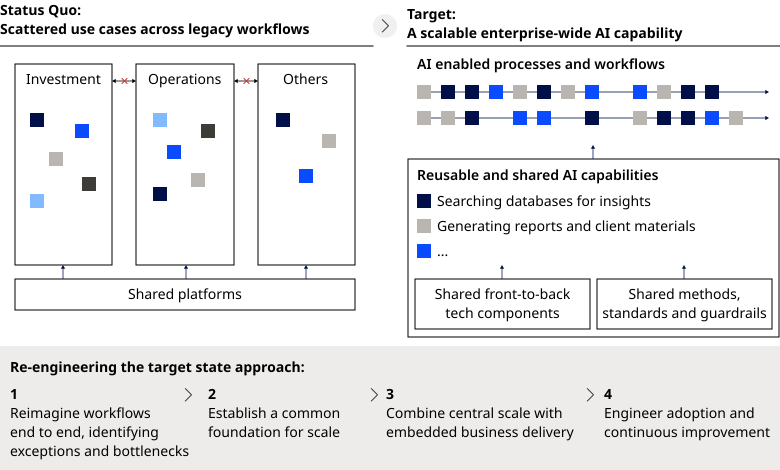
For asset managers, we estimate that leading firms that build reusable enterprise capabilities — shared data, AI components and controls, paired with business-led workflow redesign — could improve cost-income ratios by up to 15 percentage points by 2030. The advantage will come less from access to models and more from the ability to reuse infrastructure and embed AI into how work actually gets done.
In wealth management, the operating model change is more visible because it alters the advisor’s role. The advisor becomes an orchestrator retaining accountability for judgment and the client relationship, while agents handle research, meeting prep, planning, and service work behind the scenes. In one live deployment across more than 350,000 clients, digital-twin predictions matched client responses with 88% accuracy, and twin-personalized cross-sell campaigns produced roughly 30% more gross margin than comparable campaigns without that personalization.
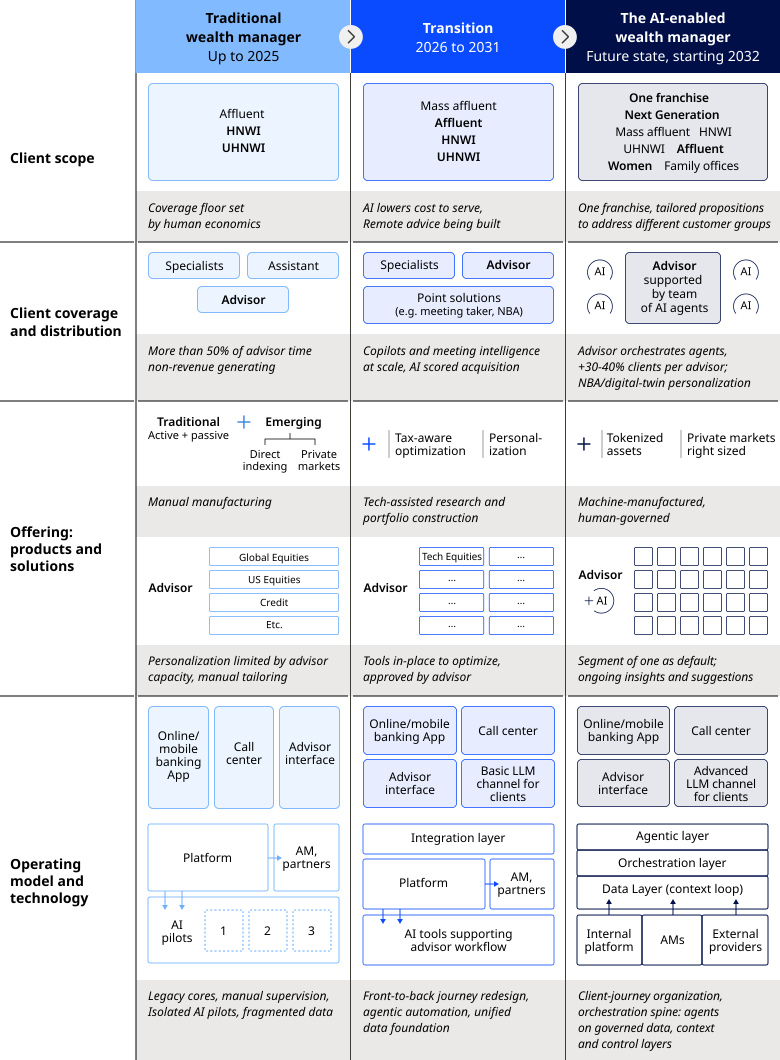
Done at scale, this approach can boost capacity dramatically. We estimate advisor capacity can rise 30% to 40%; separately, an illustrative AI-enabled operating model could reduce total wealth-management costs by up to 25% by 2032. Getting there requires an enterprise program with a common data and orchestration foundation, redesigned workflows, adoption metrics, and clear accountability for results, not a portfolio of disconnected pilots.
How tokenization will reshape asset and wealth management
Tokenization is another case where the headlines can blur what’s happening below the surface. We project tokenized real-world assets to grow from roughly $40 billion today to about $2.3 trillion by 2030, a growth rate of over 150%, with around $1.3 trillion of managed assets addressable by asset managers. That’s rapid growth but is still less than 1% of the 2030 global assets in our base case.
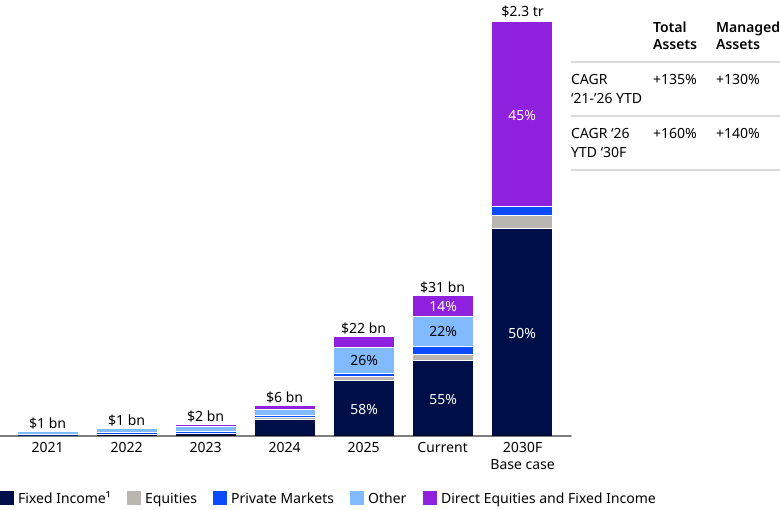
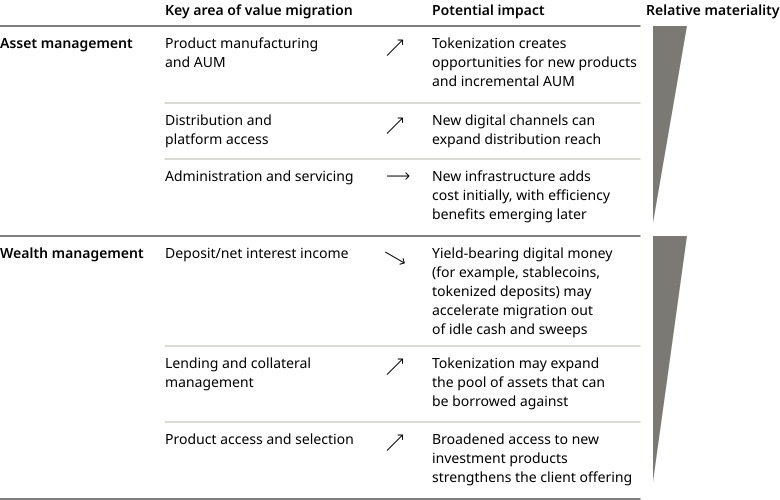
For asset managers, the near-term opportunity is concentrated in distribution and product manufacturing, especially around money market funds, short-duration instruments used for collateral and treasury management, and tokenized equities. Private markets are different. Tokenization can improve the infrastructure around ownership, transfers, and servicing, but it will not manufacture liquidity or solve the underlying problem of infrequent valuation and limited price transparency.
For wealth managers, tokenization is both a capability opportunity and a relationship-defense issue. Firms that can’t integrate tokenized holdings, digital cash, collateral, and lending into the broader client relationship risk ceding ground to digital platforms offering a more integrated solution. Digital forms of money could pressure deposit economics, while a broader pool of financeable tokenized collateral could create new lending revenue. The net effect depends on adoption and client behavior; the priority is keeping the assets, and the client interface, inside the firm’s own ecosystem.
Why asset and wealth managers need to act now
The capabilities that will define the next generation of winners are already visible on both sides of the industry: the right product and vehicle mix, scalable customization, enterprise AI, disciplined cost conversion, and access to emerging digital distribution. Leading firms are proving each of them individually.
Strong markets and healthy margins still provide the capacity to fund operating model redesign, AI infrastructure, and new product and distribution capabilities. Firms that act now will use this capacity to build capabilities that allow them to be agile enough to evolve with changes in the market. Firms that wait may find that the pack is no longer a safe place to be.
The full report includes our complete regional, asset-class, and channel-level forecasts through 2030, along with detailed case studies showing how leading firms are building these capabilities.
