


“Thinning The Herd: The Race For Relevance Fueling M&A” is our 2025 global wealth and asset management report with Morgan Stanley. We explore the global industry outlook, look at how mergers and acquisitions are changing the asset management and wealth management ecosystem, and outline ways to rethink talent in the age of artificial intelligence.
The wealth and asset management industries have long been among the most fragmented within financial services. Despite the economies of scale of both industries, there was no imperative to consolidate. The bar to profitability could be achieved with a tight-knit team and few clients. There was enough organic growth to go around, and beta was lifting all boats. Asset management clients themselves were highly fragmented (pension funds, insurance companies, independent wealth managers) each working with a wide array of fund providers.
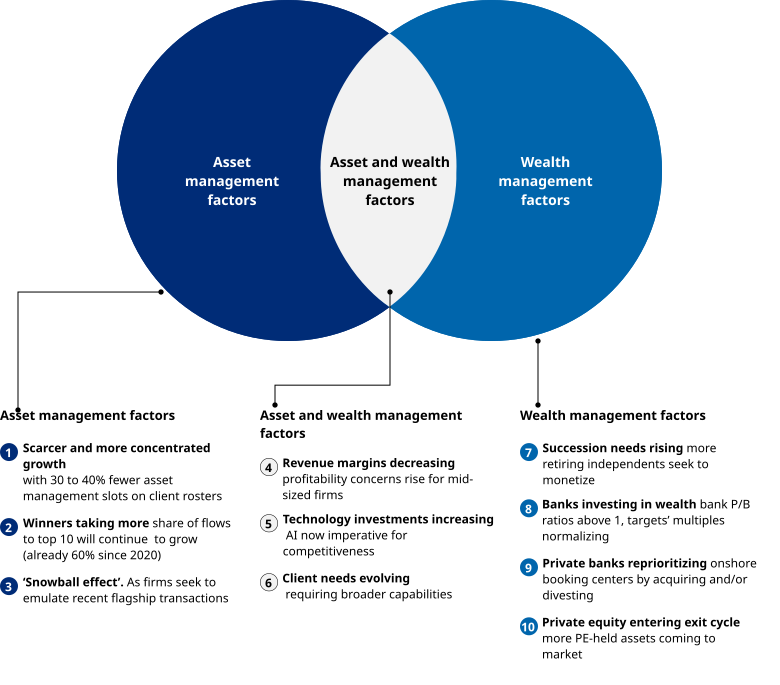
The picture is changing. Profitability is challenged with mid-sized players displaying the lowest (and decreasing) operating margins. While revenue margins continue to drop, technology and AI require evermore investment to stay competitive. Leaders are taking an increasingly disproportionate share of the net new money as they leverage their scale’s benefits to reinvest in capabilities and relationships to capture new capital- and resource-intensive pockets of growth. As asset management clients consolidate, internalize and shift to strategic partnerships, and wealth management clients raise their expectations and professionalize their relationships (for example, via using multi- and single-family offices), opportunities for growth become scarcer and more concentrated. We expect the combination of these factors to drive consolidation as mid-sized players become attractive targets for leaders seeking further scale and diversification.
 By 2029, we expect 20% fewer wealth and asset managers and over 1,500 significant transactions
The new era of asset and wealth management deals
As growth becomes scarcer and more concentrated, intra-sector scale becomes paramount. As insurers and wealth managers reassess whether they are the right owners of their asset manager, inter-sector opportunities emerge.
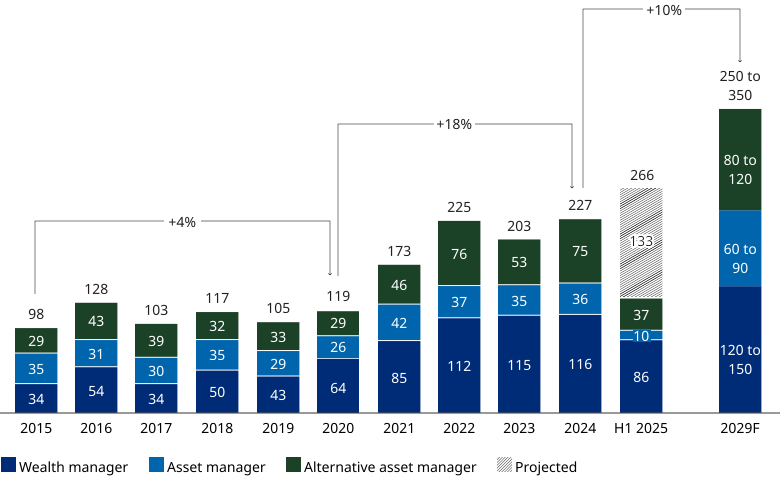
The effects are already on display. Transaction numbers have entered a new normal, at over 200 significant deals per year since 2022 (twice the rate of the previous decade) across both asset and wealth management. The asset management industry is no longer producing net new managers of mutual funds or ETFs, averaging over 150 for the past two decades, and the yearly net new additions of traditional asset managers has dropped to a handful over the past three years. Even buoyant private markets are displaying a similar trend.
Success in this new era of consolidation will require asset and wealth managers to consider M&A as a core lever of their growth strategies.
Most deals so far have been intra-sector: mergers between traditional managers, traditional managers acquiring alternatives, independent wealth managers consolidating. Success has been mixed, particularly for asset managers: Less than 40% of flagship asset management transactions improved cost-income ratios three years after a deal, half were in net outflows, and half of private market specialists acquired by traditional managers grew slower than the market. For wealth managers, multiple arbitrage has driven most of the value creation in independent consolidation, while private banks have managed to effectively leverage acquisitions and divestitures to reprioritize onshore markets and improve profitability.
Going forward, we expect inter-sector deals to grab the biggest headlines, with insurance companies and wealth managers reassessing whether they are the right owners of their asset management businesses. The value of vertical integration has proven elusive in practice, either in terms of flows or valuations, leaving owners at a crossroads: invest in convergence and maximize the value of ownership or monetize the asset through a sale to a strategic or, increasingly, financial buyer. This is already materializing with insurers monetizing the value of their balance sheets through either sales or joint ventures.
For acquirers, the execution playbook is clear yet arduous. They will need to choose the right target (prioritizing revenue complementarity and cultural compatibility over cost synergy potential), de-risk transactions (manage talent and asset attrition, reduce beta sensitivity in valuations), execute decisively to fend off competition, and run flawless post-merger integration to materialize ambitious return targets.
This report, informed by Oliver Wyman’s extensive project work and over 30 discussions with senior executives at asset and wealth managers collectively managing over $55 trillion of assets, delves into the drivers of consolidation, the different types of plays and their rationale, the track record of past deals and combinations, as well as our outlook for the next five years and a playbook for conducting successful transactions. Below is an excerpt as well as the full 2025 Global Wealth and Asset Management Report (scroll to bottom of page for full PDF).
Global asset management outlook 2025 — the rising tide is shifting
Global managed assets are at all-time highs. In 2024, assets under management (AUM) reached a record $135 trillion, marking a 13% increase year-over-year. Strong market performance drove approximately 80% of the increase. Net flow growth of 2.6%, a significant recovery from the slight contraction seen in 2022, is supported by continuous wealth creation and a notable shift in capital allocation. Specifically, lower interest rates are redirecting funds from guaranteed deposits back into capital markets, and the transition from collective (defined benefit) pension schemes to individualized (defined contribution) retirement plans could further underpin flows going forward. We expect annual net flows to average around 2.7% through 2029.
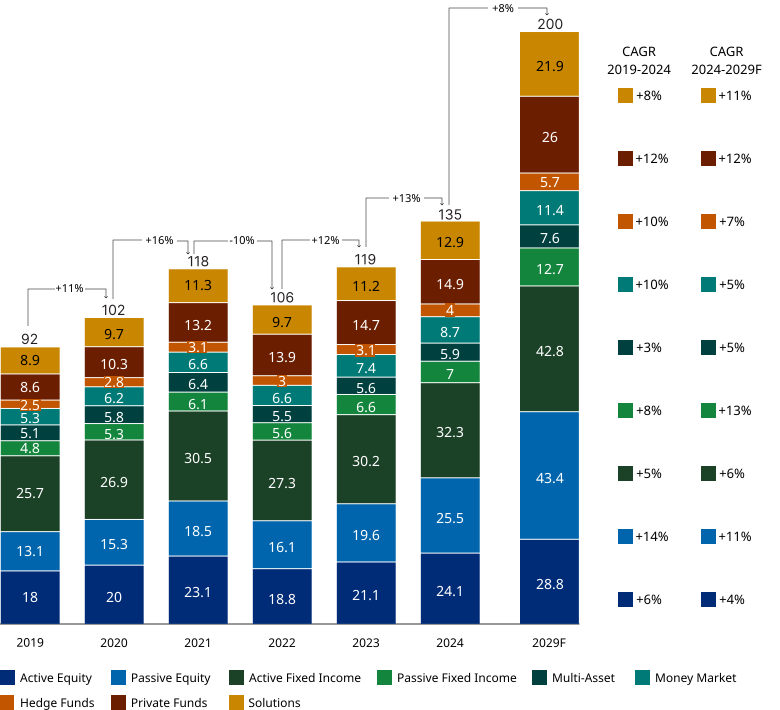
For the first time, passive equity overtook active equity in managed assets globally, and more assets were managed on behalf of retail clients than on behalf of institutions (and we project them to grow at twice the rate). However, accessing retail clients is increasingly “institutional” as more than 64% of retail assets are now held through packaged and/or customized solutions (for example, model portfolios, target-date-funds, funds-of-funds).
Private assets are set to drive growth, reaching 44% of revenues by 2029 — fueled by retail demand
Private markets, after a surge between 2019 and 2022, experienced stagnation in 2024. This plateau masks a growing disparity between leaders and smaller players. The largest firms, benefiting from proprietary capital and deal origination, continue to outpace their competitors, securing most of the new capital flows and commanding premium fees. Going forward, we nonetheless still expect significant growth across private markets, bolstered by their increasing penetration of retail clients’ portfolios.
Hover over the cards to see more information
Click on the cards to see more information

Demonstrating value for money: now a global imperative.
Europe and Asia Pacific hitherto shielded from fee compression (vs. North America), yet regulation and improving investor literacy will tighten fees.
What leaders are doing:
- Investing in alpha engines
- Demonstrating value beyond alpha (for example, customization)Reviewing pricing strategies
- Reviewing pricing strategies

Playing the retail solutions game.
Retail overtakes institutional AUM, yet addressing retail is increasingly 'institutional' as end-advisors and their clients favor solutions over individual products.
What leaders are doing:
- Offering integrated products 'embedding' advice
- Designing and selling the full solution themselves
- Supplying building blocks to solution providers

Exploring the bounds of liquidity.
Semi-liquid products are booming to fill retail demand, but delivering requires distribution strength and operating scale.
What leaders are doing:
- Private asset specialists wrapping their capabilities
- Traditional managers leveraging their distribution
- Partnerships combining the strengths of both

Rethinking active/passive: from chasm to spectrum.
Passive overtakes active AUM, yet active ETFs, systematic equities, and low tracking error cost-efficient products show promising growth.
What leaders are doing:
- Building high conviction, high alpha products within their competitive remit
- Delivering cost-efficient, low tracking error building blocks elsewhere
Global wealth management outlook 2025 — solid growth amid margin pressure
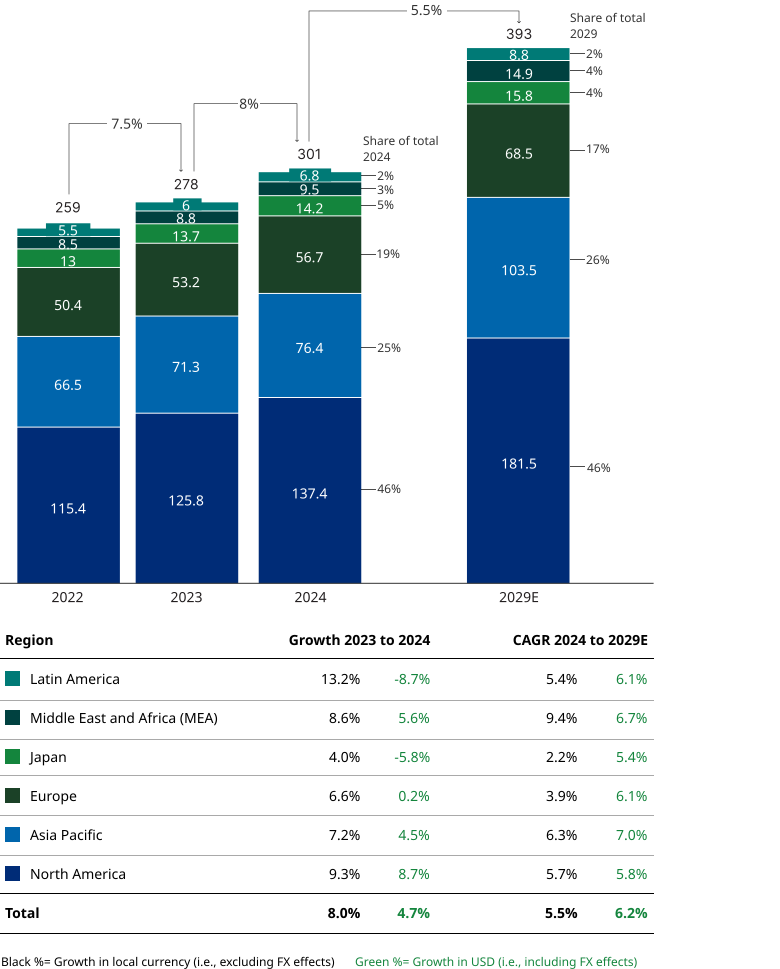
Global financial wealth of private households continued to grow steadily, reaching $301 trillion in 2024 after growing by 7% in 2023 and 8% in 2024, recovering from 2022 losses amid monetary tightening. Growth was resilient across all regions, with the Americas, the Middle East, and Africa showing the strongest gains excluding currency effects. However, when adjusted for currency, real US dollar growth was subdued across all regions, with negative growth in Latin America and Japan.
Looking forward, we project global financial wealth to grow at 5.5% annually through 2029, reverting to a level closer to 6% per annum observed between 2019 and 2023. In absolute terms, wealth growth continues to be heavily concentrated in North America and Asia Pacific. Europe’s wealth could benefit from supportive policies and greater household investment allocation going forward. The Middle East and Africa and Latin America exhibit steady growth. Overall, growth rates are lower than in past reports due to the inclusion of life insurance, pensions, and the wealth band below $0.3 million.
To counter challenges, leading wealth managers are focusing on four priority areas to boost revenue and profit margins: winning the $1 million to $10 million high-net-worth segment, scaling private markets allocations to tap into a projected $8 trillion to $10 trillion market by 2029, equipping relationship managers to create an organic growth machine, and building a durable cost base by simplifying, re-architecting, and platforming.
Hover over the cards to see more information
Click on the cards to see more information

Winning the $1-10 million HNW segment.
Leaders focus here due to the large number of addressable clients, new client growth, the segment's lower penetration and higher revenue margins.
Their success is driven by:
- A clear value proposition (precise tiering, curated product-and-credit platforms, pricing)
- A dedicated, operating and coverage model, scalable experience and feeder-channels

Scaling private markets allocations.
Net-new-assets (NNA) growth only contributed to approximately 30% of AUM growth at leading wealth managers historically.
Wealth management leaders build private markets systems:
- Leveraging evergreens to address lower wealth bands
- Differentiating beyond mega brands where possible
- Arming advisors with information
- Upgrading the plumbing.

Creating the organic growth machine.
Net-new-assets (NNA) growth only contributed to approximately 30% of AUM growth at leading wealth managers historically.
Wealth management leaders focus on NNA growth by:
- Equipping relationship managers with actionable analytics
- Implementing tools that create selling time Professionalizing pricing
- Creating incentives that buy sticky assets

Building a durable cost base.
Persistent >70% cost-to-income ratio (CIRs) indicate operating model inefficiencies.
Wealth management leaders manage costs by:
- Choosing their battles
- Simplifying their tech before modernizing
- Digitizing, front-to-back, not in pockets
- Shifting compliance to platforms
- Their programs unlock 10-25% gross savings
How M&A is changing the asset and wealth management ecosystem
The asset and wealth management industries have historically been among the most fragmented in financial services, with the top five players representing less than 20% market share. This fragmentation was enabled by low barriers to profitability in a capital and regulatory-light environment, ample organic growth for players to access with relatively undifferentiated offerings, and a fragmented client base that perceived diversification of asset and wealth management providers as a strength.
By 2029, this will no longer be the case. We expect over 1,500 significant transactions involving asset and wealth managers in the next five years, with up to 20% of existing firms being acquired. These dynamics are already at play. In 2024, the industry saw record AUM transacted, bolstered by high-profile mergers and thriving mid-market consolidation activity. The number of transactions has stabilized at a new post-COVID high, more than doubling from the previous five years, at approximately 210 per year since 2022 (versus a historical average of approximately 100).
Framing M&A plays — intra-sector, inter-sector, and financial sponsor-led deals
We see three categories of M&A emerging, despite the diversity of deals. Each of the categories themselves are driven by the pursuit of at least one of four “Cs”: Cost synergies, new client segments or geographies, new capabilities, and/or access to seed and permanent capital. Below is a summary of these deals; in our full report, we dive deeper into the deals, the outlook, and the approach.
- Intra-sector deals consisting of transactions within a vertical (asset managers acquiring asset managers, wealth managers acquiring wealth managers). These deals span scaled traditional asset managers buying private market specialist boutiques as capability bolt-ons, to mergers of traditional near-equals as cost synergy plays, to deals driven by client complementarity across segments (insurance-affiliated with bank-distribution-focused) or regions. In wealth management, this includes both intra-channel consolidation (for example, RIA roll-ups) and cross-channel acquisitions (for example, private banks acquiring independent wealth managers).
- Inter-sector deals expanding along the value chain, seeking to provide additional services to improve or complete the client experience. This includes asset management and wealth management transactions (in either direction) primarily to secure clients through captive or preferred distribution relationships, to secure differentiating investment capabilities, and/or, to a lesser extent, to generate cost synergies through shared centers of excellence. It also comprises deals involving asset or wealth managers with other sectors of the financial ecosystem, mainly insurance companies (for example, access to seed and permanent capital in exchange for asset origination). While asset and wealth managers have acquired technology providers in the past (for example, direct indexing), we do not explore these as part of this report.
- Financial sponsor deals involving financial sponsors investing in either asset or wealth management entities. Such deals can target each of the four “Cs” depending on the investment thesis. This spans both majority private equity deals (for subsequent roll-up strategies or operational/financial improvements) as well as minority deals including general partner stakes investments in asset management.
A playbook for successful M&A — target identification to post-merger integration
Acquisitions in asset and wealth management can be perilous, and we have seen the high dispersion of success across each type of play throughout the report. Succeeding in such transactions requires more than a good idea. We identified four plays to run an efficient and successful acquisition.
We expect most value to stem from complementary businesses rather than pure cost-driven deals. This complementarity should be assessed through the lens of clients (regional or channel-based), products (anticipating cross-selling strategy and managing rationalization to avoid attrition), risk (operational, investment, and ESG), culture (frequently underestimated yet fundamental driver of integration outcomes), and compensation (weighing options of harmonization and dual systems).
2. Structure deals to de-risk the transaction
We have seen the challenges of retaining value post-mergers and expect more innovation from acquirers to mitigate four key risks. First, reducing attrition risk through long-term distribution contracts or investment management agreements with previous owners will be critical for inter-sector deals. Second, talent retention is a cornerstone of success and can be secured through a combination of earn-outs, retention bonuses, equity rollovers, time-based vesting schedules, and covenants tying individuals to post-close roles. Third, reputational, legal, and compliance risks should be anticipated beyond the due diligence phase with warranties covering past conduct or escrow provisions. Finally, beta risk has been a major barrier to transactions, especially for financial sponsors that will innovate to avoid “paying for beta” through beta risk-sharing mechanisms that carry over to closure and beyond.
3. Executing efficiently pre-closing
As transaction activity boils, competition will intensify, requiring firms to act swiftly and decisively. Aligning on high-level principles early (deal objectives, integration model, valuation approach), involving all stakeholders early to avoid false starts (legal, compliance, tax, finance, HR), keeping communication lines open (preserving trust and momentum), and making effective and controlled use of third parties will all be critical in turning idea to action.
4. Running flawless post-merger integration
Post-closing, realizing objectives will require a clear vision, a bold future state design (favoring simplicity over perfection and actions that minimize execution risk), ruthless execution of cost and revenue synergies (building contingency, embedded in budgeting, and holding executives to account), and conscientious cultural alignment.
Rethinking talent in asset and wealth management in the age of AI
Artificial intelligence is revolutionizing the asset and wealth management industry, challenging traditional frameworks of talent management. Once reserved for middle- and back-office functions such as compliance reporting and operational controls, the past 12 months have seen a shift toward front-office activities, including asset managers’ investment research functions and wealth managers’ central investment offices. Tools powered by internally developed AI models and generative models automate key tasks like data scraping, model updates, sector screening, and transcript summarization. While these gains initially benefited employees by incrementally improving their productivity, they are now beginning to transfer into efficiency gains for the company, with leaders targeting up to 30% of efficiency gains in research activities.
This offers two routes for firms to leverage this newfound efficiency:
- Reinvest efficiency gains for enhanced research. AI frees up analysts’ time, allowing them to increase research depth and breadth, ultimately enabling stronger alpha generation.
- Optimize for leaner cost structures. Instead of reinvesting time, some firms are reducing their analyst base and relying on AI to perform repetitive and lower-value tasks.
Both routes offer their own talent management challenges, including the impact on traditional apprenticeship models, increasing seniority of lead portfolio managers, and a war for talent that spans beyond financial services.
Attracting and retaining a new generation of talent able to navigate a more client-centric and AI-native model will require asset and wealth managers to take a holistic approach to rethinking their value proposition — not only to attract diverse high-potential talent but also to retain and develop it over time.
