


Global mergers and acquisitions (M&A) activity is heading toward a record year in 2026, with cross-border transactions growing strongly alongside it. Cross-border M&A value is up 31% year-to-date, putting international dealmaking on track for its strongest year since peaking in the first quarter of 2021, when activity was fueled by a boom in special purpose acquisition companies.
Yet these headline figures mask a significant shift in where capital is flowing and why companies are acquiring overseas. Europe and North America are becoming more prominent investment corridors as geopolitical tensions restrict activity elsewhere.
For management teams, these changes call for a more deliberate approach to cross-border dealmaking — one that combines financial discipline with geopolitical awareness and a clear plan for long-term value creation.
Cross-border M&A growth is reshaping global investment flows
Several factors are supporting the rise in international dealmaking, which would exceed 2021 levels if the current pace continues through the fourth quarter. Corporate earnings are at record highs, and private equity firms face a multiyear backlog of investments to exit, while boards have become more accustomed to navigating inflation, interest rates, and geopolitical disruption.
Technology, media, and telecommunications, financial services, and healthcare account for more than 70% of the growth in cross-border M&A since 2024. Transactions valued above US$1 billion represent 76% of cross-border deal value in 2026. Cross-border transactions accounted for about 27% of global M&A value in the first nine months of the year.
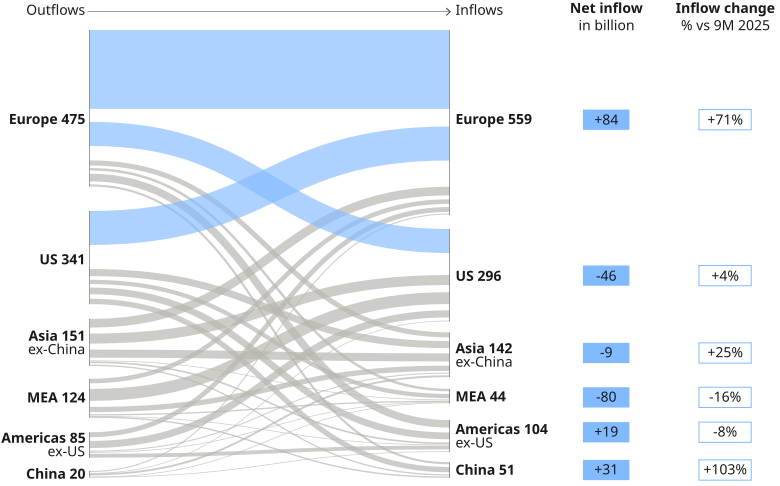
But the more significant development is how international investment patterns are changing. The transatlantic corridor accounted for $461 billion in deal value in the first half of 2026, representing more than half of cross-border M&A. Transactions involving European and North American markets, including deals within Europe, represented almost 60% of cross-border M&A value, up from 40% in 2025.
European companies are playing a growing role. Their acquisitions of US businesses have reached $149 billion in 2026 to date, up 70% over the same period in 2025. Notable deals include Banco Santander's $12.3 billion acquisition of Webster Financial, which illustrates the pursuit of greater scale in the US banking market, and GSK's $10.6 billion acquisition of Nuvalent, which reflects the importance of acquiring specialist pharmaceutical capabilities.
At the same time, geopolitical tensions and tighter investment screening are restricting other capital flows. For example, the value of Chinese acquisitions in Europe and the US in 2026 has declined approximately 90% compared with the 2016–19 average, a period of peak activity. Foreign direct investment screening has also intensified, with the EU recording a 40% increase in screenings since 2024. In the United Kingdom, Chinese acquirers accounted for less than 2% of investment notifications but 30% of transactions called in for further review.
These developments demonstrate how political and regulatory considerations are influencing which international transactions proceed.
Strategic considerations are driving more cross-border acquisitions
Despite increasing geopolitical and regulatory complexity, companies continue to pursue international acquisitions to strengthen their competitive positions.
Our analysis of 171 cross-border transactions valued above $1 billion identifies four principal motivations: geographic diversification and market access, intellectual property and capabilities, scale, and financial arbitrage.
Gaining market access and acquiring new capabilities were factors in almost 80% of the transactions analyzed. This suggests that strategic objectives, rather than valuation alone, are driving much of today's cross-border activity.
Geographic diversification remains the leading motivation. Companies are seeking access to new customers, distribution networks, and markets to support growth. The growing importance of local supply chains is reinforcing the appeal of establishing a presence in strategically important markets.
Access to intellectual property and specialist capabilities is another major driver, accounting for 36% of the 2026 transactions analyzed. As artificial intelligence transforms industries, companies are looking to acquisitions to accelerate access to technologies and expertise. Schneider Electric's announced $22.6 billion acquisition of US industrial software company PTC illustrates this approach, combining engineering software with industrial automation and energy systems.
Meanwhile, the appeal of financial arbitrage is diminishing. European equities traded at a 41% discount to US equities in 2024, but the gap has narrowed to 26%. Only 4% of the cross-border transactions analyzed in 2026 were primarily motivated by valuation arbitrage.
Even so, valuation remains important. The transactions most likely to deliver enduring value are those that combine sound financial fundamentals with a compelling strategic rationale.
Management teams need a new approach to long-term value creation
As cross-border dealmaking grows more complex, management teams need to consider how transactions will create sustainable value beyond completion. Three priorities stand out:
1. Define where value will come from and protect it
Every acquisition should begin with a clear understanding of how it will strengthen the combined business over time. For companies acquiring specialist technologies or capabilities, management teams need to identify the talent, expertise, and assets underpinning the investment case, then ensure integration decisions preserve them.
Cost synergies remain important, but they should not undermine future revenue opportunities. Compromises on headquarters, leadership roles, or brand identity may be necessary to protect the capabilities that make an acquisition valuable.
2. Anticipate geopolitical risks before they become obstacles
Political and regulatory considerations should inform transaction strategy early in the deal process. Management teams need to identify potential barriers, understand stakeholder concerns, and develop a credible case for the transaction's wider benefits.
BPCE's acquisition of Portugal's Novo Banco shows the importance of this approach. The French cooperative bank received strong local political support, owing to its limited business overlap and commitments to protecting employment in Portugal.
Successful deal execution requires management teams to balance financial objectives with the interests of regulators, governments, and other stakeholders.
3. Make culture part of the value creation plan
Culture influences how organizations make decisions, share knowledge, manage risk, and collaborate. These considerations can be particularly important in cross-border transactions.
Management teams should distinguish national culture from corporate culture and identify the behaviors on which deal value depends.
Marsh's 2019 acquisition of UK-based insurance broker JLT provides an example. A cultural diagnostic conducted before closing helped identify differences and similarities between the two businesses and informed integration decisions.
Management focused on protecting JLT's entrepreneurial culture and its established UK and Asia franchises. Most teams were co-located within six months of closing to accelerate collaboration.
The integration achieved lower-than-expected attrition and substantially exceeded the original synergy case.
Rather than attempting to change every aspect of an acquired company's culture, integration leaders should focus on the three to five behaviors most critical to value creation
Five questions to help boards assess long-term deal value
Cross-border M&A rewards preparation and disciplined execution. Before signing, boards and management teams should be able to answer five questions:
- What must be true for the transaction to create value in year 10?
- Who could prevent the deal from proceeding, and what would earn their support?
- Which behaviors are essential to the investment case?
- What are we prepared to concede, and what must we protect?
- At what point should the company walk away?
As international capital flows evolve, successful cross-border acquisitions will depend on more than identifying attractive targets or negotiating favorable valuations.
Management teams will need to combine strategic conviction with geopolitical foresight, disciplined integration, and a clear understanding of the capabilities that create lasting value.
