


Private-equity-backed CEOs are running faster than their public-company peers on growth, operational improvements, and AI deployment.
Chief executives of private-equity-owned companies are confronting the same forces as their public-company counterparts — accelerating technological change, heightened geopolitical risk, volatile capital markets, and the profound uncertainty those forces create around the future. Yet across most critical issues, private equity (PE) CEOs are responding with greater speed and decisiveness, and focusing more strongly on growth, operational excellence, and the deployment of artificial intelligence.
Taken together, these distinctions add up to something larger than differences around governance or time horizons. They represent a distinct operating model for turning disruption into competitive advantage.
Growth first — with the cost discipline to fund it
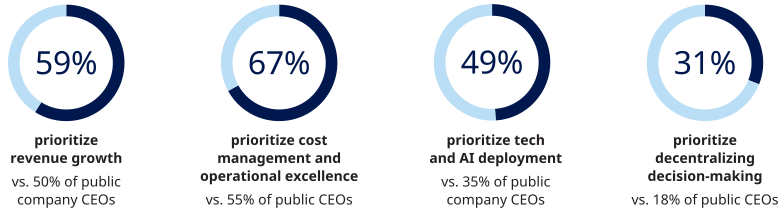
Growth is the defining objective of PE-backed CEOs, with 75% selecting a growth lever as their top priority compared with 70% of public-firm counterparts, according to a new breakdown of survey results from the Oliver Wyman Forum’s CEO Agenda 2026. Revenue uplift is the most popular growth lever, cited by 59% of PE-backed CEOs. They pair their growth ambitions with the operational rigor the industry is known for. Two-thirds of respondents rank cost management and operational excellence as a top three priority, compared with 55% of their public peers, and they are nearly twice as likely to select it as their number one priority (18% versus 10%).
Rather than treating efficiency as an end in itself, PE-backed companies treat it as the mechanism that funds growth. Cost discipline becomes investment capacity. Productivity becomes a growth enabler rather than simply a margin exercise. Public-company peers, by contrast, are more focused on long-term business transformation (38% versus 24%) and returning capital to shareholders (23% versus 14%) — a reflection of different time horizons and stakeholder obligations.
AI deployment is existential, and ROI focused, not experimental
The decisiveness and growth orientation of PE-backed companies emerge most clearly when it comes to AI adoption. Nearly half of PE-backed CEOs (49%) cite falling behind peers on AI deployment as a top three business threat — more than double the 22% of public-company CEOs. That concern translates directly into action: 49% of PE-backed CEOs regard deploying technology and AI as a top three priority for increasing shareholder value, compared with 35% of public peers.
This urgency around technology is consistent with the relatively short periods during which these companies are held by private equity owners. When you have roughly five years to create value, falling behind on AI is not an abstract risk — it is an immediate threat to exit multiples.
CEOs of PE-backed firms are combining their AI ambitions with a more aggressive reshaping of the talent pyramid than their public company peers. The clearest move is away from junior roles and toward the middle: 57% plan to shift the workforce mix away from junior roles in the next year or two, compared with 38% of public company CEOs, and 47% plan to increase the proportion of mid-level roles, versus 30% for public companies.
Building an operating model designed for AI speed and agility
The pace at which PE-backed CEOs are adopting AI is not an isolated example. They are building faster decision-making into their organizational DNA. They are nearly twice as likely as their public peers to prioritize decentralizing decision-making (31% versus 17%). They also place greater emphasis on redesigning roles and workflows (49% versus 35%), a clear signal that they are treating AI deployment as an operating-model transformation rather than an IT initiative.
The combination produces organizations that, by design, make decisions closer to execution with less latency between observation and action. That’s precisely the capability that matters most when competitive dynamics are shifting faster than annual planning cycles can accommodate. By contrast, public-company peers carry heavier governance obligations and are more focused on succession planning and leadership development (65% versus 37% for PE-backed firms), an understandable priority for a different set of pressures.
PE boards emphasize growth while public boards emphasize governance
The differing responses from PE-backed CEOs and their public counterparts have parallels at the board level and reflect how the two ownership models shape distinct strategic priorities.
PE boards are deepening their involvement in areas that drive near-term value creation. Twenty-five percent are engaging external stakeholders, likely reflecting limited-partner and investor relations intensity, compared with just 7% of public company boards. PE boards are also more likely to increase their involvement in finance and capital allocation (41% versus 26%) and operational performance (25% versus 12%). AI strategy and oversight is also climbing up the PE board agenda (29% versus 22%), consistent with the urgency PE-backed CEOs are placing on AI deployment. These priorities tend to reinforce quick decision-making and execution.
Public company boards, by contrast, are more focused on areas that reflect their accountability obligations: strategy and corporate governance (65% versus 45%), executive performance and succession (40% versus 24%), and risk, compliance, and crisis management (38% versus 29%). Neither set of priorities is wrong — they reflect the genuine differences in what each board is there to do.
Why the PE playbook matters beyond private equity
The survey underscores that PE-backed companies are managed in ways that reflect their distinctive ownership and operating model. Finite hold periods, concentrated ownership, and performance-oriented boards create an environment in which decisions are made faster, resources are allocated more deliberately, and every initiative — including AI — is evaluated against a near-term value-creation horizon.
This model is almost tailor-made for today’s volatile and fast-changing environment, in which the average CEO — public and private — is spending half their time on a planning horizon of less than one year, CEO turnover is rising, and sitting CEOs now are the youngest cohort on record.
Public-company CEOs answer to a broader set of stakeholders than their PE-backed counterparts, and they tilt more toward long-term transformation, governance, and succession planning. Yet there is much they can learn from their PE peers.
Leaning into moves CEOs can control and monetize now, such as revenue uplift and cost discipline, can create a competitive advantage in a time of disruption. Decentralizing for faster decision-making and redesigning roles and workflows to accelerate AI adoption can better position organizations for the future. Those are choices available to all leaders, not options constrained by ownership models.
