


After several challenging years, Europe's industrial goods sector has stabilized. Executive sentiment, which fell to a low of 5.4 in our 2025 State of the Industrial Goods Sector survey, rose to 6 out of 10 in 2026, while market valuations strengthened. Sixty-three percent of executives expect revenue growth of at least 3% this year.
Yet the sector is still in a transition period. Performance remains uneven by subsector, customer exposure, and geography. Structural growth markets are pulling ahead, while slower markets — especially businesses with narrower European footprints — face weak demand, rising costs, and geopolitical uncertainty.
The central shift is strategic: Growth has moved decisively to the top of the C-suite agenda. After years focused on resilience, costs, and adaptation, 95% of executives are now prioritizing annual growth of at least 3% over the next five to eight years, and 21% are aiming for 10% or more.
Our 2026 State of the European Industrial Goods Sector report finds that the most ambitious companies pursue fewer opportunities. They concentrate resources on higher-conviction growth bets, tolerate more uncertainty as new businesses scale, and exit more quickly from activities that no longer fit their long-term agendas.
Four corporate priorities stand out: choose where to grow and concentrate bets, use M&A and partnerships to accelerate growth, build the capabilities required to compete in new areas, and align the organization behind profitable growth.
European industrial goods firms are profitable, but global peers are growing faster
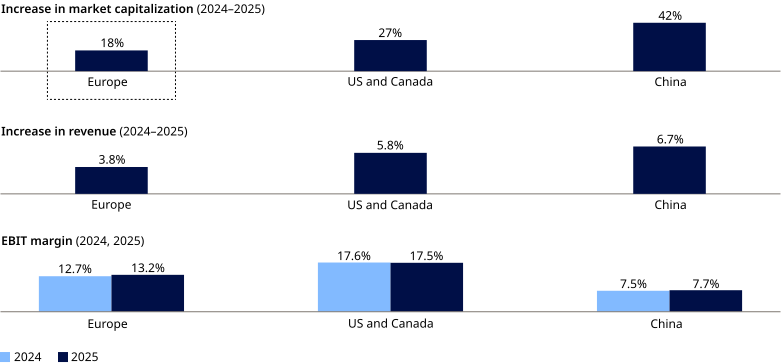
European industrial companies have protected margins through several difficult years. Average profitability rose from 12.7% in 2024 to 13.2% in 2025. Our industrial goods index gained 18.4% in 2025, ahead of MSCI Europe's 17.5%, and outperformed the broader market for a third consecutive year.
Growth remains the bigger concern. Aggregate revenue rose 3.8% in Europe, compared with 5.8% in the United States and Canada and 6.7% in China. European industrial companies gained 18% in market capitalization versus 27% for North American peers and 42% for Chinese companies.
Subsector performance is sharply divided. Semiconductor equipment manufacturers remain the decade's dominant value creators, and power systems businesses posted an aggregate 120% gain in market capitalization across 2024 and 2025. On the other hand, industrial software and production systems moved in the opposite direction, losing 14% and 6% of market value, respectively.
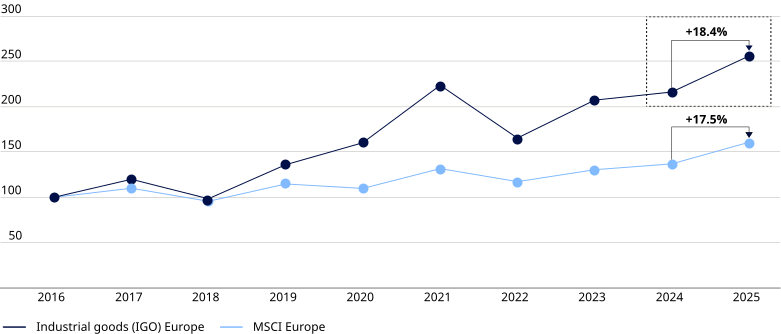
For leaders, the implication is clear: Waiting for a rising market to lift every business will not be enough. While Europe's industrial base remains profitable and competitive, growth and value creation are concentrated in a limited number of subsectors.
Industrial goods executives expect new markets to deliver a quarter of future growth
Corporate ambition for long-term growth extends well beyond the current cycle. Over the next five to eight years, 74% of executives target annual growth of 3% to 9%, while 21% target 10% or more.
Underlying markets alone are unlikely to deliver that step change. Executives expect 52% of future growth from existing markets, 20% from adjacencies, and 26% from new markets. They expect the revenue share from services, software, and data-based offerings to rise from 23% today to 29% by 2030, with more optimistic projections targeting 34%.
M&A is expected to contribute roughly one-quarter of future growth, based on our survey average. For companies targeting annual growth above 10%, the expectation for M&A is 33%.
Corporate venture activity has focused on emerging growth pools: AI, analytics, and machine learning attracted $5.7 billion in transaction value in 2025, while transaction value in nuclear power equipment was 100 times higher in 2023-2025 than in 2020-2022.
The strategic challenge is not simply to set a higher target, but to decide which markets, offerings, technologies, and capabilities deserve disproportionate investment.
 We don’t see substantial unit growth in Germany or Europe. Growth will come from services, digital offerings, and abroad
The most ambitious industrial goods companies make fewer, bolder bets
High growth ambition is distinguished less by the number of opportunities pursued than by the choices made. Companies targeting annual growth of at least 10% report 3.4 major growth bets on average, compared with 7.9 among other companies. Nineteen percent build their growth portfolio around one dominant bet, supported by a few additional options.
They also show greater commitment through uncertainty: Two-thirds are likely to hold onto high-growth businesses despite near-term losses, compared with 52% of other companies.
At the same time, 57% are likely to exit profitable, low-growth businesses that no longer promise long-term growth, compared with 39% of their peers.
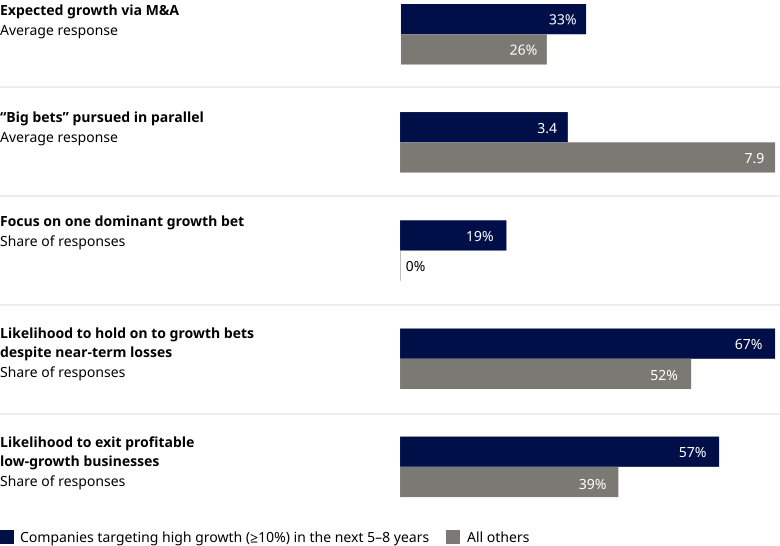
Greater ambition, therefore, comes with more willingness to focus resources, tolerate an uncertain ramp-up, and reconsider established but underperforming businesses.
Industrial goods growth is constrained more by leadership than funding
The central growth constraint is less financial than strategic and organizational. Conservative company culture and risk aversion are cited by 75% of executives as among their biggest challenges. Sixty-four percent identify capability and skill gaps as their biggest hurdles.
The highest-ranked success factors identified by the survey are largely within management control. An aligned and clearly communicated growth strategy ranks first at 60%, followed by the right capabilities and skills and sustained leadership attention, both at 56%. Secured investment funding ranks last, at 18%.
Four levers can help industrial goods companies pull ahead on growth
Our report identifies four priorities for industrial leaders:
- Choose where to grow and concentrate bets. Companies in structural growth markets should turn today's demand into durable revenues. Those in slower markets need a limited number of credible moves into new regions, applications, services, or business areas.
- Leverage M&A and partnerships to accelerate growth. Companies need to decide what to build, what to acquire, and where partnering offers a faster or less risky route. M&A should follow strategy, not replace it.
- Build capabilities and adapt the operating model. New growth areas may require different talent, incentives, governance, development cycles, and ways of working.
- Align the organization behind profitable growth. Make a strategic choice, direct resources and incentives behind it, and maintain commitment through uncertainty.
Resilience has bought time. Companies benefiting from structural tailwinds must turn today's demand into an enduring advantage before the cycle turns. Those facing weaker markets must change trajectory before established core activities define their future.
But it is also a key juncture for many corporate leaders to decide how to boost their trajectory in the next decade. Once those strategies are developed, they will need to take bold action to build an organization equipped to pursue them successfully.
This report provides insights into the European industrial goods sector, based on a survey of ~100 C-suite level executives, interviews with leading CEOs and CFOs, and market research on ~1,400 listed global firms — including ~230 in Europe with annual revenues exceeding €100 million.
