


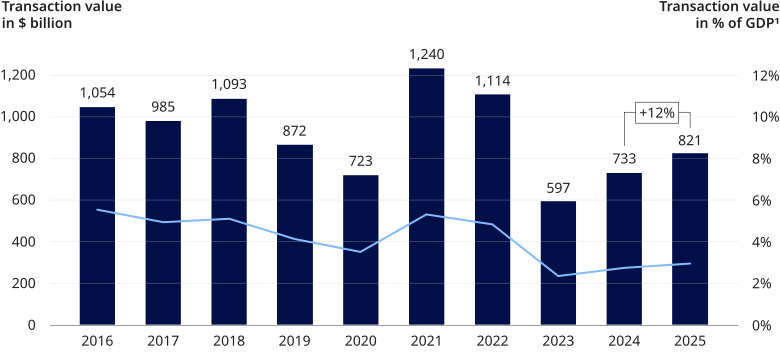
European dealmaking came back in force in 2025 and is set to remain active into 2026. Global M&A rose more than 30% last year, while Europe saw deal value grow by about 9% to roughly $800 billion as investors rotated capital toward the region. The past 12 months have reinforced a clear conviction — Europe must consolidate faster and build sovereign scale across sectors such as defense, banking, and technology.
Volatility will remain elevated, with geopolitics, interest rates, and tariffs still uncertain. Yet the core logic for consolidation remains strong. Corporate profitability across sectors is now about 50% higher than before the 2008 crisis, yet many European businesses are still subscale, and industries are more fragmented than in the United States. With equity markets up and acquisition currency available, many companies are well-positioned to act boldly.
A strong pipeline of announced but not yet completed deals, ample global capital, and easing regulatory dynamics point to sustained M&A activity in 2026.
Our latest edition of “Capital Currents” distills the top 10 themes shaping European M&A in 2026. We highlight where momentum is strongest, how sector dynamics are evolving, and what management teams can do now to turn opportunity into lasting value.
Top 10 themes that will shape European M&A in 2026
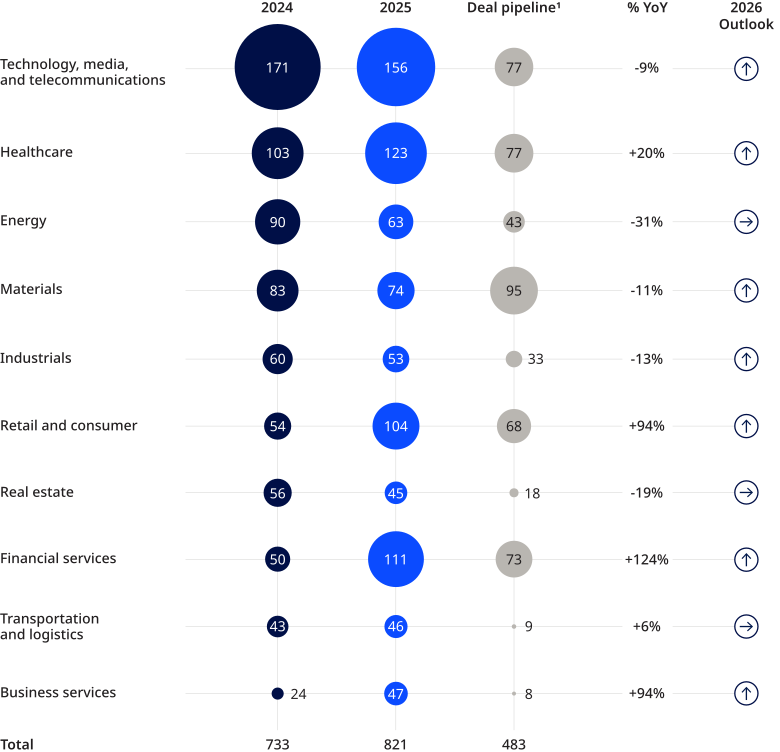
Across the 10 themes, a clear pattern emerges: Consolidation, scale, and sharper capital deployment are at the heart of European M&A in 2026.
Together, the themes indicate that management teams are using M&A to consolidate fragmented markets and to reshape portfolios to better align them with growth opportunities, resilience needs, and evolving regulatory and sovereignty considerations.
Banking consolidation will accelerate as capital and policy align
European banking M&A has just closed its largest year in more than a decade, with deal volumes doubling since 2020. Restored profitability, diversification needs, and more supportive regulators are pushing banks toward consolidation. Banks are expected to generate more than $500 billion of excess capital above regulatory minima over the next three years and are increasingly deploying it into deals that often deliver returns of 15% to 20%, exceeding buybacks.
In 2026, we expect banks to focus on fee‑income capabilities, especially wealth management, as the rate cycle turns. In‑market consolidation will deepen, and the first wave of cross‑border banking M&A seen in 2025 may gather pace, provided policymakers advance the Savings and Investment Union and common European deposit insurance. Successful deals will have clear strategic logic, add scale or capabilities that accelerate the business plan, and deliver superior returns versus alternative capital uses.
Asset and wealth managers face a consolidation race for scale
Margin pressure and client consolidation are fueling a powerful wave of M&A across asset management and wealth management. Several major European transactions in 2025, including large joint ventures and acquisitions, underline the urgency. By 2030, there may be 20% fewer asset managers in Europe, as midsize players struggle to maintain scale and fund technology and artificial intelligence investments, while leaders leverage scale to capture highly concentrated growth pockets.
M&A activity is intensifying, with roughly 100 to 200 European deals a year driven by capabilities in private markets, access to patient insurance capital, proprietary distribution, and cost synergies that fund reinvestment. As insurers and wealth managers reconsider owning asset managers outright, inter‑sector opportunities such as carveouts, alliances, and distribution investments are opening new strategic paths.
Telecom operators turn to M&A to repair market economics and fund growth
Europe’s telecom markets are mature, with modest growth in core mobile and fixed connectivity. Capital needs for nationwide 5G and fiber are colliding with fragmented market structures. The average European Union operator has about 5 million subscribers, compared with about 107 million in the United States. Sovereignty and resilience priorities reinforce the case for nationally anchored digital infrastructure, while regulators are taking a more pragmatic stance on consolidation.
In this context, in‑market consolidation remains the largest and most immediate value pool. Operators are also pursuing growth‑engine acquisitions in business‑to‑business digital services, where cross‑selling and new-segment penetration can drive revenue. Data center joint ventures, partnerships with technology firms, and transactions in fiber and towers will continue to reshape the infrastructure landscape, with private equity playing an increasingly important role in building sovereign compute capacity.
Defense M&A pivots to scaled production and supply security
European defense enters 2026 with a structurally strong demand outlook. Military spending is projected to grow by about 9% per year through 2030, lifting budgets by more than 50% versus 2025 as governments prioritize readiness, stockpile replenishment, and capability build‑up. Order books are full, and production lines are running near capacity, with projected demand over the next decade roughly 20 times current annual output.
M&A is moving from portfolio clean‑up to a strategic push for production capabilities and critical technologies, particularly software‑heavy systems. Sovereignty concerns and program eligibility rules will shape deal structures, driving more joint ventures, minority stakes, carveouts, and ring‑fenced governance. Private capital will remain most active in suppliers, carveouts, and less-sensitive adjacencies, while mid‑market defense businesses seek capital to expand capacity and capture sustained growth.
Logistics players pursue scale, tech, and network density
In logistics, e‑commerce growth and mail declines are intensifying the need for consolidation. The European market is shifting toward fewer, higher‑value deals as players seek scale synergies, optimized networks, and automation to offset margin pressure. Recent large transactions highlight a push to build broader platforms and partnerships that can meet rising shipper expectations for end‑to‑end, reliable solutions.
Acquirers are tilting toward stickier revenue pools, such as contract logistics, warehousing, and specialized value‑added services. Technology capabilities in visibility, analytics, and automation are no longer optional; they sit at the center of deal theses and post‑merger value creation.
Pharma and life sciences sharpen portfolios around priority therapies
Pharma dealmaking is becoming essential rather than opportunistic as the industry moves from the 2023-2024 slowdown into a more selective, more constructive environment. Financing conditions and confidence have improved, but discipline remains high, and quality assets command a premium. Pipeline gaps, looming patent cliffs, and the need for external innovation make M&A and partnering core strategic levers.
Companies are targeting assets through explicit portfolio and commercial lenses, ranging from rare disease plays to larger, established indications and next‑generation modalities such as cell therapies, bispecifics, and antibody‑drug conjugates. At the same time, non‑core assets are being divested to fund investment in priority disease areas, scalable platforms, and AI‑enabled discovery. Into 2026, we expect more de‑risked bolt‑on and midsize acquisitions, capability‑driven platform deals, structured options and staged transactions, and continued carveouts that sharpen strategic focus.
Chemical companies reshape portfolios to build resilience
Chemicals players are using M&A to refocus on specialties, secure advantaged positions, and bolster cash flow. Persistent headwinds include global commodity overcapacity, soft demand in key downstream sectors, structurally higher energy and feedstock costs in Europe, and tightening sustainability mandates.
Under‑utilized commodity assets are increasingly under scrutiny for divestment or even closure. Smaller and midsize acquisitions in margin‑resilient specialty segments, especially in high‑growth regions such as Asia, support local‑for‑local strategies and customer proximity. At the same time, larger transactions aim to build global platforms, secure feedstock access, and accelerate moves into downstream, circular, and bio‑based chemistries.
Insurers and intermediaries continue a powerful consolidation wave
In insurance, a consolidation of private-equity-backed brokers and service providers has dominated deal volumes, accounting for about 90% of transactions in recent years. There remains runway for roll‑ups and an emerging “consolidation of consolidators” as larger platforms look to scale further. The appetite for managing general agents is growing among both carriers and brokers, with vertical integration seen as a way to protect margins and differentiate propositions.
On the carrier side, recent mergers and combinations across Europe show that scale remains essential for market relevance and technology investment. Structural challenges in life insurance continue to generate run‑off deals and attract private equity as a funding source. In 2026, we expect more acquisitions of specialty underwriting franchises, as strategic buyers seek capabilities and alternative capital looks to long‑tail specialty risk as a complement to life.
Corporate dry powder can unlock private equity’s exit backlog
European corporates are currently holding around €2.6 trillion in cash, while private equity is managing aging portfolios, stretched holding periods of over six years, and limited options for IPOs or secondary exits. This creates a structural opening for trade buyers to acquire financial sponsor‑backed assets. In 2026 alone, more than 1,500 European private-equity-backed assets, representing roughly $760 billion in enterprise value, could come to market, versus a historical range of 700 to 800 per year. Technology, industrials, and business services are set to lead this wave.
To turn this backlog into a repeatable growth engine, corporates will need to become “PE ready.” That means sharpening their M&A theses, mapping private equity ownership in priority value pools, and engaging sponsors early and bilaterally rather than waiting for broad auctions. Faster governance, comfort with complex carve-outs and creative structures, and industrialized M&A capabilities from screening through integration will be critical.
Strategic portfolio rebalancing returns to the top of the agenda
Portfolio rebalancing is becoming a central theme in European M&A as corporates respond to persistent headwinds and a higher cost of capital. Divestitures and carveouts fell sharply in 2022 and 2023, then stabilized and began to recover, with larger asset sales most visible in healthcare, consumer, and transportation and logistics. One-third of European corporates now generate returns below their cost of capital, suggesting misallocated capital and underperforming portfolios.
In 2026, disposals of non‑core or underperforming assets will be a key unlock, freeing capital to return to shareholders or to reinvest in scale deals in core businesses. Materials, energy, consumer, healthcare, and financials all show significant misallocated capital, and conglomerates continue to spin off assets to crystallize value. Activist investors are adding pressure, pushing management teams to refocus and simplify.
How leaders can win in the next phase of European M&A
European M&A is entering 2026 with renewed momentum and sharper strategic intent. Common threads across sectors include scale, capabilities, and portfolio quality. Banking, asset management, telecoms, defense, logistics, pharma, chemicals, insurance, and many other industries are using deals to reposition for a more volatile, capital-intensive, and technology-driven decade.
We see three priorities for leadership teams:
- Define a clear M&A blueprint linked directly to strategy, with explicit theses by sector, theme, and asset type.
- Build repeatable M&A capabilities across sourcing, diligence, structuring, and integration to move faster than competitors.
- Embrace portfolio rebalancing as a continuous discipline, not a one-off exercise.
As 2026 unfolds, disciplined consolidation and sharper capital deployment will separate leaders from followers — and those who move decisively will set Europe’s next era of industrial and technological scale.
