


Digital assets have arrived — as an asset class, as a form of money, and as a technology. But the real question facing wholesale banks is whether digital assets will have any meaningful impact on the business, and what that change might look like.
In Digital Rails, Real Economics, the 2026 edition of our annual wholesale banking industry outlook with Morgan Stanley, we examine how wholesale banking would perform across different economic scenarios and how digital assets will factor into the evolution of the business.
Wholesale banks enter 2026 from a position of strength. Industry revenues reached a record $660 billion in 2025, supported by strong performance in core corporate and investment banking (CIB), particularly investment banking and equities. Looking ahead, we see a path to continued growth, but with outcomes increasingly shaped by macroeconomic uncertainty, evolving capital rules, artificial intelligence, and the growing adoption of digital assets.
Across three diverse macro scenarios, we estimate the industry will generate $650 billion to $850 billion in revenues and an average return on equity (RoE) of 12% to 20% by 2030 — very healthy considering where the industry has come from.
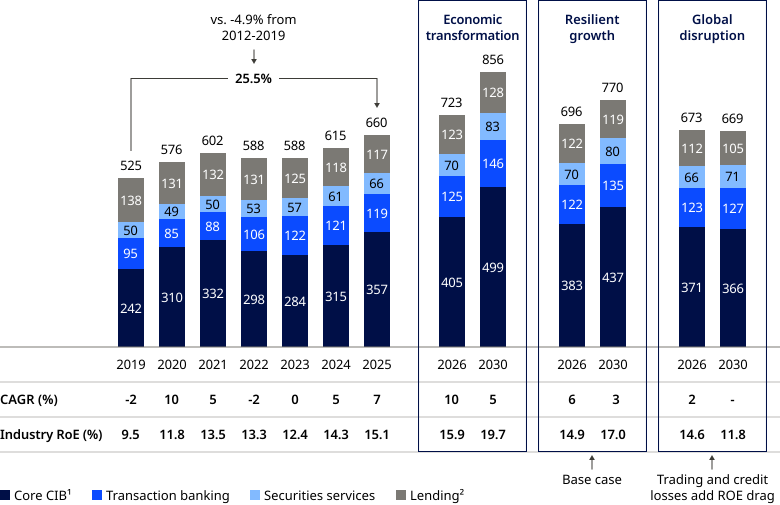
Across all scenarios, we see the industry remaining resilient, but relative performance will depend on how effectively banks respond to structural change. Among these structural forces, digital assets are emerging as one of the most important long-term shifts in the market structure and infrastructure of wholesale banking.
The future of digital assets in financial services
Digital assets encompass three related trends in financial services: the rise of a new asset class (crypto), the emergence of a new form of money (stablecoins, tokenized deposits, central bank digital currencies), and the development of a new set of technologies to enable the creation, exchange, and custody of emerging or existing assets (distributed ledger technologies, tokenization). All three will figure prominently in the future of wholesale banking.
The impact will depend on the answers to five foundational questions:
- Will digital assets emerge as a significant institutional asset class?
- Will digital assets pose a meaningful threat to bank funding models?
- Are technologies that enable digital assets fundamentally better than those used today?
- How could these technologies reset the competitive balance in established banking businesses?
- Will these technologies drive meaningful change in bank operating models?
Despite the headlines, we find that there is a low probability that digital assets will evolve into an asset class rivaling established trading businesses or disrupt the foundations of the banking model (specifically deposit funding). We estimate that institutional capital markets activity related to crypto assets (market making, financing, custody) could reach at most $16.4 billion by 2030. And we see few paths to widespread adoption of stablecoins in place of traditional bank deposits, even if tokenized money is widely adopted and parts of the business see far greater change.
More significant is the potential migration of all or parts of existing business lines — especially in payments, collateral, liquidity, and servicing — onto digital rails.
Why digital rail adoption is a turning point for banks
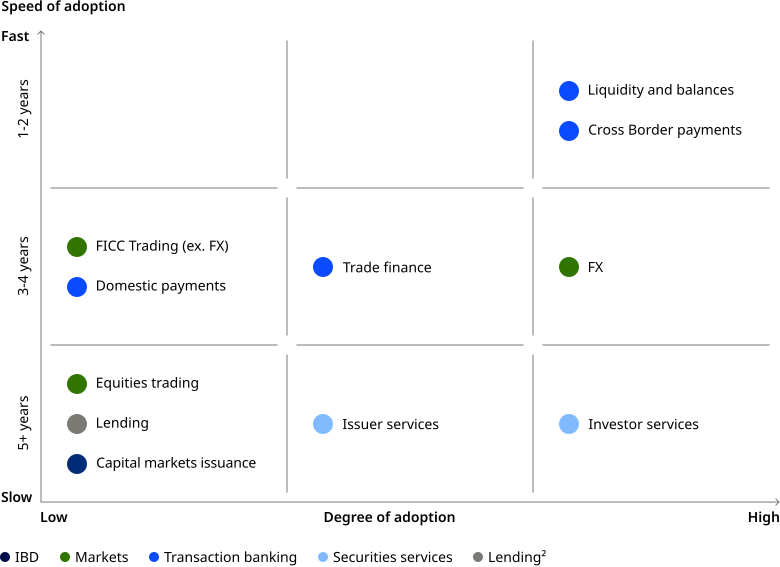
In our base case, adoption of digital rails will reshape businesses that generate more than $200 billion in revenues, placing $46 billion in revenue at risk to margin compression and market share shifts. Adoption is likely to be strongest in cross-border payments, collateral management, funding and liquidity, foreign exchange, trade finance, and investor services, where digital rails can deliver lower costs, faster settlement, 24/7 access, and improved collateral mobility.
We do not expect adoption to be linear; rather, we expect it to build cumulatively across connected use cases, with tokenized money (including stablecoins and tokenized deposits) forming the foundational layer for broader activity.
Revenue shifts and competitive dynamics in wholesale banking
The emergence of digital assets (specifically crypto) as an institutional asset class could add up to $8 billion in net new revenues for wholesale banks — only about 1% of projected 2030 revenues for the industry. However, a more significant shift will come from the disruption and redistribution of existing revenue streams, ranging as high as $82 billion (more than 10% of projected 2030 revenues). This could widen the gap between leaders and the rest of the market, or allow some more aggressive challengers to catch up in business lines that have historically been difficult to penetrate.
Early movers that build client-relevant capabilities and embed digital assets into core workflows will be better positioned to retain client balances, capture flows migrating on-chain, and defend market share. Institutions that move more slowly risk gradual erosion, particularly where nonbank or crypto-native competitors can offer cheaper, faster, or more seamless alternatives.
Bottom line: We remain bullish on the wholesale banking industry through 2030, but expect performance in the next cycle to be driven by banks (and other competitors) that invest to capture structural shifts in the market versus riding the wave. The winners are likely to be the firms that can do three things well: allocate capital toward the most attractive businesses, markets, and clients; convert AI investment into tangible financial outcomes; and establish a credible position in the digital asset value chain before client activity and economics begin to migrate.
