



The state of financial services today is strong. Trouble may loom on the horizon, however, as artificial intelligence and other forces threaten to disrupt revenue pools, operating models, and most critically, customer relationships.
While financial institutions have delivered strong performance and valuations have jumped, we believe investors aren’t fully pricing in the transformation that AI and a more favorable regulatory environment could unleash. In this notoriously cyclical industry, investors may be skeptical that the good times will last — or wary of the threats that AI and other forces might pose in the years ahead.
To win them over, the financial services industry will need to show that it can harness these forces to strengthen the key drivers of value: earnings power, operating margin, and capital efficiency. We believe trust is the unique asset financial institutions can leverage to pull this off. But the current approach to AI and other disruptions will not get them there.
Banks are back — for now
First, the good news. The vast majority of financial institutions we touch in our work — banks, wealth and asset managers, insurers, exchanges, data providers, fintechs, and so on — are performing well and delivering healthy returns to shareholders. Valuation multiples are approaching post-crisis highs, the fundamentals of the business are strong, and policymakers are taking a more flexible approach to financial regulation. This is a surprising and significant development given the challenges facing the industry leading up to the pandemic.
Nowhere is the trend more evident than in the banking sector, where performance is strong and valuation metrics have improved. The price to tangible book value multiple of the 78 institutions in our index of global banks (which excludes China and specialist banking models) has jumped to 1.8 today from 1.3 in 2019, while their return on tangible common equity has climbed to 14.2% from 11.9%. Most banks have been winners since the end of 2019, with the share of banks trading below book value or generating less than 10% return on tangible common equity falling close to zero.
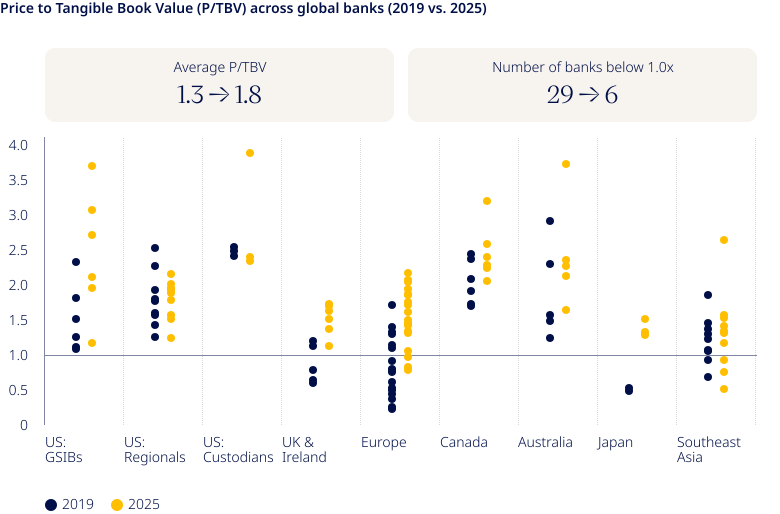
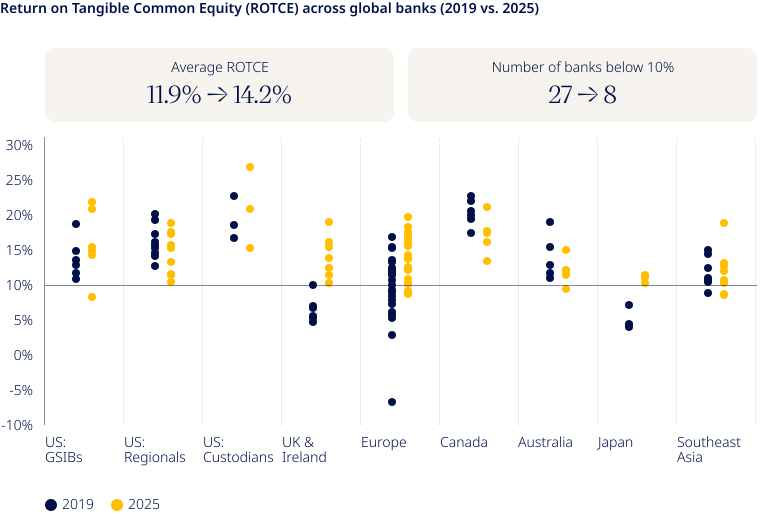
Several forces have driven the reversal of fortunes for banks, but one of the most important has been the earnings power generated by the shift in global interest rate policy and levels (the end of the lower-for-longer rates regime). With some notable exceptions, banks continue to depend on interest income to drive performance; net interest margin and net interest income as a percentage of revenue spiked in 2023 and have held steady since.
Banks have used this windfall to return capital to investors, lifting average payout ratios (share buybacks plus dividends as a percentage of earnings) by nearly 20 percentage points to 76% in 2025. Valuations have enjoyed the ride; the global banks in our index have delivered a total shareholder return of 171% over the past five years, compared with 72% for the MSCI All Country World Index.
Investors are buying into bank performance — to a point
There are three well-understood drivers of shareholder value for financial institutions: earnings power, operating margin, and efficient use of capital. The industry has made good progress on all three over the past five years, and valuations have risen accordingly.
However, investors are showing concern that this moment in the sun may be fleeting — and such concerns are keeping valuations from rising higher and breaking out of historical valuation ranges. Financial services is a notoriously cyclical industry and when valuations approach the top of their range, investors become cautious.
And the list of potential worries is long. The geopolitical situation is tenuous, which may threaten the global business models that banks have worked so hard to build (and would need to work even harder to restructure). Interest rates, trading volumes, and asset prices have been on a historic run, which may leave the industry vulnerable to shocks or cyclical downturns. New technologies storming onto the scene threaten to disrupt the long-established drivers of value in financial services. The AI arms race has also created imbalances in the economy and financial markets, which are increasingly tied to the fortunes of the AI sector and could easily be destabilized by a correction or deeper crisis.
Financial services is at a crossroads as AI reshapes the industry
But there also may be something more fundamental happening. Despite solid performance of late, we believe investors have yet to price in the full potential of AI to transform the economics of the business or the more accommodating stance of policymakers and regulators across the world. If AI radically improves the efficiency of the business and regulators are reducing the capital required to run the business, returns should be set to lift off in the coming years. Investors don’t seem to be making that bet (yet). The question is why.
AI’s potential to transform the economics of financial services is massive. While this is true of most industries, financial institutions are especially dependent on complex, labor-intensive, data-dependent processes that could be fundamentally reshaped by AI. Even modestly reducing the cost to serve customers and the cost to comply with regulation could generate a step-change in operating margins and returns for financial institutions.
But the advent of AI in financial services is a double-edged sword. The complexity and sensitivity of financial services have historically served as barriers to entry — individuals and institutions care deeply about the safeguarding of their assets and financial institutions have a track record of getting this right (within the regulatory safety net). These barriers could evaporate in a financial system dominated by AI platforms.
And these disruptions aren’t limited to AI: Stablecoins could compromise the traditional funding model of banks and erode their natural advantages in payments; regulation has already shifted significant lending and trading activity away from banks; and geopolitics could fragment the global financial systems in ways that limit access to the fastest growing or most attractive revenue pools around the world.
We explore these uncertainties in five debates that collectively form this year’s "Known Unknowns for Financial Services."
How trust gives financial institutions an edge in the age of AI
We believe banks hold a significant natural advantage at this crossroads: trust. Financial institutions have unique levels of trust with customers — in identifying and understanding their needs, safeguarding their assets and data, and faithfully executing transactions as intended (or taking responsibility to correct mistakes). This is a powerful asset that should only become more so in a world dominated by AI platforms where identity, intent, and truth are uncertain.
But financial institutions aren’t leveraging trust effectively in their journey into the age of AI.
Why financial institutions’ AI strategies remain incomplete
Financial institutions’ response to AI thus far has focused on using AI to improve the efficiency of existing operating models and serving the growing ecosystem of AI-driven businesses (from hyperscalers to chip makers and data centers) as clients. There are challenges with both elements of the strategy.
First, financial institutions can do only so much to improve the efficiency of existing models. The track record of realized margin improvements from the “digital transformation” wave over the past 20 years has been mixed (for a variety of reasons, including regulatory requirements). The financial services industry has experienced an extraordinary period of fee compression over the past two decades, passing most of the efficiency gains from new technologies and financial innovations on to customers. This is true across securities trading, wealth and asset management, and custody and fund services, to name three. The industry cost base across financial services has been stubbornly rising in line with revenues since the financial crisis, despite major investments in automation and other efficiency measures.
Second, the future path of the AI economy is uncertain and AI is becoming a very crowded trade, with significant risks for investors and lenders. A correction comparable to the dot-com crash could wipe out more than $30 trillion in investor wealth; a hybrid equity-debt crisis would be even more damaging. The shift would also place enormous pressure on an increasingly important source of earnings for the entire financial sector — serving the rapidly growing ecosystem of AI businesses.
And neither of these strategies creates the opportunity for banks to break out of historical valuation ranges. The true upside for financial institutions lies in business model transformation that draws on client trust built over decades. The critical transformation for financial institutions will occur at the client interface, not in the middle and back offices.
Building an AI-ready business model for financial services
The winners of the AI age will reshape their business model to reflect the significant changes in the ways consumers, corporates, and investors operate and the significant role that trust will play in serving those needs effectively.
What will this require? An honest, thoughtful investigation of how AI (and other forces like stablecoins) will transform the way clients operate and the role that individual institutions play in the AI-enabled ecosystem of the future.
In some cases, it will be an evolution; in others, it will be a revolution. In all cases, a clear vision of the business model of the future will be essential to inform strategic pivots, keep pace with a rapidly expanding set of competitors, maintain pricing power and operating margins, and direct investments in operating model transformation toward the future and away from the past (such as automating broken processes).
What will it take? We believe the winners will: Invest with purpose to build the business model of the future; invest with courage, especially as cycle turns and operating margins are pressured; and invest with patience, building robust data, infrastructure, and governance to unlock the potential of AI without compromising trust with customers.
The window of opportunity will be short, and this brief moment will determine the winners and losers in the industry for years to come.
This article is part of our Known Unknowns report, highlighting the debates that will shape the future of financial services in the age of AI.