


The results are in, and the early fanfare over agentic AI tools in sales is now paying dividends. Organizations that invested heavily when technology debuted have now figured out how to best leverage it, emerging as clear winners over those that opted to wait. In a new survey of 100 sales leaders at companies already using agentic AI, a remarkable 89% reported seeing a positive impact on sales growth.
Released by enterprise CRM software vendors in 2024, agentic AI tools promised to autonomously perform a range of previously time-consuming manual tasks, thereby supercharging sales teams’ productivity. Our survey, conducted in partnership with proSapient, a leading tech-enabled expert network, revealed how the promise is translating into impact, and the serious risk faced by organizations that remain saddled with older commercial models.
Because achieving impact is complex, Fortune 500 firms, private equity portfolio companies, and midmarket enterprises need practical guidance on which use cases to prioritize, how to prepare and upskill their teams, and how to pilot and scale agentic AI with the right governance. Below are four research-backed insights and actions leaders can take to launch and then scale agentic AI across their sales organizations.
Four key insights into how agentic AI is reshaping sales growth
Agentic AI is already changing how sales teams identify opportunities, engage prospects, and drive growth. Based on a survey of 100 sales leaders, these four insights reveal where organizations are seeing the greatest impact and where successful scaling requires new capabilities and operating models.
1. Agentic AI delivers results on the sales metrics that matter
Sales leaders most often report a positive impact of agentic AI on three core KPIs: sales growth, sales rep productivity, and lead conversion (see Exhibit 1).
Implications for your business: Agentic AI is showing its largest impact on three key sales metrics that drive revenue performance, not just efficiency. In the research we conducted in collaboration with proSapient, sales leaders using agentic AI reported strong benefits: 89% saw a positive impact on sales growth, 87% on sales rep productivity, and 61% on lead conversion.
Agentic tools can grease the skids of everyday selling, helping reps process information faster, direct their energy more effectively, and move the highest-potential opportunities forward. For example, a sales agent can help to identify sales leads and continuously scan for customers that match an ideal client profile, enrich records and remove duplicate ones, and help prioritize leads in real time. Freed from handling those tasks, reps have more time to weigh which targets to pursue and spend more time selling.
Other use cases span lead qualification and scoring for fit and urgency, continuous sales stream monitoring to detect buying intent and recommend next-best actions, and automating administrative work (such as meeting summarization and updating the CRM), among others. As a result, sales organizations can convert more leads and grow sales with the same headcount.
What’s more, though sales organizations might be wary of disrupting processes that already work, our research showed they need not be overly concerned. Only 1% of survey respondents reported agentic AI negatively affecting growth, productivity or lead conversion.
Process and strategy changes are likely necessary to unlock improvements in KPIs related to more operational areas with complex interdependencies. For example, our survey found that agentic AI has comparatively less impact on sales operating costs, customer satisfaction metrics and sales cycle length. Nevertheless, because agentic AI can strengthen core execution right now, organizations have a significant opportunity to create top-line value while building toward broader transformation.
2. The biggest agentic AI wins start at the top of the funnel
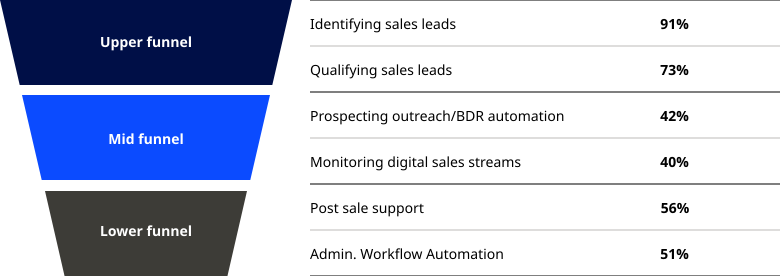
Sales leaders overwhelmingly reported that agentic AI is driving moderate to transformational impact at the top of the sales funnel, where reps find and prioritize promising sales prospects (see Exhibit 2).
Implications for your business: Agentic AI already demonstrates significant value at the top of the sales funnel. And the sizable shares of respondents reporting moderate to high impact (5% to 20% uplift) as well as transformational impact (more than 20% uplift) suggest further upside from optimizing and scaling the use of agentic AI across the organization.
These gains reflect a close alignment between top-of-funnel work and agentic AI’s ability to automate workflows that were previously largely manual tasks for sales reps. Lead identification and qualification depend on collecting market and account signals, interpreting them, and frequently updating prioritization — tasks that AI agents can perform faster and more comprehensively. As a result, reps’ work shifts more to oversight and validation. And in addition to boosting reps’ productivity, the larger, higher-quality pipeline increases the probability of downstream conversion and improves the likelihood of achieving their sales goals. Nothing could be more motivating for a sales rep than tools that help them more easily exceed their sales targets.
3. Mid-funnel handoffs are the hardest part of agentic AI
Fewer sales leaders reported meaningful impact of agentic AI in the mid funnel, where sales leads are nurtured, and handoffs occur between AI sales agents and reps (see Exhibit 2).
Implications for your business: The mid-funnel is a proving ground where potential for automation meets the difficulty of operationalization in practice. While some use cases, like initial outreach to leads, should in theory be well-suited to agentic AI, the mid-range impact scores from our survey highlight the inherent coordination challenges that come from handoffs from AI sales agents to sales reps. Getting this right requires tighter orchestration to ensure a seamless customer experience. Further, because the mid-funnel is where agentic AI outputs are more directly experienced by buyers, the penalty for getting relevance wrong is immediate and significant.
Organizations that succeed in deploying agentic AI in the mid-funnel often have more mature data architectures, centralized governance, and a clear playbook that defines how automated recommendations and human judgment work together. Those capabilities strengthen an organization’s ability to pilot and scale agentic AI in the mid-funnel — and to deliver consistently relevant, tailored messaging at scale through the right channels, at the right time — while also enabling smoother handoffs to sales reps.
4. Enhanced decision-making is an unexpected benefit
While productivity gains and reduced manual effort are often the expected benefits of agentic AI, the most commonly cited impact theme in our survey was enhanced decision-making — 37% of sales leaders said it was the single most effective change agentic AI has brought to their sales organizations.
Implications for your business: For sales reps, time is one of the most valuable — and scarce — resources. Historically, reps have been weighed down by manual work, limited time to think, and the need to make high-stakes judgment calls with incomplete data. Agentic AI can offload routine tasks (like updating CRM) and provide contextual recommendations, helping reps focus on the right opportunities and execute clear next-best actions. Against that backdrop, it’s not surprising that improved decision-making is one of agentic AI’s biggest unlocks, freeing salespeople to do more of what they do best: spend time selling and applying their emotional intelligence to the accounts, relationships and deals that matter most.
Five strategic steps to scale agentic AI beyond early wins
While our survey focused on more advanced sales leaders already using agentic AI, less mature organizations can still take practical steps to get started. Delaying only increases the danger of falling behind and losing share to faster competitors.
Here are the actions to take today to pilot and scale agentic AI in your sales organization:
- Prioritize and run time-boxed pilots focused on the upper funnel. Focus on lead generation and qualification, with a 90–180-day horizon to prove measurable impact — more qualified leads, less rep research time, and improved lead-to-opportunity conversion. Scale what works into day-to-day workflows across teams/regions, then enterprise-wide.
- Make integration non-negotiable. Require CRM integration so agentic outputs are captured and acted on in core workflows rather than stranded in isolated point solutions. As you scale, expand integration to adjacent systems (for example, marketing automation, pricing tools and ERP) based on their ability to speed cycle times and remove manual steps.
- Activate credible change champions. Identify and empower leaders in sales and sales ops who have trust with quota-carrying reps. Adoption accelerates when incentives are clear. Early adopters can demonstrate how agentic tools help them increase productivity and hit quota — then codify and spread those practices through coaching and feedback loops.
- Expand to mid- and lower-funnel use cases with staged autonomy. Once upper-funnel pilots are scaled, test downstream applications under human-in-the-loop oversight, using a phased automation plan that increases autonomy only as trust and data quality improve.
- Scale governance in parallel. Document success factors, failure modes, and guardrails (including compliance and hallucination mitigation), and maintain a disciplined KPI/ROI review cadence as coverage expands.
In summary, agentic AI is shifting from hype to measurable competitive advantage. The next wave of value will be captured by leaders who can pilot and scale agents in a systematic, repeatable way — evolving the sales operating model with integrated data, clear governance, and tightly choreographed human/AI handoffs that protect the customer experience. Organizations that act now with focused pilots, strong change leadership and disciplined guardrails will be best positioned to turn agentic AI into a durable, repeatable source of advantage.