


In recent years, chief financial officers across industries have been operating in a structurally more complex financial and business environment. Inflation, geopolitical tensions, and supply chain disruptions are no longer temporary shocks; they now define the baseline for financial decision-making.
Corporate investment agendas have fundamentally broadened: Energy transition and electrification, digitalization including AI, and supply chain resilience have all moved from long-term transformation themes into active execution. These priorities are no longer sequenced; they are unfolding simultaneously, creating persistent pressure on cash generation and balance sheet capacity.
At the same time, the cost of capital is stabilizing on a higher level, with the European Central Bank’s 10-year bond yield curve more than 50 basis points (bps) higher in 2026 than three years ago.
In this context, the CFO role is evolving beyond financial stewardship: CFOs are increasingly expected to act as strategic architects, ensuring coherence across initiatives that differ in timing, risk profile, and economic logic. The challenge is no longer to optimize programs in isolation but to keep strategic ambition, execution discipline, and financial resilience aligned over time.
Why capital allocation is getting harder for European companies
This reality applies across a wide range of European companies: utilities and grid operators, energy-intensive industrial groups, infrastructure owners, technology and digital players, and corporates with complex supply chains.
The change is not the disappearance of traditional investment needs — maintenance capex, regulatory compliance, growth initiatives, and M&A remain — but the emergence of additional, structurally large investment requirements. Energy transition, electrification, AI, and supply chain transformation increasingly compete for capital alongside established priorities, reshaping capital allocation dynamics.
Energy transition and electrification set a new capital baseline
Energy transition and electrification are among the most capital-intensive investment areas for European companies, with a marked acceleration over the past decade. International Energy Agency research finds that total energy-related investment in the European Union increased to approximately €330 billion in 2024, up from around €180 billion in 2015, reflecting a sustained and structurally higher level of capital deployment.
The investment mix highlights the breadth of the transition. End-use accounts for the largest share, at around 40% of total investment, driven by electrification across transport, buildings, and industrial processes. Investment in low-emissions electricity — encompassing renewables and nuclear — has grown significantly, reaching close to €100 billion in 2024, as power generation shifts toward low-carbon sources.
At the same time, capital allocated to grids and storage has more than doubled since 2015, exceeding €70 billion annually. This reflects the infrastructure required to integrate renewable generation, manage system flexibility, and support rising electricity demand linked to electrification. By contrast, investment in fossil fuel power and supply now represents only a marginal share of total energy investment.
Taken together, both the scale and evolution of these investment trends highlight a fundamental shift. Energy transition and electrification are no longer cyclical or discretionary investment themes but long-term structural commitments. The combination of sustained capital intensity, long asset lives, and limited flexibility once investments are made makes these expenditures increasingly binding for balance sheets, shaping financial capacity and investment choices well beyond the energy sector itself.
Digital infrastructure and AI drive a new layer of structural investment
Digital infrastructure and artificial intelligence represent a second structural pillar of corporate investment for European companies. Investment in information and communication technologies — including IT equipment, communications equipment, and software — is recorded in European national accounts as gross fixed capital formation, reflecting its treatment as long-term productive capital rather than discretionary IT spend.
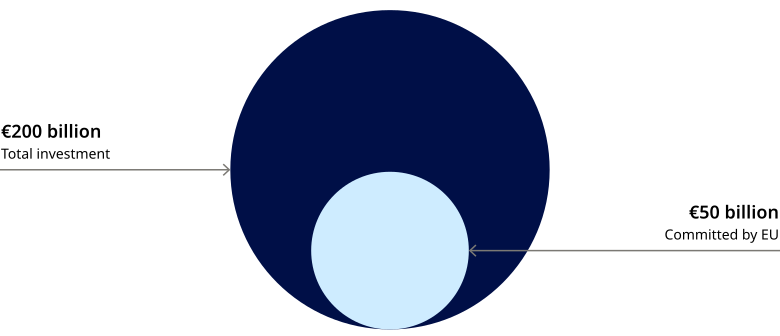
In a recent example of this evolution, in 2025, European Commission President Ursula von der Leyen launched the InvestAI initiative to mobilize €200 billion in AI investments, including a new EU fund of €20 billion for AI gigafactories.
Beyond physical infrastructure, companies continue to allocate capital to cloud platforms, AI-enabled software, automation, and advanced analytics embedded across core business processes. While less capital-intensive per-asset than data centers, these investments are recurring and cumulative, adding a growing layer of spending alongside long-lived infrastructure commitments.
Taken together, digital infrastructure and AI represent a durable and expanding claim on corporate capital necessary to compete in global markets.
Supply-chain transformation expands capital needs across industries
Finally, supply chain transformation has become a lasting investment priority for European companies. Since 2020, firms have increased capital deployment into manufacturing capacity, logistics infrastructure, and inventory buffers as responses to supply disruptions and dependency risks.
This shift is broad-based: According to Eurostat, between 2021 and 2023, around 80% of EU enterprises reported experiencing supply chain disruptions or actively reorganizing their supply chains, with nearly half facing shortages of raw materials, intermediate inputs, or finished goods.
These pressures have translated into sustained investment in supplier diversification, process digitalization, and reconfiguration of logistics networks. At the macro level, manufacturing investment has stabilized and regained momentum across the EU since 2021, signaling a renewed focus on physical and industrial assets after years of relative underinvestment.
These investments are typically medium- to long-cycle and capital-intensive. Their primary economic role is to safeguard operational continuity and resilience rather than to generate rapid returns, making them durable and often non-discretionary balance-sheet commitments.
Europe’s higher cost of capital raises the bar for new investment
The cost of capital is stabilizing at a higher level, with the ECB’s 10-year bond yield curve 50 to 80 bps higher in 2026 than three years ago, as markets reprice the long end of the yield curve to reflect persistent inflation uncertainty and fiscal and geopolitical risk, while the ECB reduces its balance sheet through quantitative tightening.
In an environment where the cost of capital is higher, CFOs must allocate capital efficiently and carefully price risk in investments’ hurdle rates.
Why CFOs are central to driving large-scale corporate transformation
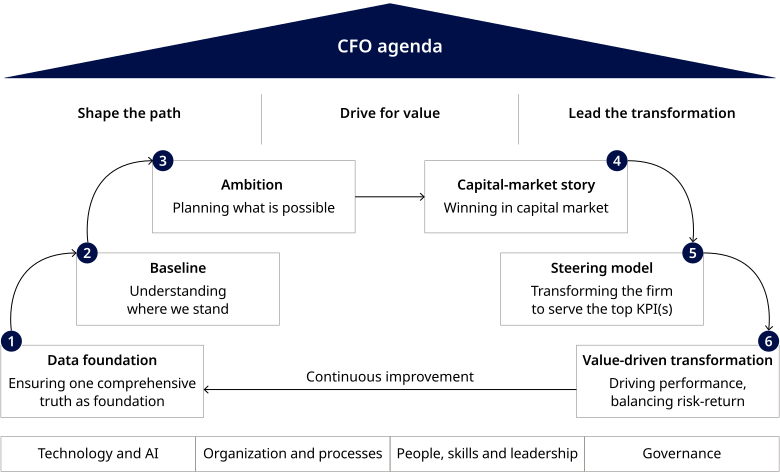
With investment demands expanding simultaneously, sustained pressure is placed on execution capacity, cash generation, and balance-sheet resilience. The result is an expansion of the CFO role well beyond pure financial stewardship: CFOs are increasingly expected to act as strategic architects, ensuring financial coherence across the corporate transformation agenda. We’ve captured this evolution in a framework that structures the CFO mandate around three closely connected dimensions.
Shape the path
Shape the path focuses on creating clarity before commitment. In a volatile, data-intensive environment, CFOs play a central role in securing a trusted data foundation across financial, operational, and environmental dimensions, enabling more dynamic planning, sharper performance insight, and a shared baseline for informed trade-offs.
Drive for value
Drive for value translates ambition into performance. As investment priorities broaden, CFOs steer the organization toward the most impactful efficiency, productivity, and cash-generation levers, while actively managing risk and ensuring a coherent capital market story that aligns with strategy, performance, and execution credibility.
Lead the transformation
Lead the transformation to extend the CFO’s role across both the CFO department and the wider organization. With multiple initiatives running in parallel, CFOs orchestrate execution at scale, sequencing priorities, embedding discipline into delivery, and ensuring that long-dated investments translate into sustainable value.
Together, these dimensions reflect a structural shift in the CFO mandate: CFOs increasingly bear the responsibility of steering corporate strategy to unlock value and achieve long-term ambition within financial capacity.
Taken together, these shifts mark a structural redefinition of the CFO mandate. As investment demands multiply and the cost of capital remains elevated, financial leadership is no longer about optimizing individual programs but about orchestrating coherence across the entire transformation agenda.
CFOs who can shape the path with data-driven clarity, drive value through disciplined capital allocation, and lead execution at scale will determine whether long-dated investments translate into sustainable performance. In a capital-intensive Europe, the CFO has become the ultimate integrator of strategy, execution, and financial resilience.