



Washington has given full-throated support to digital assets like stablecoins, creating the potential for widespread adoption in the years ahead. The question now is what threat they might pose to banks — and how banks and regulators around the world will respond.
Stablecoins are privately issued blockchain tokens designed to maintain a stable value relative to a reference asset, usually the US dollar. The GENIUS Act signed by President Trump in July 2025 creates a regulatory framework that could drive significant adoption. While the legislation prevents stablecoin issuers from paying interest to holders, it does not prevent other parties from offering “rewards” to holders, making them competitive with bank deposits.
The response from central banks and regulators worldwide has varied widely. Some countries, like China, have implemented outright bans, while others have chosen to compete by launching their own central bank digital currencies. Meanwhile, some jurisdictions have opted to adapt and integrate stablecoins into their financial systems — in the UK and Japan, regulators are starting to include stablecoins in their regulatory frameworks. The decisions made by each jurisdiction depend on many factors, including legal authority, supervisory capacity, market structure, and geopolitical alignment.
Within the US, some see stablecoins as a momentous threat to banks. Ronit Ghose, the global head of the Future of Finance think tank at Citi Research, has suggested that the allure of interest-like payments could trigger a flight from bank deposits similar to the shift toward money market funds in the 1980s. Others are more sanguine, however. Federal Reserve Board of Governors member Stephen Miran, for example, has suggested there is little risk of a mass exodus from the domestic banking system.
A likely scenario is a mixed bag in which stablecoins grow substantially in the years ahead, putting pressure on bank funding and payment fees, but also providing banks with substantial revenue opportunities via blockchain transaction, conversion, and foreign exchange fees.
While it is still early, market activity and regulatory developments this year are likely to provide meaningful signs of the shape of things to come — and banks need to read the cues closely.
How stablecoins could reshape bank economics by 2030
Access to stablecoins is poised to grow rapidly. Consumers increasingly are able to use them at the point of sale and online, while corporations have access to stablecoin integrations in the systems they use for resource planning and treasury management. In use cases like cross-border payments, treasury, and trade finance, stablecoins provide customers with always-on liquidity, instant payment, and programmability.
The good news for banks is that nothing is imminent. Even if stablecoin supply were to reach Citigroup’s bullish scenario of $4 trillion by 2030, total supply would remain small compared with the more than $72 trillion in projected global commercial deposits (excluding China).
But even if banks defend the lion’s share of their deposits, stablecoins could have a material impact on the cost of funds and payment fees. Beyond deposit substitution, the manner of adoption of stablecoins and adjacent technologies could have a profound effect on banking economics and the competitive landscape of the financial system.
We have assessed Citi’s three scenarios for the 2030 stablecoin market and found material effects on both bank costs and revenues across all three. On the cost side, a shift of funds from deposits into stablecoins raises funding costs, and the migration of cross-border payments to stablecoins reduces fee income. At the same time, banks can capture new revenues on stablecoin redemptions, including exchange-related redemptions.


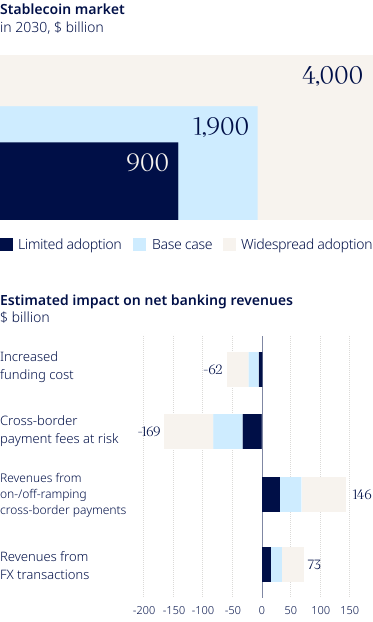
If there’s a short-term threat to banks, it isn’t disintermediation but rather fragmentation. The proliferation of blockchains, digital asset types, and issuers — from bank tokens to stablecoins to tokenized money market funds and central bank digital currencies — is poised to threaten banks’ historical role at the center of client liquidity. Some banks will struggle to participate at all, given the state of their legacy systems.
Questions shaping the impact of stablecoins on banking
As banks and other institutions navigate this rapidly changing landscape, the answers to several open questions will determine the path forward.
Will regulators allow stablecoin holders to receive interest?
Banks are pushing Congress to tighten bans on stablecoin interest. If they succeed, that is likely to dampen the pace of stablecoin adoption in the short term, though longer-term swaps to blockchain-based money funds could emerge as substitutes. Politicians could feel pressure from crypto-industry advertisements arguing that consumers are blocked from earning returns on their assets to protect banks.
Will bank customers adopt stablecoins as deposit substitutes?
Many financial, technology, and commercial entities are exploring stablecoins as a means of capturing a share of bank revenue pools generated by corporate operations. Leading banks are working on product offerings like tokenized deposits and tokenized money funds that meet these demands. Other banks are hoping regulators will take steps that limit the risk of disintermediation, such as requiring more reserves to be held in bank deposits (like in Europe) or limiting the amount of stablecoins that can be held in a wallet (like in the UK). These policy and market dynamics will determine whether banks will have to compete for their corporate customers.
What do stablecoins mean for finance outside the US?
Blockchains operate globally, but policymakers can regulate only those people and companies in their jurisdiction. Some US policymakers see stablecoin growth as a way to increase demand for Treasuries and advocate for stablecoins as a means of meeting the global demand for dollars.
Policymakers in other jurisdictions are strategizing how to protect their monetary, economic, and financial stability objectives. Financial hubs face the additional challenge of how to structure regulations to preserve the prominent role of their markets and institutions. The degree of trust in society, and which institutions are trusted, could determine the prominence of different forms of money in the future.
While US banks must compete against US dollar stablecoin issuers, the stablecoin and tokenized deposit field is still open for banks in many other jurisdictions. The opportunity is ripe for major banks in Europe and Asia to win meaningful liquidity from competitors that are slower to adapt. Speed to market and scale to achieve network effects are likely to be important to achieving lift-off.
Which business lines are most exposed to competition from stablecoin issuers?
Banks are still the center of the financial system, and the best commercial offerings are still as good as, or better than, what is on offer from stablecoins. But stablecoins are making significant inroads in particular markets with strong use cases. Tokenized solutions for cross-border settlement and foreign exchange have grown fourfold year-over-year. Fintech, bank, and core management software wallets will likely converge for next-generation corporate treasury services. A dynamic to watch is whether regulators allow stablecoin issuers privileges historically reserved only for banks, like direct payment system access.
What success looks like in the stablecoin future
We believe these dynamics point to a future with many winners in the stablecoin race, where multiple forms of tokenized money coexist. In this world, banks aren’t disintermediated but instead must compete and collaborate across a more complex ecosystem of issuers and infrastructures to avoid being left behind.
The winners will be the organizations that conceal the complex systems behind the scenes to deliver a clean customer experience that seamlessly bridges traditional and decentralized finance. While software-focused companies are moving fast, banks still have real advantages in trust, distribution, and credit in the battle for the future of money.
This article is part of our Known Unknowns report, highlighting the debates that will shape the future of financial services in the age of AI.