



Are today’s lofty market valuations, massive capital expenditures, and historic economic concentrations justified by artificial intelligence’s potential as a breakthrough technology? Or has AI become a bubble that’s about to burst? Financial institutions can't afford to wait for a definitive answer to this question.
Valuations of the so-called magnificent seven tech titans (Apple, Microsoft, Amazon, Alphabet, Meta, Nvidia, and Tesla), fueled by AI, have increased nearly eightfold (in total return) since January 2020, according to our analysis of market data, while the rest of the S&P 500 hasn’t even doubled. And although historical comparisons aren’t perfect, today’s magnificent seven market value is 35% of the S&P 500 — the same degree of concentration in the top seven as at the peak of the dot-com bubble.
Meanwhile, the funding needs for AI investment remain enormous. JP Morgan estimates that more than $6 trillion in funding will be required between now and 2030 for the development of AI-related data centers, energy projects, and the AI supply chain. An increasing share of this investment is debt-financed, much of it in off-balance-sheet vehicles remote from cash-rich tech titans.
The investment super-cycle, in turn, is having a profound impact on the real economy. Harvard economist Jason Furman estimates that AI-driven infrastructure investment accounted for 92% of US GDP growth in the first half of 2025.
In short, financial markets and the real economy are increasingly a naked bet on the future of AI. The question for banks and other financial institutions isn’t whether the AI bubble will burst, but what happens if it does.
Two ways the AI bubble could burst
Two bubble-bursting scenarios can help frame the likely paths of an AI market collapse: an equity scenario, and a hybrid scenario turbocharged by debt.
In an equity downturn, investor sentiment pops the valuation bubble
In an equity scenario, a sudden shift in investor expectations would deflate the sky-high valuations of hyperscalers and other AI-related stocks, triggering a market-wide correction. The wider the AI-induced contagion, the steeper the decline across broad equity indices.
The stakes for the economy are high. US equity market capitalization has been on an inexorable climb since 2009 and is currently nearly twice GDP — much higher than it was at the peak of the dot-com bubble.
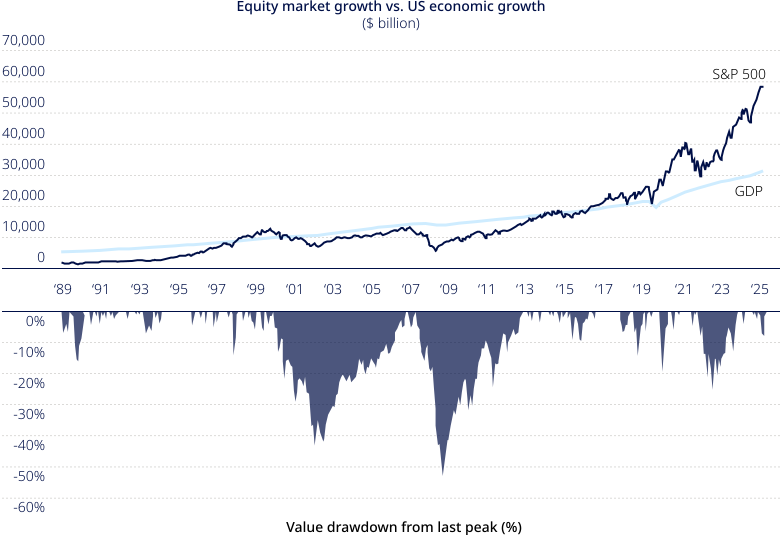
Any major market correction can be expected to lead to serious macroeconomic repercussions: a reduction in business investment (especially for AI-related capital spending, which is already driving much of GDP growth), a wealth dragon consumption, a spike in unemployment, and an inevitable recession. The wealth effect is likely to be substantial. Stock ownership across US households is at record highs, accounting for 30% of total wealth in 2024 — and that was before the 2025 run-up.
If this scenario sounds familiar, that’s because we lived through an equity scenario in the aftermath of the dot-com bubble.
Following the 1990s boom, the NASDAQ Composite crashed by nearly 80% from its high in March 2000 to the low point in October 2002, with the S&P 500 falling by 50%. The equity market downturn wiped out almost $6 trillion of equity valuation — 60% of GDP. The economy was knocked into recession, with the unemployment rate peaking at 6.3%. It took 47 months for unemployment to return to previous levels, and seven years for the S&P 500 to recover its lost value.
Adding debt to the equation makes a bad situation worse
A debt scenario would be fueled by credit financing for AI-related capital spending. The more leverage, the more fuel, the hotter the fire.
In a serious AI downturn, the dependence on debt financing could lead to a wave of AI-related credit defaults. The large scale of AI projects makes AI debt concentrated, lumpy, and vulnerable to idiosyncratic risks.
Of course, we’ve lived through an extreme debt crisis in recent years. The Global Financial Crisis, with roots in credit outside the banking system, morphed into the worst systemic threat since the Great Depression. Opaque linkages and interdependencies acted as a transmission mechanism between nonbank mortgage originators, packagers, distributors, insurers, and the core banking system. The credit contagion led to the collapse of nearly 500 banks from 2008 through 2013, resulting in the most severe recession in 80 years.
Financial consequences of an AI-led market collapse
Both scenarios suggest the consequences of an AI-led market collapse would be severe. At today’s valuations, an equity crash like the early 2000s would wipe out approximately $33 trillion of value — more than US GDP. The loss of investor confidence would inevitably lead to delays and cutbacks in AI capital investment, compounding the drag on GDP. This combined effect could send the economy into a significant recession.
There are signs the damage might not be confined to an equity downturn. Given the enormous scale of AI-driven investment, the financing of AI capital spending is shifting from free cash flow to credit. If half of the $6 trillion of projected AI capital spending between now and 2030 is debt-financed, this would lead to a credit buildup that exceeds all broadband infrastructure investment since the beginning of the internet. Although the AI debt-issuance boom is still in the initial stages, bond issuance by hyperscalers totaled more than $100 billion in the last six months, more than five times that of the prior two years.
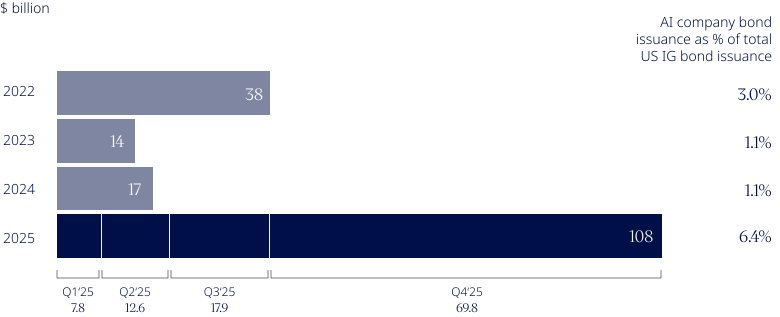
Spreads on these bonds are already widening (by as many as 40 basis points relative to investment-grade bonds since September), potentially an early sign of investor discomfort with the sector’s credit concentration.
Over $1 trillion of the AI debt is expected to come from private credit, a substantial increase on top of the approximately $3 trillion of global private credit outstandings. Recent deals, such as Meta’s $27.2 billion data center financing with Blue Owl, have combined aspects of multiple debt markets (for example, asset-backed securities, commercial mortgage-backed securities, investment-grade debt) in off-balance-sheet structures.
In 2008, banks discovered they owned far more US housing risk than their internal reports suggested. They might soon discover the same about data-center and digital infrastructure risk — only this time, exposures are spread across corporate, real estate, infrastructure, fund financing, and alternative credit books.
A more moderate path is possible, avoiding a full financial market crash
The current run-up in equity valuations has yet to reach the extreme levels of the dot-com bubble. Letting air out of the AI balloon may not necessarily lead to a broader market rout or trigger severe wealth effects. In addition, some AI debt will continue to be financed (or backstopped) through direct issuance by the cash-rich tech titans, which, so far, have been able to support greater leverage.
However, geopolitical instability, supply chain risks, deregulation, and record public debt issuance could compound the severity of an AI downturn. Assuming a benign external environment is a lot to bank on. There is little room for complacency.
Forewarned is forearmed
While either scenario would bring severe consequences for the financial services sector, firms can start taking proactive measures to forearm themselves against a potential burst. Lessons from past crises can help prepare for the future.
Banks and other financial institutions should be conducting rigorous scenario analysis under both the equity and debt scenarios. They should assess the risks of a 30%, 40%, or 50% drop in equities and the vulnerability of their businesses to recession. Most important, they need to make sure they have a complete picture of their exposure to AI, both direct and indirect. They need to know when to pull back on lending to exposed names and sectors.
Counterparties should be laser-focused on interdependencies and hidden concentrations among tech firms, off-balance-sheet vehicles, and private credit providers. Firms that act early to execute hedges and diversify portfolios will be best positioned to weather the storm.
It remains unclear when — or whether — this storm might come to pass. But the longer these equity and debt pressures build, the likelier the chance of a downturn. And this time, given all the warning signs, banks shouldn’t be caught off guard.
This article is part of our Known Unknowns report, highlighting the debates that will shape the future of financial services in the age of AI.