



The biggest commercial threat pharmaceutical companies are likely to face over the next decade won't be competitors launching better drugs. It may come from large technology companies — whether global giants new to pharmaceuticals or existing physician-focused platforms. By becoming the platforms that physicians rely on for information and decision-making, these companies could fundamentally displace pharma from the physician's information environment without ever competing directly.
Over the past decade, pharmaceutical companies have invested heavily in omnichannel capabilities — digital channels, next-best-action engines, customer data platforms, and redesigned field force models. They have also tried to be more focused. While these investments have improved commercial effectiveness, it will not be enough. In the future, the winners will not be companies that orchestrate the most channels. The winners will be companies that health care practitioners (HCPs) consider an indispensable part of their daily workflow.
Why pharma’s traditional engagement model is reaching its limits
Despite substantial investment, physicians continue to report fragmented interactions, inconsistent experiences across functions, and information overload. A global survey of more than 6,000 physicians across 13 countries found a significant decline in the overall quality of pharma-physician interactions, measured across trust, relevance, and simplicity. The fundamental constraint is no longer HCP access. It is relevance.
Physician use of AI increased from 38% in 2023 to 66% in 2024 — one of the fastest rates of technology adoption observed in healthcare. More recent data shows more than four in five physicians now use AI in their practices, with 76% reporting it gives them an advantage in patient care.
A 2026 survey of more than 3,000 physicians across 15 specialties found 94% are currently using AI or are actively interested in doing so. As physicians increasingly rely on AI to summarize research and synthesize evidence, the traditional assumption that healthcare professionals will actively navigate impersonal pharmaceutical channels becomes increasingly uncertain.
The next generation of commercial excellence will not be achieved by increasing touchpoints. It will be achieved by creating value within the moments that matter most.
Why omnichannel engagement with physicians is no longer enough
Most organizations recognize that HCPs expect personalized experiences. Hybrid engagement is now the norm, and the representative's role is evolving. These shifts are real and important. Yet they share a common assumption: Pharmaceutical companies remain at the center of the engagement model and simply become more sophisticated in how they manage interactions.
As physicians become more digitally enabled, more time constrained, and more reliant on technology to manage growing complexity, they will gravitate toward integrated environments that simplify their professional lives. The strategic challenge therefore shifts from optimizing engagement to securing relevance within the physician's broader ecosystem.
The rise of the physician operating system
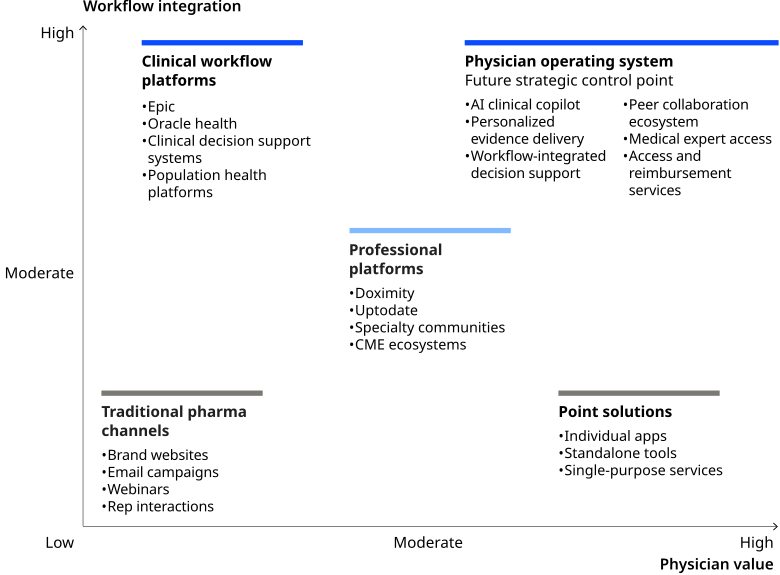
The most important commercial platform of the next decade may not be a CRM system, a marketing automation platform, or a next-best-action engine. It may be what can best be described as a physician operating system. This integrated digital environment combines AI assistants, clinical decision tools, knowledge platforms, peer networks, and workflow applications through which physicians increasingly learn, decide, and act.
The building blocks already exist. Ambulatory physicians spend an average of 5.8 hours on electronic health records (EHRs) for every eight hours of scheduled patient time. The leading clinical-decision-support platform serves more than 3 million clinicians across more than 190 countries, and its AI-powered version has been adopted by approximately 2,500 US hospitals. The leading physician professional network now reaches more than 85% of US physicians. The question is no longer whether workflow-centric ecosystems will emerge. It is which organizations will control them.
Competitors aren’t limited to other pharma companies
Most pharmaceutical organizations continue to view commercial transformation through the lens of competition with other manufacturers. That assumption may soon become outdated. The organizations best positioned to shape physician behavior over the next decade include EHR providers, clinical decision-support platforms, AI-native healthcare companies, medical knowledge platforms, and technology companies building healthcare copilots.
These platforms aren’t winning because they possess proprietary therapeutic expertise. They’re winning because they are becoming embedded in environments where physicians search for information, interpret evidence, collaborate with peers, and make decisions. Their competitive advantage is not superior scientific expertise. It is workflow ownership.
What makes this threat distinctive is that AI underpinning these platforms has no inherent incentive to surface pharmaceutical-driven content. If AI platforms curate information on the basis of clinical objectivity and workflow efficiency, pharma content risks being filtered, summarized, or simply deprioritized. This is not due to regulatory restriction but because it is not part of the physician's trusted digital environment. This is a new form of structural disintermediation.
AI is becoming the primary gateway to scientific information for physicians
Perhaps the most profound shift underway is the emergence of AI as the primary interface between physicians and information. Rather than searching for information, physicians will request answers. Rather than navigating content, they will engage through conversation.
When a physician asks, "What are the most appropriate treatment options for this patient?," the AI assistant may become the primary interpreter of scientific evidence. As a result, pharmaceutical companies face a new strategic challenge: How does scientific information remain discoverable, trusted, and influential when AI becomes the primary intermediary?
Historically, pharmaceutical organizations focused on rep access, conference visibility, website traffic, and search rankings. Increasingly, they will need to focus on AI discoverability, AI citation frequency, content interoperability, and scientific trustworthiness. The winners may not be those that deliver the most messages. The winners will have evidence that is effectively understood, trusted, and surfaced by AI.
Three priorities for pharma to stay relevant in an AI-driven world
To remain relevant as AI reshapes physician engagement, pharmaceutical companies should focus on three strategic priorities.
1. Secure a position inside physician workflows. The strategic objective should no longer be driving physicians toward proprietary channels. It should be the opposite — bringing value directly into the environments where physicians already work. Organizations that remain outside physician workflows risk becoming increasingly invisible, regardless of the sophistication of their omnichannel capabilities.
2. Build an AI distribution strategy. As AI becomes a primary interface for information discovery, pharmaceutical companies must ensure their scientific content is discoverable, interpretable, and trusted by AI systems. Early movers are already conducting "AI audits" of their medical affairs content, restructuring clinical data packages for interoperability, and engaging directly with platforms to ensure their evidence is accurately represented. This is not a future capability. It is a present-day commercial imperative.
3. Shift investment from attention to utility. Organizations should evaluate every engagement initiative through a simple lens: Does this create measurable professional utility? Promotion becomes the outcome of value creation rather than the objective itself.
The next frontier of pharma commercial engagement
The larger opportunity is not to make today's commercial model more efficient. It is to build a fundamentally different one — in which physicians operate within trusted digital ecosystems, AI assistants become primary interfaces for information discovery, and service and utility matter more than promotion.
For decades, the industry competed to influence physician decisions. The next competition will be for influence over the systems that shape those decisions. The winners will not be those with the most channels. They will be the ones physicians cannot imagine practicing without.
