


Healthcare has been on the verge of a major transformation for as long as most people can remember. Every year, someone steps onto a conference stage and warns the audience that costs are unsustainable, the workforce is stretched too thin, and that we have to act immediately.
Chris Schrader, a partner at Oliver Wyman, wants to have a different conversation entirely. It’s not that the healthcare system is broken and needs fixing (sometimes trying to fix what is broken triggers new problems). Rather, the entire foundation upon which healthcare was built is shifting below the surface.
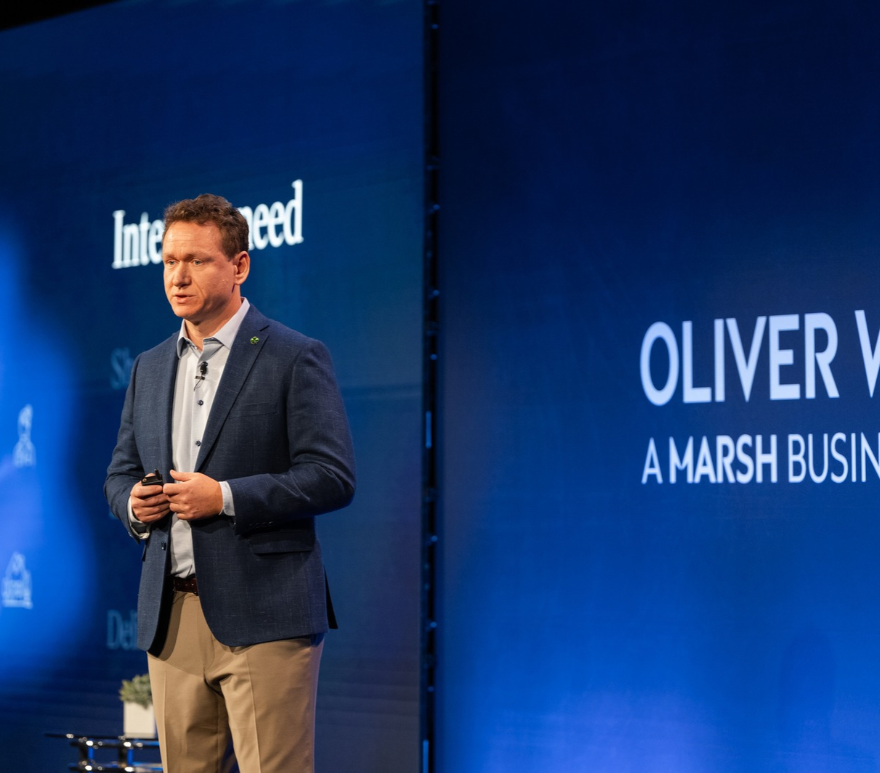
During a keynote presentation at the Oliver Wyman Health Innovation Summit 2026, Schrader described four major shifts in healthcare that will take place regardless of what industry stakeholders do. “That should feel, hopefully, like an opportunity, not a crisis,” he told attendees.
Shift one — AI moves to the front of the healthcare journey
The healthcare industry has invested significant resources to make it easier for people to enter and navigate the system (for example, patient portals, walk-in clinics, and retail care locations). But something more fundamental is underway today. About two-thirds of people with health questions are turning to AI tools — such as ChatGPT or Claude — for answers. This means key conversations about whether care is needed might not take place in a healthcare setting or even over the phone with a clinician. What are the implications? Like a clinician, AI-powered tools can identify and interpret symptoms, ask follow-up questions, and assess urgency. They can also guide people in the next steps, such as whether to seek care, how soon, and from whom. About 80% of people who consult AI about their health take some action as a result, while around 20% decide not to see a clinician they would otherwise have visited.
As these tools become more sophisticated and capable, they will go beyond just offering advice. They will act, and consumers will no longer need to navigate the complex healthcare system alone. Powered by agentic AI, these interfaces will automatically book appointments, renew prescriptions, check insurance benefits, and follow up on care compliance. For health plans and health systems, the most formidable competitor in the future could be an organization that was not part of the health ecosystem a few years ago.
Shift two — Healthcare system embeds clinical expertise at every step
Healthcare has historically been organized around clinical expertise — knowledge acquired by clinicians over years of training and experience. That model is evolving. Evidence-based guidelines are moving out of textbooks and into the workflow, surfacing automatically at the point of care. Clinical pathways will drive treatment decisions in real time, personalized to each patient's history and circumstances.
This does not mean clinicians will become less important. It means that their roles are changing. When clinical expertise is embedded in the system, patients will rely on clinicians for their experience, judgment, and decision-making in complex situations. This could help patients and clinicians build a deeper level of trust rooted in human relationships.
Shift three — AI transforms how healthcare detects health risks
 The pathway no longer ends when the encounter does. It can follow the person. It can see what happens next. It can learn and determine and steer. That continuous connection is what makes moving care upstream possible at scaleChris Schrader, Partner, Oliver Wyman
Prevention of disease has always been a goal in health care, but it is not a great economic model. AI is helping to change that by reducing the cost of sensing risk, personalizing outreach, and acting before a conventional clinical event occurs. Eye scans, for example, can reveal signs of cardiovascular disease long before symptoms develop. An analysis of how someone walks, the sound of their voice, or their facial expressions can indicate neurological and metabolic conditions years before a symptom surfaces. AI models are already forecasting individual health trajectories across thousands of diseases.
Schrader described “Dave,” a hypothetical 58-year-old man drifting toward heart failure without knowing it. In the traditional healthcare model, Dave would eventually show up in an emergency department after years of slow and steady decline and hundreds of thousands of dollars in downstream costs. Through continuous intervention, AI could reduce the need for such reactive, episodic care. AI-enabled wearable devices and sensors could continuously track patterns across Dave’s daily life, identifying changes in sleep, exercise, and other lifestyle behaviors. By combining this data with his clinical history, AI could detect emerging risks before they become acute. Once a risk is identified, an AI agent could determine an appropriate intervention and help ensure that it is implemented. In this scenario, the emergency room visit isn’t needed, and the patient gets more years of good health.
The system can sense risk earlier, predict trajectories, intervene sooner, and prevent some expensive episodes from forming at all.
Shift four — Healthcare economics shift with new models of care
According to Schrader, when care changes fundamentally, so too do the economics. This shift is much broader than the cost of care. Care is endlessly variable. Every patient and every encounter is a little bit different. Clinicians typically document every procedure so they can be appropriately compensated. Current Procedural Terminology (CPT) codes and Diagnosis Related Group (DRG) codes were created to help with that documentation. But AI can be used by health plans to challenge clinical decisions and bills. The medical record, once a straightforward account of care, is becoming more of a negotiating document.
While AI is already leading to faster diagnoses, greater clinical capacity, and fewer people needed to handle prior authorizations and other back-office tasks, prices have not yet reflected those changes. New payment models built around fixed-pathway pricing, subscriptions, and upfront agreements are likely to replace the current billing system.
That should give you a sense of how much value is up for grabs as all the activities around us change. A lot of this can feel like everything is changing all at once. Don't try to solve the whole thing. Choose something you're excited about. Pick an action that you're going to start doing next weekChris Schrader, Partner, Oliver Wyman
Healthcare’s next shift puts trillions of dollars in play
These four shifts Schrader outlined do not happen in isolation. They reinforce each other. A smarter front door becomes more powerful when clinical expertise is embedded behind it. Embedded knowledge becomes more powerful when the system stays connected to the patient over time. Continuous connection makes upstream intervention possible. And when that changes, the economics have to change, too.
Schrader estimates that roughly $1 trillion dollars in healthcare spending sits downstream of initial patient interactions. That's directly tied to the new front door. Another $3 trillion is tied to clinical judgment, and $1 trillion more is attributable to health risks that could be modified.