


The global pharmaceutical industry is entering the second half of the decade with strong scientific momentum, even as structural pressures intensify. Worldwide prescription drug sales are projected to exceed $1.7 trillion by 2030, fueled by continued advances in oncology, immunology, metabolic disease, and rare conditions.
Momentum is especially strong in the newest therapeutic modalities, which are advancing at a remarkable pace. Antibody drug conjugates are growing at over 20% annually, RNA therapeutic pipelines have expanded more than twofold since 2018, and biologics now account for more than half of global prescription medicine revenues.
While these trends signal a period of tremendous opportunity for the industry, the geopolitical and economic environment is becoming more complex. Pricing frameworks are tightening at a global level with the highest pressure in the industrialized Organization for Economic Co-operation and Development (OECD) countries, as payers introduce new negotiation mechanisms, stricter evidence standards, and reimbursement models linked to outcomes.
Research and development (R&D) productivity is under pressure as costs rise and scientific portfolios expand into more complex modalities that require specialized manufacturing capabilities and greater capital intensity. Supply chains face increasing geopolitical uncertainty, with shifting tariff policies and periodic disruptions that strain the flow of active pharmaceutical ingredients (APIs), intermediates and finished products.
China’s influence on global innovation and clinical development is expanding rapidly. And the industry is approaching a massive patent cliff as branded drugs accounting for nearly $200 billion in annual revenue lost exclusivity by 2029. These dynamics demand a more proactive response from industry leaders. Executives must decide how they will compete in a market where capital, evidence, and supply resilience are under increasing scrutiny. The choices made now will determine who is positioned to lead as the next era of global healthcare takes shape.
Pharmaceutical industry outlook — navigating volatility and competition
We identified four macro trends that are acting as pressure points for the pharmaceutical industry.
Tightening pricing and market access pressure
Pricing pressure is intensifying across major markets. Recent policy changes in the US, including the Inflation Reduction Act, are reshaping expectations by enabling the government to engage in direct price negotiations for a subset of Medicare medicines. Commercial pricing dynamics remain unchanged for now. Additional pressure is emerging from proposed reference-pricing systems that benchmark US prices to a basket of selected OECD countries such as Germany, the UK, and Switzerland (amongs others). In Europe, payers are rethinking evidence requirements and mechanisms, tightening cost-effectiveness thresholds, and expanding budget-impact mechanisms that require manufacturers to return funds when national or therapeutic-area spending caps are exceeded. China continues to exchange price for volume, with national reimbursement drug list and volume-based procurement driving reductions of up to 70%.
Persistent pressure on R&D productivity
Scientific pipelines remain robust, but productivity lags. R&D spending is projected to grow at around 3% annually, compared to more than 7% growth experienced in the previous decade. Advanced modalities require specialized manufacturing capabilities, sophisticated analytics, and higher capital intensity. Academic analysis shows that bringing a new medicine to market often requires over $2 billion in capitalized cost. While artificial intelligence (AI) promises to streamline development by improving trial design, predicting enrolment bottlenecks, reducing protocol amendments, and automating parts of data analysis, its impact is limited by fragmented data systems and inconsistent adoption across organizations. Additionally, China is offering greater clinical expertise and expanded investment opportunities in fast, state-of-the-art clinical Phase I and II trials.
Geopolitical volatility and supply chain fragility
Geopolitical shifts are a structural risk for supply chains. Although they continue to evolve, policy scenarios indicate that cross-border pharmaceutical flows could face tariffs of up to 20%. Meanwhile, logistics disruptions have pushed freight costs to over 300% above historical levels during periods of stress. Shortages of intermediates, regulatory delays, and rising concentration risk in API sourcing expose the fragility of highly globalized networks. Companies must now operate in a world where supply chain resilience is as critical as efficiency.
China’s expanding innovation impact
Over the past five years, China launched more than 200 novel active substances, representing an increase of about 60% compared with the prior period. China now accounts for 30% of global clinical trial activity, benefiting from large patient pools and rapid recruitment timelines. Its innovative ecosystem is increasingly influencing global pipelines and reshaping multinational partnership strategies.
Five strategic imperatives for the next era in global pharma
Keeping pace with these trends won’t be enough to maintain competitiveness. Industry leaders need to embark on a strategy that gets ahead of the curve. Here we outline five key areas for leaders to tackle.
1. Reinvent pricing and access for a constrained global environment
Elevate pricing and access into a core strategic discipline that is closely tied to launch strategies. Evidence generation must begin earlier and align with evolving health technology assessment (HTA) expectations. Organizations need stronger analytical insight into how pricing decisions, contracting approaches, and value messages translate across markets under increasing pressure around affordability. Integrated governance between global and local teams is essential to maintain clarity, consistency, and pricing power. Scenario planning for shifting US and EU policy frameworks must be embedded into lifecycle strategy so teams can anticipate pressure points, assess implications, and prepare negotiations proactively.
2. Strengthen R&D through better integration and flexible, future-ready manufacturing
R&D must operate with greater integration and discipline. Scientific, clinical, regulatory, and commercial teams need to collaborate earlier to shape development strategies and evidence plans. Companies must also build manufacturing flexibility so sites can accommodate different modalities — ranging from small molecules to biologics, antibody–drug conjugates (ADCs), and RNA therapies — without treating the choice of modality as a strategic R&D decision. AI and advanced analytics should be embedded across trial design, monitoring, and operations. For example, to optimize protocols, predict enrolment and site performance, and streamline data analysis, rather than used in isolated pilots. As development becomes more complex and capital intensive, external innovation must also play a broader role in sustaining portfolio strength.
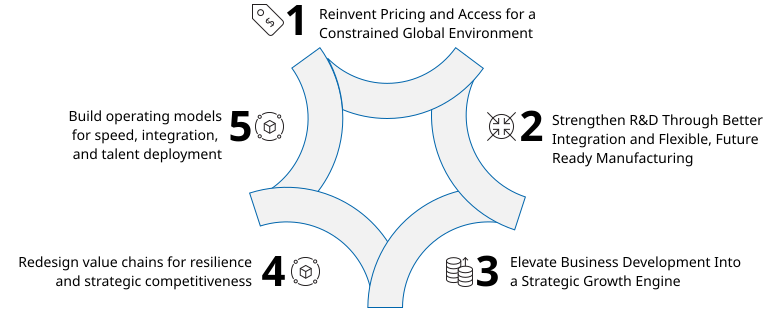
3. Elevate business development into a strategic growth engine
Business development requires greater rigor and must evolve into a faster, more technically anchored, and globally oriented growth driver. Companies need to rethink where to play and how to win by proactively partnering with emerging biotech hubs, academic ecosystems, and innovators with roots in China. Due diligence needs to accelerate and be more technically anchored, and deal structures should be more flexible to reflect modality-specific requirements. The most successful organizations will treat business development as a core strategic capability on par with internal R&D. At the same time, IT must enforce commercial consequence by supporting entry into selected therapeutic areas with a clear and defensible reason to win.
4. Redesign value chains for resilience and strategic competitiveness
Supply networks must be engineered for resilience as much as for efficiency. Diversifying API and intermediate sourcing, strengthening supplier partnerships, and exploring selective nearshoring will be essential to protect continuity of supply. Companies should invest in digital visibility tools that allow real-time monitoring, risk detection, and scenario planning. Resilient networks will safeguard revenue, enable sustainable growth (incl. blockbusters), protect quality, and offer a competitive edge in markets where reliability is increasingly valued.
5. Build operating models for speed, integration, and talent deployment
Operating models must reflect the importance of countries for top- and bottom-line impact, while enabling faster, more integrated decision-making. Clearer governance, stronger global-local alignment, and improved cross-functional collaboration are essential as portfolios and evidence requirements grow more complex. Talent strategies should prioritize expertise in advanced modalities, digital competencies, and data-driven decision-making. Automation across regulatory, quality, and operational workflows will be critical to unlocking speed and reducing friction, and achieving higher levels of efficiency and effectiveness across the organization.
The pressures facing the industry are not temporary. They mark a structural change in how innovation is funded, evaluated, and delivered. Companies that move first to confront trade-offs directly, reallocate resources, and build capabilities that turn uncertainty into a source of differentiation will gain the advantage.