



Healthcare executives are exhausted. They’ve spent years deploying vendor solution after vendor solution, each promising greater efficiency, cost savings, or improved quality. Yet the proliferation of point solutions has often produced the opposite effect: increased fragmentation, more operational complexity, and limited enterprise-wide return.
By some estimates, inefficiencies resulting from information technology (IT) system downtime, poor interoperability, and weak integration across the care continuum cost the industry nearly $8 billion annually. As margin pressure tightens for payers and providers, and debate around affordability intensifies, there’s an appetite for solutions that streamline and unify operations.
Against this backdrop, we believe investors in 2026 will gravitate toward assets designed to connect disparate parts of the healthcare ecosystem and unlock net new value creation. Four areas stand out as likely beneficiaries of this shift: provider IT, commercial market services, payer services, and pharmacy services.
Provider health IT: From documentation to decision advantage
Revenue cycle management and AI: Revenue cycle management is evolving from a back-office function into a strategic capability, driven by deeper adoption of artificial intelligence (AI) across payer and provider workflows, with total value of AI in the healthcare market expected to eclipse $200 billion by 2030. That includes embedding AI further upstream in clinical encounters. Consider ambient listening: What began as a passive recording and transcribing service has become an integral part of clinical decision making. Today, ambient listening powered by AI can capture structured data and generate clinical notes, orders, and diagnostic codes in real time. We expect ambient listening to grow at a 25% to 35% compound annual growth rate (CAGR) between now and 2030.
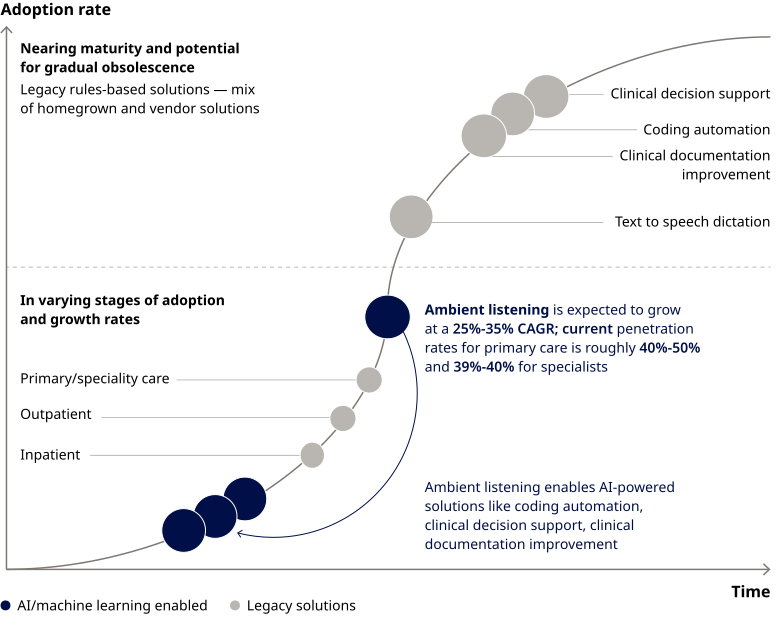
When advanced technology is used earlier in the care journey, it has a larger impact downstream. More accurate and consistent clinical documentation can reduce friction around prior authorization, improve billing accuracy, and limit avoidable claims denials. This doesn’t mean that AI is the silver bullet. Payers and providers still need to improve collaboration and align reimbursement policies. Organizations also need to bolster their quality assurance programs to ensure AI-driven outputs are validated and defensible.
For investors, the opportunity is no longer confined to point solutions. Value is concentrating in platforms that integrate ambient listening, AI-powered documentation, and revenue cycle management analytics into end-to-end workflows.
Specialty EHRs: Care delivery is migrating away from traditional inpatient environments toward outpatient clinics, specialty practices, home-based care, and virtual settings. Between 2000 and 2023, inpatient stays declined by 18%, while outpatient utilization increased by 31%. Looking ahead, we estimate that nearly 64% of care could be delivered in the home by 2035.
This migration exposes limitations of electronic health record (EHR) systems designed primarily for hospital-centric workflows. Specialty EHRs are gaining traction by addressing the specific documentation, billing, and regulatory needs of settings such as assisted living, dental practices, fertility clinics, and physical therapy locations.
In assisted living, for instance, EHRs enable better tracking of resident clinical information, incident reporting, and care plan generation. Meanwhile, physical therapy locations benefit from EHRs that ingest patient-generated data from wearables and harness AI to modify treatment plans. These platforms are increasingly important as specialty care becomes intertwined with value-based contracts and data must move freely between providers and payers.
From an investment perspective, specialty EHRs benefit from volume growth in outpatient settings. Platforms that can pair workflow with scalable analytics and payer connectivity are well positioned to capture durable value.
Commercial market services: employers demand ROI
Employer benefits platforms: Faced with ever-rising costs — which are hitting employees, too, via higher deductibles and copays — employers are zeroing in on demonstrable return on investment, operational simplicity, and solutions that address their largest cost drivers.
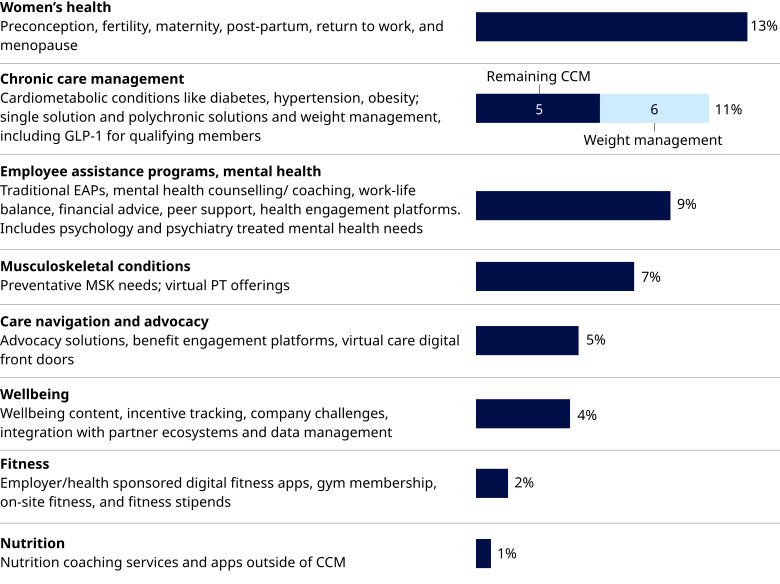
Against those targets, chronic disease management, women’s health, and musculoskeletal (MSK) care stand out as significant markets that have not yet fully matured. Weight management, fueled by the rapid adoption of GLP-1 therapies, has become a primary growth engine within chronic care. We estimate this market will grow at a 10% CAGR through 2029, expanding from approximately $5 billion to $8 billion.
The women’s health market is projected to grow at a 5.7% CAGR, with meaningful opportunity beyond fertility, which has historically been the growth engine. In MSK care, virtual-first and hybrid models continue to demonstrate cost savings through reduced surgical utilization and improved functional outcomes.
As these categories mature, investors are likely to favor platforms that move beyond narrow use cases and integrate into broader benefits ecosystems. Solutions that can scale across employer segments and earn long-term consumer trust will increasingly differentiate themselves.
Alternative and innovative funding models: Rising premiums and volatile risk pools are also prompting employers — particularly small and mid-sized organizations — to rethink how they fund healthcare. Our analysis of National Association of Insurance Commissioners data shows that fully insured plans declined by 26% between 2016 and 2023, with many smaller organizations turning to alternative models like level funding, group captives, and professional employer organizations (PEOs).
As discussed in previous Oliver Wyman Health articles, Individual Coverage Health Reimbursement Arrangements (ICHRAs) are gaining traction as well. While adoption has been concentrated in a limited number of states, broader uptake appears likely. We also estimate that 60% to 70% of small businesses could benefit from level funding models given their potential for cost savings and improved claims transparency.
These shifts create both opportunity and disruption for insurers and service providers. Platforms that help employers navigate funding choices, manage risk, and integrate benefits with care delivery will be best positioned to win.
Payer services: two levers for cost transformation
Containing total cost of care: Payers are contending with several converging trends: increasing utilization, rising drug costs, and chronic disease prevalence. In response, many are deploying a comprehensive suite of solutions that cut across everything from utilization and care management to network optimization, and member engagement.
While some capabilities are being insourced, many plans continue to rely on external partners for speed, specialization, and advanced analytics. The most effective strategies for managing total cost of care combine multiple levers rather than treating them in isolation.
Investment opportunities lie in platforms that can demonstrate measurable impact on medical cost trend while navigating regulatory compliance and operational complexity. As payer margins remain under pressure, demand for scalable, outcome-driven solutions is unlikely to abate.
Payment integrity: Payment integrity is another area that is poised for growth, especially as providers adopt artificial intelligence (AI) to improve revenue cycle management. In fact, we estimate that the total addressable market is between $20 billion and $50 billion. Rather than accelerating the arms race with providers, we believe there are opportunities for greater collaboration, including solutions that operate across the claims lifecycle, from pre-submission guidance to post-payment recovery. The highest return will be for solutions that embed insights into workflows to reduce errors before claims are submitted.
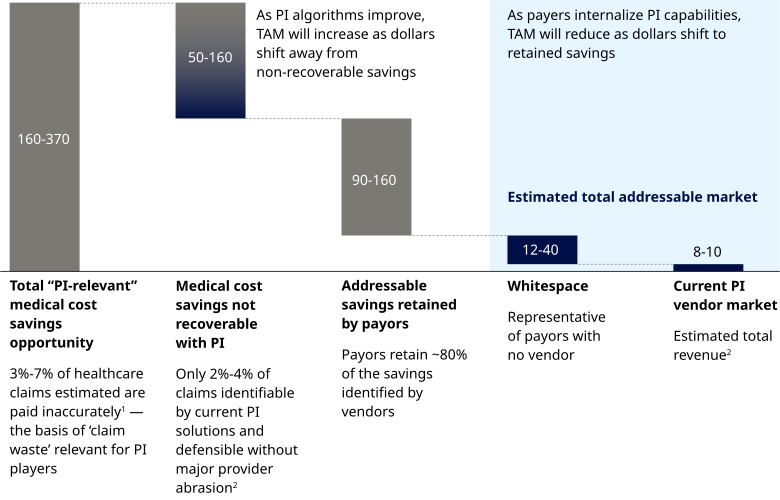
For investors, the most attractive payment integrity assets are those that balance scale with nuance: minimizing provider abrasion, adapting to regulatory scrutiny, and integrating seamlessly with payer operations.
Pharmacy services: evolving PBM and specialty models
New PBM business models: We project that the pharmacy benefit management (PBM) market will be nearly $700 billion by 2030, up from $533 billion in 2022. The sector, which has undergone significant consolidation in recent years, faces constant political and cost pressure. Policymakers are looking at options to increase price transparency among PBMs. At the same time, spending on specialty drugs is increasing.
Traditional PBM models are being challenged by employers and payers seeking clearer alignment between cost control, clinical outcomes, and administrative fees. New models are emerging that emphasize pass-through pricing, tighter clinical integration, and data-driven formulary management. These approaches aim to realign incentives while preserving the negotiating scale and operational capabilities that PBMs provide.
For investors, differentiation will depend on the ability to manage specialty drug economics, support alternative benefit designs, and withstand regulatory scrutiny. Scale remains important, but strategic positioning and trust are becoming equally critical.
Specialty infusion: Specialty infusion is benefiting from tailwinds, including the continued shift of care out of hospitals, the expansion of specialty drug pipelines, and payer efforts to lower site-of-care costs. We project the market will hit $142 billion next year, up from $112 billion in 2023. The most significant leap will be seen in ambulatory infusion centers (AIC), which should grow at a 26% CAGR.
Since infusion services delivered in alternative settings like AICs can be 50% to 70% less expensive than services provided in a hospital, payers are adopting policies that streamline prior authorization and advance reimbursement models to steer patients to lower site-of-care settings.
Infusion therapy is gaining interest from investors, and we expect more opportunities to emerge for roll-ups in an extremely fragmented market. Operators that can deliver consistent quality and cost performance will command premium valuations.