



Whether it’s cloud migration, infrastructure modernization, or new use cases for artificial intelligence (AI), health insurers are spending more on technology. Forrester projects that the US insurance industry overall will boost spending on technology by 7.8% in 2026, representing a $173 billion increase. That’s on top of nearly 8% growth in 2025.
Despite the surge in spending, a hard financial truth remains: administrative costs have not fallen in proportion to technology investments. Administrative costs for health insurers grew from $72 billion in 2014 to $131 billion in 2024, according to the most recent year-end data available from the National Association of Insurance Commissioners. The result is a widening value gap in the administrative loss ratio (ALR), cost per transaction, and operating margin.
The issue facing chief financial officers (CFOs) and chief information officers (CIOs) is how to fund modernization efforts that are necessary to remain competitive without asking the board for more money and, critically, how to turn those dollars into measurable administrative cost improvement.
The answer requires a shift from managing IT as a budget line to managing it as a technology profit and loss (P&L) center, with explicit mechanisms to free trapped capital, improve unit economics quickly, and scale what works and stop doing what doesn’t.
How AI is changing unit economics and exposing operating gaps
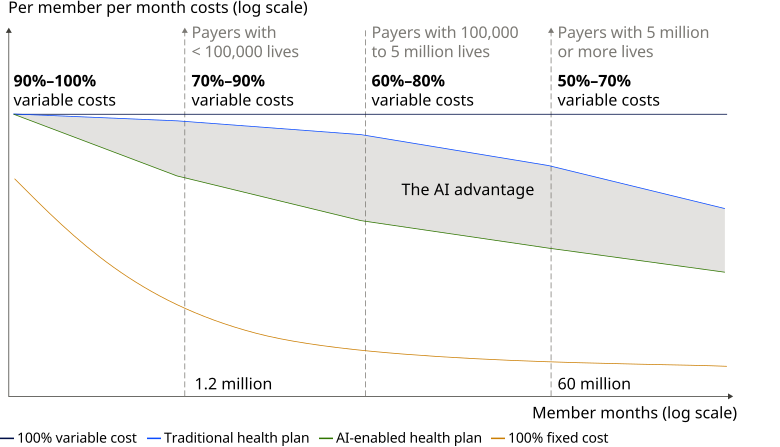
AI and automation are bending the traditional administrative cost curve and altering the competitive landscape for all payers, regardless of size.
In the legacy operating model, achieving administrative scale required growth: more members, more claims, more prior authorizations, more configuration, all managed by more staff. In an AI-enabled model, the marginal cost of handling the next unit of work can fall sharply when workflows and platforms are designed to enable automation to scale. This levels the playing field, making degrees of administrative efficiency previously available only to large national plans accessible to regional plans as well. This shift creates both opportunity and threat:
- The opportunity: AI-enabled payers that redesign their operating model — not just deploy tools — can convert productivity gains into real unit-cost reduction, creating a structural advantage.
- The threat: Plans that industrialize AI can lower their administrative cost base and reprice competitively, compressing margins for everyone else.
The challenge is that most payer organizations are not designed to capture AI’s economics. They can deploy tools, but, like their provider counterparts, struggle to make the surrounding changes to workflows, governance, and talent and end up having a difficult time showing a true return on investment.
Most payers fail to realize bottom-line results because capital, teams, and platforms can’t move fast enough to turn ideas into measurable outcomes. They also continue to fund things that aren’t working well or meeting business needs.
Three common frictions create a liquidity issue:
- The fixed cost problem: When ALR is flat, the organization can’t repeatedly ask for more funding. Capital is frequently locked in multi-year vendor commitments, rigid run teams, and inflexible platforms. The money exists in the portfolio, but it is not movable.
- The maintenance tax: Each year, new code and new capabilities are added, but old systems and processes rarely get retired. The cost to operate, maintain, and repair these assets compounds and consumes budget, leaving little remaining for innovation.
- The reallocation failure: Even when initiatives become obsolete or underperform against their business case, budgets often remain attached to departments and annual plans. Organizations fund activity, not outcomes, and capital stays trapped well past its useful return.
Turning transformation into a self-funding reinvestment engine
Payers don’t need another standalone agile transformation, cost program, or platform modernization roadmap pursued in isolation. Those moves rarely compound into sustained value if done separately.
A better model is an integrated reinvestment engine that continuously converts efficiencies into investable liquidity and directs that capital into the highest-value modernization and AI initiatives — with measured outcomes and P&L accountability.
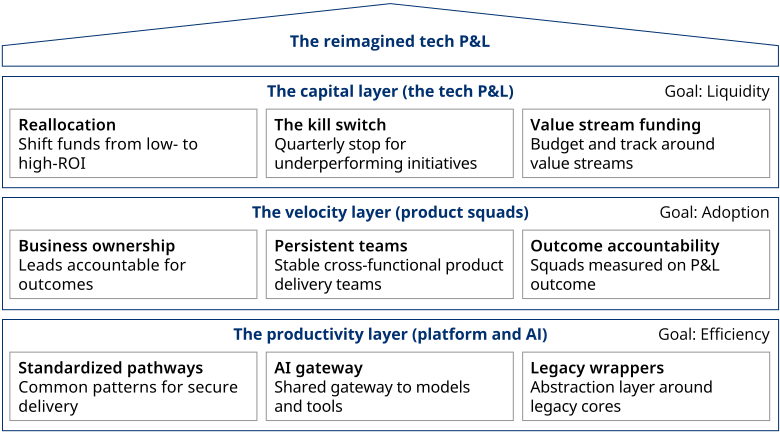
At its core, the reinvestment engine only works when three layers move together: capital, velocity, and productivity. Most previous attempts at this failed because organizations tried to fix these dimensions in isolation.
Even when leaders recognize that AI or a modernization effort should be a priority, freeing up funding tied to legacy platforms, vendor contracts, and compliance activities is a persistent challenge.
A technology P&L reframes the problem. Instead of treating IT funding as annual entitlements owned by departments, capital is managed as a portfolio tied to value streams and measurable outcomes. Funding is released in tranches, benefits are explicitly tracked, and there is a predictable mechanism to stop or resize underperforming initiatives and to recycle that capital.
This shifts the CFO-CIO conversation from “How much should we spend on technology next year?” to “Which investments are improving our unit economics, and which aren’t?” Over time, this creates a self-funding model where savings from reduced run costs and improved productivity directly finance the next wave of transformation.
AI operating model shift from projects to products for insurers
The reinvestment engine also shifts from projects with end dates to products with P&L accountability. Persistent, cross-functional product teams own specific value streams, such as claims processing, call handling, or utilization management, on a continuous basis. Business and technology leaders share responsibility for outcomes.
This operating model materially increases speed. Teams that stay together build institutional knowledge, release changes continuously, and learn what actually works in production. For AI and automation in particular, this matters: value is rarely realized in a single “big bang” launch, but through rapid test and learn cycles where adoption, accuracy, and cost are measured incrementally.
Reducing change costs to unlock automation and productivity gains
The final — and frequently overlooked — constraint is the cost of making change itself. In legacy environments, even minor enhancements can trigger extensive testing, long release cycles, and significant operational risk. Organizations become risk-averse, and the economics of automation or AI never fully materialize because the delivery overhead consumes the savings.
The productivity layer focuses on systematically lowering that cost. Rather than attempting wholesale rewrites of core systems, leading payers are wrapping legacy platforms with modern abstraction layers, standardizing cloud and data environments, and creating governed gateways for AI experimentation. These investments do not always generate immediate savings in isolation, but they dramatically improve the economics of everything that follows.
When change becomes cheaper and safer to make, teams can iterate faster, retire legacy processes sooner, and finally capture the productivity gains that automation has long promised.
Governance models that help insurers move faster with control
A reinvestment engine only works if leaders can make fast decisions without creating chaos. That requires governance that is clear, joint, and data-driven, not another layer of committees or approval workflows that slow execution. Effective technology P&L governance aligns three roles:
- Finance as capital steward: sets the funding envelope, enforces stop-and-start rules, and holds the portfolio accountable to financial outcomes.
- Technology as platform guardian: defines non-negotiable architectural guardrails and AI risk standards that protect speed without creating fragmentation.
- The business as value owner: holds accountability for adoption, operational change, and savings recognition — not just for go-live dates.
A shared performance scoreboard focused on leading indicators, not lagging reports, is essential. At any point, executives should be able to answer four questions: Are we returning real cash to the P&L? Are we delivering faster than last year? Is automation genuinely cheaper than labor at the unit level? And are we moving faster without increasing operational risk?
A robust operation model will close the competitive gap
For health plans, technology transformation has become a margin agenda item, not merely an IT one. AI will widen the gap between organizations that can redesign workflows and redeploy capital at pace — and those that simply layer new tools onto old operating models.
A reimagined technology P&L, powered by a reinvestment engine, offers a viable path forward. It enables payer leadership to create liquidity without incremental budget, convert technology investments into measurable unit-cost reductions, and scale winning bets quickly while stopping losing ones early.
The plans that pull ahead will not be the ones with the most AI pilots or the largest modernization budgets. They will be the ones that built an operating model capable of turning each dollar of technology investment into a measurable reduction in administrative cost — and then doing it again the following year. That discipline, compounded over time, is what separates a competitive cost structure from a perpetually rising one.