


From AI To Value-Based Care: Success Depends On Execution
This is part of our continuing coverage of the 2025 Oliver Wyman Health Innovation Summit. We previously wrote about how the industry can restore trust, and how leaders can reshape policy, payment models, and care delivery.
During the final day of the 2025 Health Innovation Summit, Thomas Osborne, M.D., shared an all-too-familiar story about the fragility of the nation’s healthcare system. Following a fall, a friend’s mother was hospitalized with a fractured hip. She then suffered a series of preventable complications that led to her death. Miscommunication between providers, hospital-acquired infections, and delayed interventions turned a survivable fall into a tragedy, said Osborne, chief medical officer at Microsoft Federal and adjunct professor at Stanford Health Care.
The story was a stark reminder that healthcare, at its core, is a human enterprise. Technologies like artificial intelligence (AI) or new care and payment models can help transform the industry, but as Osborne and other speakers emphasized, capturing those opportunities will only happen if leaders experiment, share ideas, and find ways to turn friction into momentum.
Solving problems that people care about
Osborne laid out the well-known problems: high costs, administrative burden, clinician burnout, disparities in care, an aging population, and more. Layered on top is the struggle of getting new initiatives off the ground. Project champions often face a gauntlet of approvals — compliance, IT, security, finance, legal — each causing delays. Months turn into years before promising projects get off the ground or prove value.
Despite these tensions, Osborne insisted progress is possible. He offered a three-part prescription: start small, solve problems that matter to clinicians, and bring stakeholders to the table early to cut through bureaucracy. He cited an example from pathology where repeated non-value-add tests were draining resources. Engaging clinicians early, analyzing data, and piloting a new ordering process resulted in significant reductions in unnecessary tests and costs. “If you solve problems people care about, they’ll champion the solution,” he said. “That’s how you build momentum.”
Making value-based care work everywhere
Oliver Wyman’s Peter Borden and Risant Health CEO Jaewon Ryu, M.D., zoomed out to explore how value-based care can work in today’s fragmented system.
For Ryu, value-based care is not just a payment model but a transformation of the care model itself — shifting the focus upstream to prevent disease, reduce unwarranted variation, and simplify navigation for patients. Risan Health’s early efforts are showing impact, including a 7% reduction in specialty referrals through more effective primary care and improved patient flow from emergency departments to inpatient beds, reducing ED boarding and related mortality risk. He also highlighted how ambient listening technology has given physicians back an average of 37 minutes per day.
Ryu pushed back against the idea that value- and volume-based models are incompatible. He pointed to “two-fers” — interventions that work in both value-based models and in fee for service. For example, efforts to optimize capacity and get patients to the most appropriate level of care work in either model. “At the end of the day, it’s just better care,” he said. “And better care creates financial sustainability regardless of the payment model.”
The AI debate: Will it reduce total cost of care?
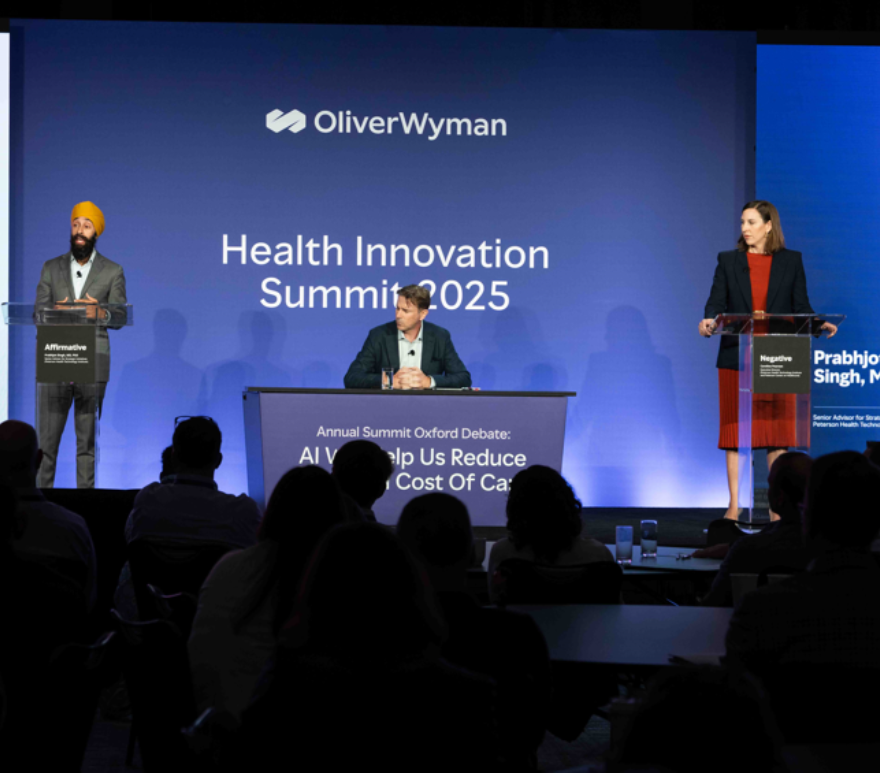
The day’s closing session was an Oxford-style debate on whether AI can truly reduce the total cost of care.
Prabhjot Singh, Senior Advisor for Strategic Initiatives, Peterson Health Technology Institute, argued yes, pointing to AI’s ability to automate documentation, streamline transactions, and triage patient needs. Even modest gains in efficiency, he said, could yield enormous savings. “Every experiment is a down payment on discovering what efficiencies work,” Singh noted, adding that commoditization is driving down costs and accelerating adoption.
Caroline Pearson, Executive Director of the Peterson Center on Healthcare and Peterson Health Technology Institute, took the opposite view. While agreeing that AI would improve outcomes and access, she questioned whether savings would ever reach patients. Efficiency gains, she warned, too often translate into higher revenues for industry players rather than lower costs overall. “Unless we make brave choices to realign incentives,” Pearson said, “AI may actually escalate spending instead of containing it.”
The debate underscored a familiar challenge: whether AI becomes a cost-saver or cost-driver will depend less on the technology and more on how leaders choose to deploy it.
This year’s Inspiration Experience, an immersive learning lab, also focused on how executives can build “AI IQ.” Attendees explored how AI can evolve from being just another tool to a valued team member that can ideate and offer solutions.
From tension to momentum
As Oliver Wyman’s Jim Fields and Holly Noto reminded attendees, tension isn’t something to fear. Like the stretched rubber band from day 2 of the Summit, it holds potential energy. Leaders who lean into it can convert it into momentum.
The ideas debated at the Summit are opportunities to be courageous, not sit on the sidelines. Noto urged attendees to bring new voices into the conversation, gather diverse perspectives, and spark experimentation. The leaders who embrace that tension will be the ones who shape the future of healthcare.