


The so-called SaaSpocalypse was supposed to challenge the underlying software as a service (SaaS) business model. As customers automate more work with AI, fewer software seats could mean less revenue for vendors, while rising AI usage and inference costs would put additional pressure on SaaS gross margins.
But so far, that hasn’t happened — at least not to the extent initially anticipated.
According to a recent Oliver Wyman survey, 2026 SaaS Pricing Outlook, of more than 150 North American software buyers, few enterprise buyers expect seat counts in most categories to decline more sharply over the next three years than they have over the past three.
AI is still changing software economics by increasing the cost of serving customers as usage grows. But, like seat counts, the impact on margins has been less severe than expected. This gives software vendors and investors a window to act, not a full reprieve. Over the longer term (five to 10-plus years), automation risk and steady-state inference costs still remain uncertain, even if seat counts prove more resilient than expected. They have an opportunity to use this window today to:
- Play (proactive) defense. Determine whether existing pricing models are fit for purpose to sustain profitable growth and whether changing them will strengthen economics or put existing revenue at risk. Our pricing decision framework can help software buyers dimensionalize these decisions.
- Play offense. Alongside “future-proofing” the commercial models, build out the right mix of AI-forward products, packaging and pricing to capture additional spend from an increasingly discerning customer base.
The risk of moving too slow, or too fast
Traditional SaaS pricing has been straightforward: Companies purchased more seats as they added users, with usage and value growing alongside them. The cost to serve was relatively marginal.
The risk is that AI agents drive increasing automation and perform more work without adding seats, or even drive seat reductions, limiting software vendor revenue growth even with increasing usage. Meanwhile, every AI interaction consumes tokens — units of data processed by AI models — and computing power, introducing variable costs that rise with usage.
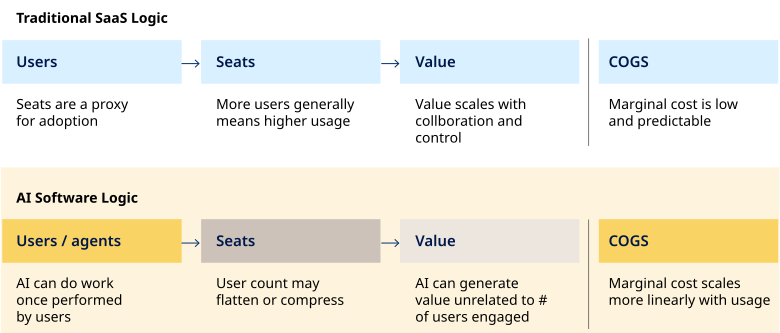
However, these same vendors are now realizing that seat counts are evolving less drastically than expected. Our research suggests that few enterprise buyers expect seat counts in most categories to decline more sharply over the next three years than they have over the past three.
Thus, the challenge for vendors is increasingly knowing when to evolve their pricing models: Moving too soon could undermine predictable recurring revenue or risk disrupting well-established customer relationships; waiting too long could leave vendors absorbing rising costs without capturing the value that AI creates.
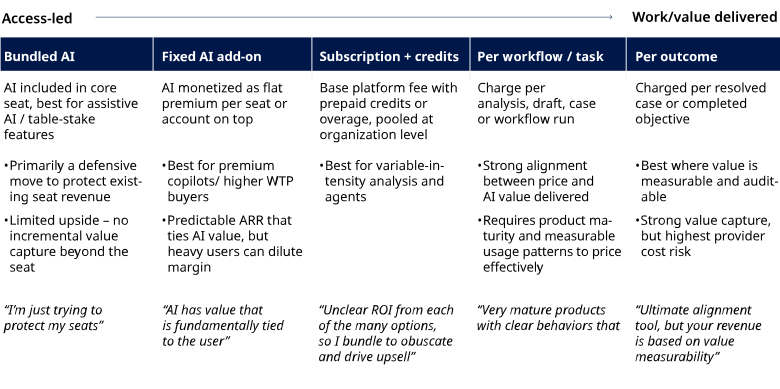
Monetizing access versus delivery
As a result of this uncertainty, vendors are testing new ways to monetize AI capabilities, from bundling features into existing subscriptions to piloting usage- and outcome-based pricing.
Bundled AI and fixed add-ons help protect predictable subscription revenue but offer limited upside as usage grows, while credit- and task-based models allow vendors to capture more value from AI activity but require more sophisticated usage tracking.
Our study found that nearly two-thirds of current customers view usage-based pricing favorably and find it easier to understand. But that enthusiasm also comes with a caveat: Roughly nine in 10 buyers are also concerned about unpredictable costs. They want the flexibility to scale AI usage without signing up for a bill they can’t anticipate.
The appetite to make this shift in pricing also varies by software category. Interest is strongest in already-metered areas, like customer support and developer tooling, where activity provides a familiar basis for pricing. It’s weakest in categories serving fixed-budget sectors, including healthcare, education, and utilities, where usage can be harder to meter and spending less flexible. For those markets, any shift to usage-based pricing won’t happen overnight, if at all.
How SaaS vendors can choose the right AI pricing model
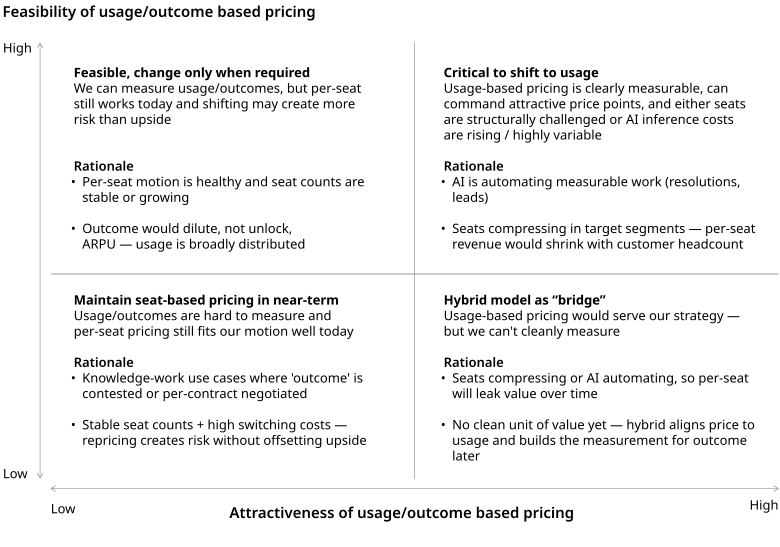
While usage-based pricing offers opportunities to capture more value from AI, it isn't the right fit for every software vendor. Deciding whether to shift away from traditional seat-based pricing — and how far — comes down to two key questions.
- Is usage-based pricing feasible? For this to be the case, there would have to be a clearly defined usage metric that customers understand. Vendors would also have to be able to reliably track and bill for it. The final requirement would be that the model provides customers with predictable pricing that they can budget for.
- Is usage-based pricing attractive? Vendors would have to establish that usage-based revenue would exceed the cost of delivering it and outperform today’s per-seat economics. Ultimately, the model would have to protect margins and drive margin expansion as adoption scales.
In practice, clear-cut cases are rare. Few vendors have usage metrics that are easy to measure and valuable enough to justify replacing seat-based revenue. Where both hold, the case for shifting is strong, as usage-based pricing can align revenue more closely with AI delivery costs while reducing reliance on seats. This becomes particularly important when AI-driven automation reduces seat counts, creating a disconnect between the value delivered and revenue captured.
For most vendors, the decision is less clear. Measurable usage isn't necessarily profitable to monetize, and most buyers remain satisfied with existing pricing models, according to our research. Replacing predictable seat-based revenue before a new model proves its economics creates risk, while capturing potential upside from usage-based pricing may require new tracking and billing systems.
Hybrid pricing models often offer vendors a way forward, combining seat minimums or platform fees to ensure recurring revenue with usage-based mechanisms that capture more value as adoption grows and protect margins from rising inference costs.
Vendors in traditionally seat-based categories, including CRM and productivity software, are increasingly adopting hybrid models to monetize new AI capabilities, either as a transition or a longer-term strategy.
A case study we conducted followed a SaaS provider that launched an AI agent to monitor portfolios and flag important changes. Rather than abandoning seat-based pricing, the vendor adopted a hybrid model, maintaining subscriptions at pre-AI prices to encourage adoption while introducing usage allowances to cover compute costs and fees for high-value outputs, such as client-ready portfolio reviews.
However, customers struggled with abstract “compute units” and were hesitant about pay-as-you-go pricing. The vendor responded by bundling usage into more familiar activities, such as data retrievals, making pricing easier for customers to understand and anticipate while allowing the vendor to capture the value of its AI capabilities without putting existing subscription revenue at risk.
Customers will pay more for AI that delivers measurable value
Most buyers expect AI to increase their software and technology spending over the next three years, with nearly 80% anticipating that this increase will come from expanded budgets or reallocating labor savings rather than cuts to existing software spending in 2029. Buyers aren’t opposed to paying more for AI. Our research finds that roughly 93% are willing to share a significant portion of the efficiency gains AI delivers through higher pricing.
But vendors can't count on capturing this spending growth without significant and continued product innovation because customers aren’t yet seeing the results they expected. As our recent research shows, the biggest gains come from reengineering how work gets done, not just deploying better AI tools. That raises the bar for software vendors, as value-based AI pricing depends on customers realizing, measuring, and sustaining that value.
According to our study, nearly 65% of buyers say embedded AI features haven't delivered measurable business impact, while nearly four-fifths are concerned about managing AI spend as usage grows.
What’s more, nearly 80% of buyers have cut or paused AI pilots that failed to demonstrate sufficient return on investment. And almost half now expect measurable returns within six months, increasing pressure on vendors to demonstrate value quickly.
The bottom line? Alongside future-proofing their pricing models, software vendors need to use this window to ensure the AI products and services they build deliver tangible value through time savings, faster workflows, and lower operating costs. Meanwhile, investors must assess whether those models can sustain profitable growth and withstand scrutiny, making pricing even more central to software diligence.
Five priorities for SaaS vendors and investors adapting to AI
While the shift to AI-driven software economics is unfolding less drastically than many expected, vendors and investors cannot afford to stand still. The challenge is to adapt pricing models without undermining recurring revenue, while ensuring AI products deliver measurable customer value and sustainable margins. To navigate this transition, five near-term priorities stand out:
- Pick metrics that reflect your AI’s real work. Choose what to price —seats (access), usage, or outputs/outcomes — and don’t try to price everything at once.
- Keep it simple. Complexity can stall adoption before price becomes the sticking point.
- Anchor price to ROI. Tie pricing to measurable value, while accounting for buyers’ budget constraints and the cost of comparable solutions.
- Build in guardrails. Use caps, true-ups, and contractual flexibility to give buyers cost predictability while accounting for changing AI costs and aligning pricing more closely with the cost to serve. Equally important, ensure pricing is implementation-ready, with the back-office systems and usage tracking needed to support it.
- Stress-test the economics of AI. Model revenue, inference costs, and margins at three and five times current usage to see whether greater adoption drives profitable growth or erodes it.
Above all, software vendors should move quickly but deliberately. Pricing decisions are difficult to reverse, and the stakes are high. AI will expose the difference between companies that build valuable products and those that build profitable businesses around them.
This means success will require getting the commercial model right but also ensuring that AI tools deliver enough underlying customer value to unlock ROI and incremental spending, while challenging existing assumptions about growth, customer value, and revenue durability.