


Digital assets are beginning to reshape the infrastructure behind wholesale banking. For European and UK transaction banks, the opportunity has been about protecting and expanding existing businesses as payments, liquidity, foreign exchange, and trade finance increasingly move onto digital rails.
But our global analysis Digital assets reshaping the future of wholesale banking, found that the more consequential shift is likely to be the migration of established banking activities onto blockchain-based, programmable infrastructure. In Europe, the stakes are particularly high because a significant share of the region’s transaction banking economics is connected to cross-border trade and treasury activity.
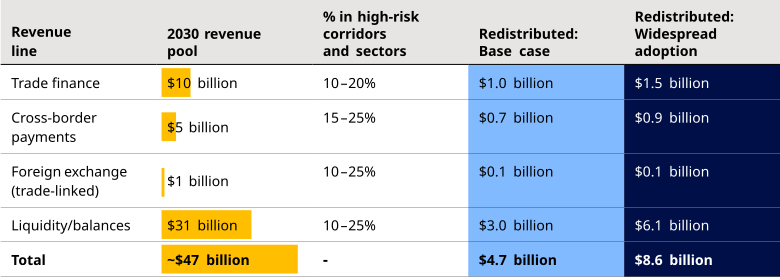
Our analysis identifies approximately US$47 billion to $50 billion of European transaction banking revenue that intersects with digital rails. Across three adoption scenarios, between $2.2 billion and $8.6 billion of that revenue could be redistributed by 2030.
The key word is redistributed. Billions of dollars are not necessarily disappearing from banking. The real shift is in where that value moves, and which institutions control the client relationship as it moves.
Digital rails will matter most where banking friction remains high
Europe already has a highly efficient payment infrastructure. SEPA Instant Credit Transfer — an always-on, pan-European payment system that allows euros to be sent and received in under 10 seconds — enables real-time euro payments, while the TARGET Instant Payment Settlement (TIPS) supports 24/7 settlement in central bank money. Because of these systems, the incremental benefit of moving payments onto blockchain-based infrastructure may be limited in well-served domestic and regional corridors.
The economic change is most visible in markets where friction remains high. Digital money becomes more compelling when companies must pre-fund transactions, correspondent banking networks are fragmented, foreign exchange spreads are significant, or payments depend on complex trade documentation and manual verification. These conditions are common in trade corridors connecting Europe with Africa, the Middle East, Southeast Asia, and Latin America. They are also prevalent in working-capital-intensive sectors, such as commodities, logistics, and agriculture.
For banks, that means adoption is unlikely to happen uniformly. It will begin use case by use case — wherever digital infrastructure produces a measurable economic benefit for the client. A freight forwarder, for example, may currently have to pre-fund customs, port, and local agent payments weeks before a vessel arrives. Instead of using digital money and verified shipping data, payments could be released when predefined conditions are met. The result is likely to be less trapped liquidity, lower foreign exchange exposure, and better treasury visibility. That is a fundamentally different proposition from using blockchain simply because the technology is available.
Europe’s digital money shift creates two strategic challenges
The first challenge Europe faces is commercial. European and UK banks need to determine whether they will retain the payments, liquidity, foreign exchange, and financing economics associated with cross-border transaction banking as infrastructure evolves.
The second concerns the euro itself. The euro remains an important currency in European international trade, yet US dollar-backed stablecoins dominate the global stablecoin market. As digital settlement grows, that imbalance could reinforce dollar-denominated liquidity in important trade corridors.
While this would eventually erode the euro’s relative importance as a settlement currency, European banks could successfully serve clients using dollar-backed stablecoins and retain commercial relationships. Alternatively, euro-denominated digital currencies could gain adoption while non-bank providers capture the underlying client workflow. Banks need to understand both scenarios, rather than treating them as interchangable. For additional context on Europe’s position, see Inside Europe’s crypto future from MiCAR to leadership.
The digital wallet is becoming the new current account
The strategic control point for transaction banking value is also changing. Historically, transaction banking value accrued to institutions controlling correspondent networks, nostro and vostro accounts, foreign exchange infrastructure, and access to payment rails. As those rails become more accessible and increasingly commoditized, competitive advantage shifts toward the layer above them.
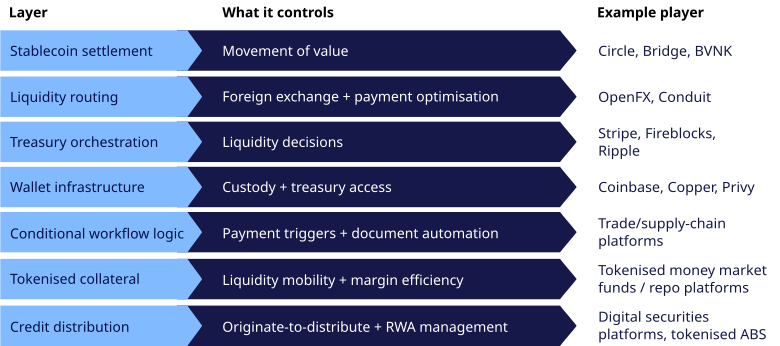
The emerging corporate wallet is not simply a place to store digital assets. It is an orchestration and intelligence layer that could determine where liquidity sits, which currency or digital-money instrument is used, which rail executes a payment, when foreign exchange occurs, and when funds are released.
In effect, the wallet can become a digital control center for corporate treasury. That makes ownership of the orchestration layer strategically important. A bank may still hold a corporate client’s account while another provider increasingly controls how that client manages liquidity, routes payments, exchanges currencies, and accesses financing. Over time, the institution controlling that workflow is better positioned to capture the economics surrounding it.
While multiple instruments coexist, banks win by routing every transaction to the right one
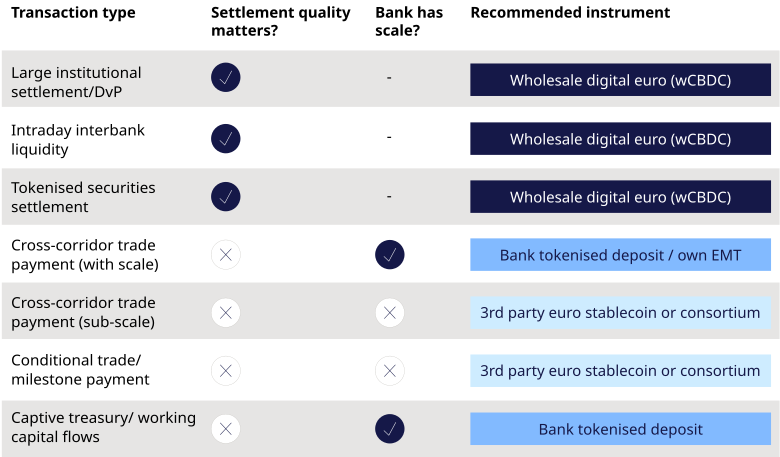
It is unlikely to be one universal digital settlement instrument. Large-value institutional transactions and tokenized securities settlement may require the risk-free finality of settlement in wholesale central bank money. Banks with sufficient scale may use proprietary tokenized deposits or regulated e-money tokens for commercial flows. Other institutions may access established third-party stablecoins or participate in industry consortia.
These instruments are more likely to coexist than to produce a single winner. The strategic differentiator will be the intelligence that sits above them, enabling a bank to route each transaction to the most appropriate currency, asset, and settlement rail based on the client’s needs.
Stablecoins, deposit tokens, and central bank digital currencies (CBDCs) are shaping tomorrow’s money. Explore how these different forms of tokenized money can address distinct use cases across the payments ecosystem.
Digital money will redistribute revenue rather than erode it
As transaction banking becomes more programmable, some existing revenue streams could compress. Real-time settlement can reduce pre-funding requirements. Progressive payment release can lower financing needs. Digital distribution can potentially reduce the cost and time required to distribute trade finance exposures.
But new sources of revenue can emerge at the same time. Banks may increasingly monetize wallet and custody services, foreign exchange conversion, treasury orchestration, automated verification, conditional payment triggers, and tokenized credit origination and servicing. Thus, the revenue model begins to shift away from balance-sheet-intensive financing spreads and toward service, workflow, and embedded fees.
Our scenarios illustrate the potential scale of that shift. Under limited adoption, approximately $2.2 billion of European transaction banking revenue could be redistributed by 2030. In the base scenario, that rises to approximately $4.7 billion. Under widespread adoption, approximately $8.6 billion — around 20% of the relevant revenue pool — could move toward institutions with competitive digital infrastructure. The largest shift could occur in liquidity and balances, reinforcing why control of the client’s treasury workflow matters as much as control of the payment itself.
Banks need client-led use cases before scaling digital assets
The strategic response should not begin with a decision to build a blockchain platform. Banks first need a clear view of where digital adoption is most likely to affect their own clients, corridors, sectors, and revenue pools. Client engagement should identify where existing friction is substantial enough to create genuine demand.
The next step is to develop a small number of lighthouse use cases with real clients. Unlike a technology pilot, a lighthouse use case should demonstrate that the economics work for both the client and the bank. That evidence can inform the larger decisions that follow: which parts of the digital-money stack the bank should own, where partnerships can accelerate delivery, how the wallet and orchestration layer should develop, and what operating model is required to commercialize these capabilities.
No bank needs to build every component itself. But banks do need to be deliberate about which capabilities determine the client relationship and where handing control to a third party could weaken their strategic position. The window for making those choices is open. Building digital-asset infrastructure, integrating it with legacy banking systems, and embedding it into corporate treasury workflows will take time. Banks that establish where they can create tangible client value now will be better positioned as digital rails move from experimentation toward everyday transaction banking.
