


The Asia-Pacific travel retail landscape has undergone a profound structural shift since the COVID-19 pandemic. What was once a predictable growth story, anchored by explosive Chinese outbound tourism and a duty-free price advantage that made airport shopping an obvious choice, has evolved into something considerably more complex.
Our latest research draws on surveys of over 2,250 consumers across Mainland China and India and in-depth interviews with more than 40 senior industry executives. It offers a rigorous assessment of where the opportunities lie in Asia-Pacific travel retail and what it will take to capture them.
Indian and South Korean travelers are reshaping Asia-Pacific travel retail
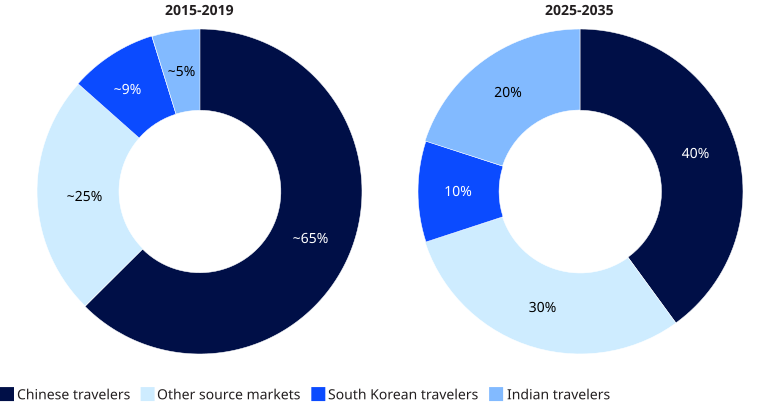
Over the last decade, Chinese travelers accounted for roughly 65% of the Asia-Pacific travel retail market's expansion, and most travel retailers and airport operators built their commercial model around winning Chinese travelers’ wallets. Although that strategy delivered strong results for a long time, the coming decade will require a fundamentally different approach.
Our research projects that the contribution of Chinese travelers to regional travel retail growth will fall to approximately 40%. This substantial recalibration reflects both shifts in Chinese spending behavior and rising ambitions of other traveler segments — in particular, Indian and South Korean travelers.
These two cohorts of travelers are expected to pick up much of the slack, with Indian travelers contributing as much as 20% of future growth and South Koreans 10%. For players in Asia-Pacific travel retail, this is an important reality to plan for, as the needs and expectations of these two groups of travelers look very different from those of Chinese travelers and each other, posing an additional challenge.
Catering to the new buying habits of Asia-Pacific travel retail shoppers
Indian travel retail spending in Asia-Pacific is projected to quadruple between 2025 and 2035, driven by a fast-growing affluent class and a young millennial segment showing the strongest travel sentiment of any demographic in the market. Unlike Chinese shoppers, Indian consumers tend to do most of their duty-free shopping upon arrival rather than departure, and they have very specific categories in mind: wine and spirits, gold, and confectionary and fine food.
South Korean travelers lean heavily toward beauty and fashion. To win both segments, operators will have to completely rethink how they stock, design, and run their stores.
This does not mean China is fading from the picture. After several subdued years, affluent Chinese consumers are once again traveling more and spending more on personal luxury goods. The recovery is uneven, however. The older generations are driving much of the spending rebound, while younger consumers are more selective, drawn toward prestige beauty and luxury apparel rather than watches and leather goods.
Why Asia-Pacific travel retail is missing a $5 billion revenue opportunity
Even setting aside a shifting traveler mix, the sector faces a more immediate and quantifiable challenge. As the region recovered, Asia-Pacific travel retail captured only around 70% of the growth in passenger traffic and overall tourism spending. In dollar terms, this is approximately a $5 billion missed opportunity.
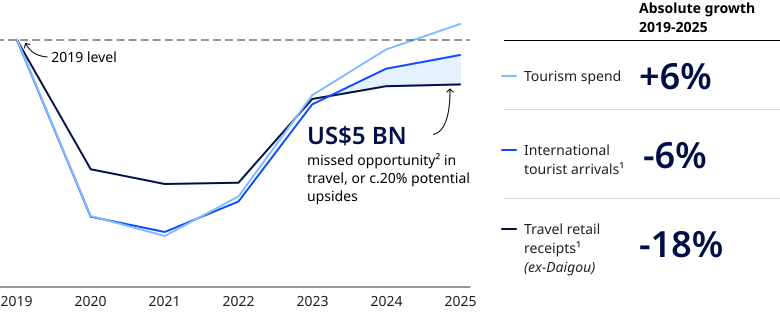
Two forces explain the shortfall. The first is domestic repatriation. Chinese luxury consumers have redirected a growing share of spending back home, with the overseas share of Chinese luxury spending having more than halved since 2019. China’s own online and offline retail offering has also matured significantly. Hainan — a government-backed domestic duty-free hub — has emerged as a competitive alternative that has narrowed the price gap between China and overseas markets. Beyond price, more than 75% of Chinese luxury spenders now maintain regular contact with their local sales associates, and as domestic service standards have risen, those relationships have become a genuine pull factor back toward the home market.
The second force is the current stagnant value proposition in travel retail. Airport retail has largely stopped giving travelers a compelling reason to shop. While price used to be the draw for airport duty-free shopping, AI tools now offer instant and effortless cross-channel price comparisons, both duty-paid and duty-free, stripping out whatever sense of exclusivity the channel once had. The time travelers spend browsing duty-free has also declined steadily, with people choosing to work on their devices or visit lounges or restaurants instead.
These challenges present opportunities for brands and operators that treat duty-free like a destination, and not just shelf space. Bookable experiences and exclusive time- and location-specific launches have proven successful in giving travelers a reason to seek out the store.
How AI will reshape duty-free and airport retail in Asia-Pacific
Technology, and AI in particular, is rapidly becoming both the cause of some of these pressures and the most promising answer to them. If the past decade was defined by competition around services, loyalty, and personalization, the next decade will be shaped above all by AI and the organizational willingness to invest in it seriously. The findings from our executive survey are both striking and sobering. A little more than three-quarters (76%) of surveyed senior leaders describe AI and innovation as critical to sustaining growth, yet fewer than 40% of these senior leaders say their organizations are treating these areas as investment priorities. The gap between what executives believe and the areas where organizations are investing is a vulnerability that will compound over time.
AI adoption within the sector remains largely concentrated in back-of-house functions. Customer-facing AI technology is only beginning to gain traction, with just 20% of surveyed businesses reporting deployed solutions today, while 65% plan to do so within the next 12 months.
That said, the more consequential shift is happening at the level of the travel planning journey itself. AI is already influencing how consumers decide where to go and where to spend, and brands should urgently optimize so their brands and products are effectively linked to shopping missions and occasions in the way consumers plan and consult with AI. They should also ensure their product, pricing, promotion, and store information is correctly fed into AI engines.
The next decade will not be won by the operators that still cater to yesterday’s traveler. Those that move fast to serve a more diverse and more digitally empowered traveler, using AI capabilities, will surge ahead.
