


Financial institutions have been harnessing the power of artificial intelligence (AI) over the past few years to boost efficiency, reduce costs, and manage risk. And just as they are starting to realize a return on investment for many of those backend implementations, the next breakthrough is emerging: agentic AI.
Unlike earlier AI tools that handled isolated tasks, agentic AI acts as a semi-autonomous orchestrator — planning, acting, and coordinating complex compliance workflows with human oversight. This new wave of AI is set to transform compliance functions end-to-end, changing how data is used and how teams deliver value.
Our latest report, “Reimagining Compliance With Agentic AI” reveals how this technology can help compliance teams pivot from being reactive task-doers to strategic advisers.
Drawing on extensive client engagements and benchmarking analysis, the report highlights how agentic AI can enable faster, more defensible decision-making that enhances both operational efficiency and regulatory compliance.
We found that automating up to 70% of manual work can improve risk detection accuracy by as much as four times. Additionally, enabling continuous, comprehensive testing and real-time regulatory monitoring, agentic AI can help compliance teams become more proactive.
Practical roadmaps for seamless AI transformation
Successfully integrating agentic AI into compliance operations requires more than deploying a new piece of technology. Organizations need a thoughtfully designed implementation strategy that includes a number of stakeholders.
Compliance leaders should have clear and measurable goals, prioritize high-impact processes for AI transformation, and thoughtfully redesign workflows that optimize the partnership between human expertise and AI capabilities.
Firms can mitigate risks by defining strict boundaries for autonomous AI operations and addressing data bias, transparency gaps, and operational dependencies.
As agentic AI rolls out, the compliance workforce needs to transform. AI-enabled execution teams will oversee and configure AI agent playbooks, focusing human talent on critical adjudications and exception management rather than manual casework.
Compliance professionals will shift from drowning in highly manual reviews to refining AI insights and shaping forward-looking strategies alongside business and regulatory counterparts, unlocking the full strategic potential of compliance. Firms embracing this approach today will lead the way in operational excellence, cost optimization, and risk mitigation in an increasingly complex regulatory landscape, while those who wait risk being left behind.
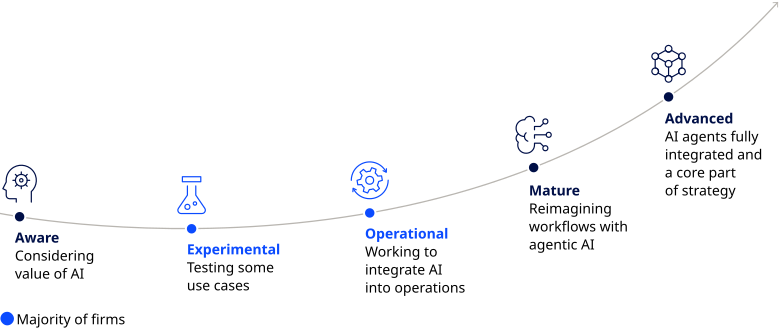
Four priorities for successfully implementing agentic AI
We’ve zeroed in on four strategic priorities that form the foundation of effective agentic AI adoption:
- Framing ambitions and priorities: Set measurable objectives, select high-impact processes, and balance AI’s autonomy with human judgment for optimal results.
- Reimagining workflows and roles: Redesign compliance activities to leverage agentic AI for routine tasks while elevating human talent toward judgment-intensive, strategic activities.
- Mitigating risks with strong controls: Deploy disciplined rollout strategies with quality gates, performance validations, and robust traceability to ensure transparency, compliance, and trust.
- Building future-ready teams: Reskill compliance professionals into AI operations managers, focusing on oversight, escalation, and continuous improvement to sustain transformation at scale.
With agentic AI enabling continuous, intelligent risk management, organizations can enhance compliance quality, reduce operational costs, and deliver value as a strategic business partner in a complex regulatory landscape.
