


Artificial intelligence is becoming one of the fastest-growing procurement categories for most enterprises, with runaway spending on software licenses, foundation models, cloud infrastructure, professional services, embedded AI features, and usage-based pricing. Yet most organizations still manage AI as a collection of disconnected technology purchases and lack a comprehensive view on why and how much they should be spending.
As adoption accelerates, organizations face the risk of costs scaling faster than the value AI delivers. That need not be the case. For most chief operating officers (COOs) and chief procurement officers (CPOs), the biggest and most pressing challenge today is how to govern AI spending with the visibility, commercial discipline, and cross-functional control needed to enable innovation without budgets rising to unsustainable levels.
Rising AI costs extend far beyond tokens to cloud and software
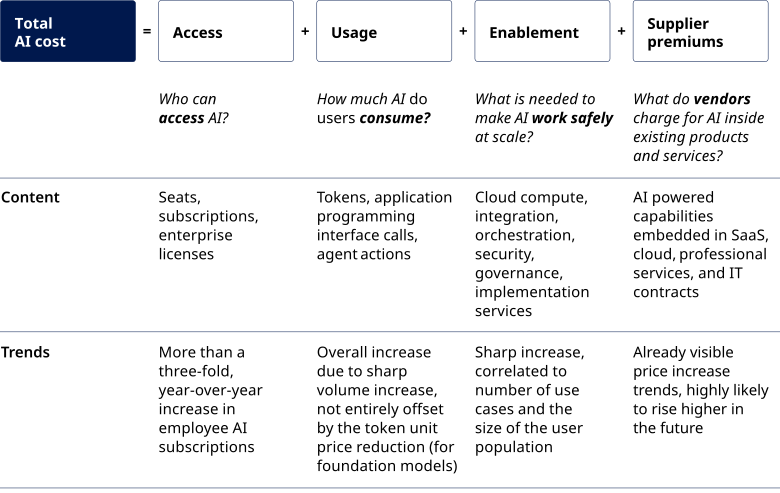
While token usage may be attracting the most attention at the moment, it represents only one component of the exponential rise in the total cost of AI. Organizations also find themselves facing rapidly increasing costs for enterprise licenses, cloud infrastructure, implementation, security, governance, and the growing AI premiums embedded within software and technology contracts.
As AI adoption grows, these costs increasingly behave like a hybrid consumption model — combining fixed subscriptions with variable usage charges. Managing only one component of the spending can leave significant costs unchecked.
Instead of addressing each spending category individually, organizations need to view AI as a single budgetary category that requires visibility across all suppliers, contracts, and business units, and that must be addressed as a whole.
Why AI spending has become difficult to control
Five structural challenges make AI harder to manage than previous technology investments:
- Fragmented visibility. AI costs are dispersed across multiple budgets, vendors, business units, and technology platforms. Few organizations can answer a simple question about how much they are spending on AI today.
- Consumption grows faster than governance. Once users gain access, consumption often expands faster than approval processes, funding mechanisms, and value tracking.
- Premium capability becomes the default. Without clear governance, users are frequently granted higher-performing — and more expensive — models than their work requires, leading to excessive token consumption.
- Commercial leverage is limited. Most organizations lack meaningful benchmarks, consumption forecasts, or credible supplier alternatives. This weakens their negotiating position in an already concentrated supplier market.
- Traditional procurement models no longer fit. AI introduces dynamic consumption pricing, rapidly evolving commercial models, and productivity-based value creation that conventional technology procurement approaches were never designed to manage.
These issues mirror the early days of cloud computing but are amplified by the speed and fragmentation of enterprise adoption.
AI requires a new strategic management approach to spending
Organizations should stop treating AI as simply another software purchase. Instead, AI should be managed as a strategic external spending category supported by a cross-functional operating model. This should compel various corporate functions to work together to develop the governance necessary to scale AI sustainably.
Given the rate of adoption, this collaboration must be treated as an urgent priority to avoid cost increases that curb the appetite to scale AI.
The C-suite has a to-do list of urgent priorities on AI
Organizations can strengthen controls without slowing innovation by focusing on three priorities: improving visibility, governing consumption, and strengthening commercial discipline. These measures should be in place before AI scales, or rising costs will offset the benefits.
The first priority, creating adequate visibility, may be one of the hardest tasks. AI requires a complete view of all spending related to it across businesses, suppliers, and existing technology contracts, including cloud services and embedded AI capabilities that may otherwise go unnoticed.
The second priority, governing consumption, may be slightly easier to achieve, as top management can issue rules and monitor compliance as a first step. Organizations must define access rights, accessible model tiers, guidance on choosing the right model, and procurement approval processes. The hardest part of this task is the ongoing oversight: Usage must be continuously monitored to ensure that consumption aligns with business value. Giving users visibility into their own AI consumption and the associated costs can help reinforce accountability across the organization.
The third priority, is strengthening commercial discipline. To achieve this, supplier negotiations should extend beyond price to include true consumption transparency, benchmark pricing, renewal protections, data portability, audit rights, and mechanisms that allow organizations to share in future productivity gains.
Leaders can control AI costs without slowing adoption
AI is quickly becoming one of the largest new enterprise spending categories. Organizations that establish governance now will be better positioned to scale AI efficiently, while protecting margins and preserving commercial flexibility.
Those that delay risk locking themselves into supplier dependency, opaque pricing models, and escalating operating costs that become increasingly difficult to unwind.
For COOs, CPOs, and finance leaders, the opportunity is not to slow AI adoption. It is to ensure AI becomes one of the enterprise's highest-value investments — not its least-controlled cost category.
