


The landscape of global travel retail has undergone a profound structural shift since the COVID-19 pandemic in 2020. A once-predictable growth story — anchored by increased passenger traffic and the duty-free price advantage that made airport shopping a less expensive alternative — has evolved into something considerably more complex.
Our latest research, part of our report Global Travel Retail Pulse — Opportunities in Customer Growth, draws on surveys of 3,825 consumers across key regions and in-depth interviews with more than 30 senior industry executives. It offers a rigorous assessment of where opportunities lie, where problems have developed, and what it will take for airports, retailers, and brands to capture travelers’ attention again.
Why travel retail growth is lagging behind passenger demand
Travel demand has recovered, with passenger traffic once again following a long-term growth trajectory. The compound annual growth rate was 6.2% between 2023 and 2025, supported by continued expansion in Asia-Pacific, Europe, and emerging markets.
Yet the recovery in travel retail has been far less pronounced, with a compound annual growth rate (CAGR) of 2.7% between 2023 and 2025. Travel retail's inability to keep pace with passenger growth has created a US$5 billion global revenue gap versus the 2019 sales per passenger level. The reasons behind this gap vary across regions, categories, and generations.
Asia-Pacific — historically the industry's largest growth engine — accounts for the majority of the shortfall. Average sales per traveler remain well below 2019 levels, primarily because of a dropoff in spending by Chinese travelers in traditional travel retail channels. This reflects structural changes in China, including the development of a more competitive domestic luxury proposition, such as duty-free shopping in Hainan; tighter government controls on the Daigou channel’s informal cross-border trading network; narrowing price differentials; and changing shopping behavior.
By contrast, Europe has emerged as one of the strongest-performing regions. Investments in airport retail, the return of duty-free shopping on UK-EU routes following Brexit, and a favorable long-haul traveler mix have resulted in sales that outpace passenger growth.
Meanwhile, South America and Africa continue to mature alongside rising passenger volumes. The Middle East remains the world's highest-value travel retail region on a sales-per-passenger basis, despite temporary traffic disruption caused by geopolitical tensions.
Category performance is similarly uneven. Fragrances and cosmetics, historically one of travel retail’s largest categories, have borne much of the impact of Asia-Pacific’s slowdown given its outsized exposure to the region. Excluding Asia-Pacific, the picture is considerably stronger, with fragrances and cosmetics remaining an important contributor to growth alongside tobacco. Wines and spirits, by contrast, have faced a softer market.
Younger travelers are reshaping travel retail
The traveler mix is also evolving, which has fueled the slowdown in travel retail. Millennials and Generation Z, which already account for six out of 10 dollars spent on airline travel, don’t prefer the channel as much as baby boomers did. While younger generations travel more frequently, they spend less time in airports and are more likely to spend time on their mobiles or in airport lounges and restaurants than shopping.
They also have different expectations of what duty-free shopping should deliver, not only in terms of product assortment but also the retail experience itself. For instance, Frankfurt Airport has transformed product trial into a retail destination, placing an experiential tasting bar at the heart of its duty-free store. Here, travelers can taste and compare products through guided experiences and cross-category pairings.
And the millennial and Gen Z influence is only expected to grow, with projections that the two generations will account for around eight out of 10 dollars spent on airline travel by 2035. This means travel retailers will need to up their game if they expect to return to a faster growth trajectory.
Travel retail is at an inflexion point, requiring new ways to attract consumers
Three structural shifts are reshaping the market. First, travel retail is no longer dealing with a captive audience, with younger travelers more likely to spend their time at the airport on social media, streaming content, or eating. With Gen Z, the competition for eyeballs and share of wallet is particularly intense, because they spend less time at the airport before flights than baby boomers.
Second, the rise of indie brands targeting increasingly specific profiles and needs — across age, lifestyle, ethnicity, and others — has raised consumer expectations. Traditional propositions built around broad categories, price tiers, and geographies are increasingly giving way to appealing to smaller, more fragmented demand spaces. Domestic retailers outside the airport have responded by continuously refreshing assortments, merchandising, and experiences. By contrast, travel retail can still feel comparatively predictable, with familiar global brands, longer merchandising cycles, and brand-led layouts.
Finally, travel retail’s price advantage has been reduced. Online shopping has extended access to many commodity purchases that once dominated travel retail, often at discount pricing. At the same time, digital transparency has also fundamentally changed how travelers assess value. Search engines, comparison platforms, and increasingly AI assistants allow consumers to check prices within seconds, making competitive pricing an expectation rather than a sufficient reason to buy.
Winning tomorrow’s traveler through discovery
Consumers are remarkably receptive to discovery when they travel. Our research finds that 89% of travelers have “discovered” or seriously considered a new brand or product while browsing airport retail. This tendency is even stronger among younger travelers, rising to 96% among Gen Z compared with 76% among baby bboomers.
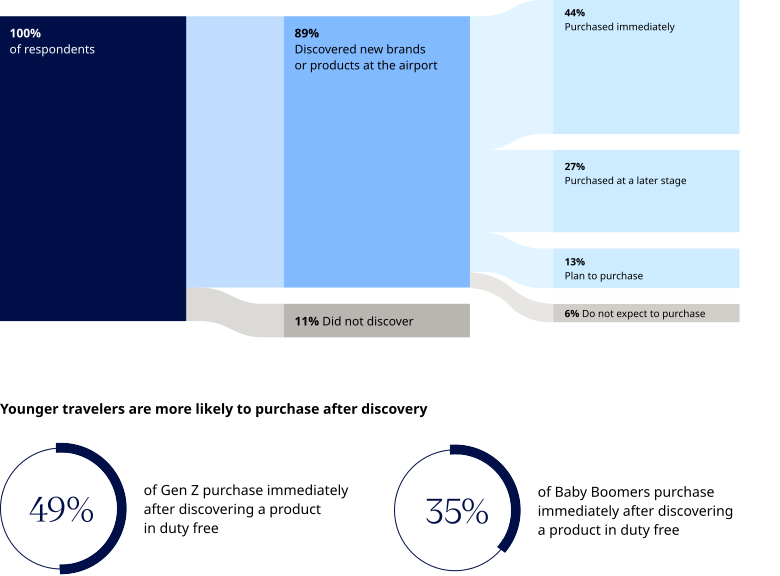
Crucially, discovery does not stop at awareness, and translates into conversion. Of travelers who discover something new, 44% purchase it immediately, while a further 27% purchase it at a later stage, and 13% plan to do so. Younger travelers are particularly responsive: Almost half of Gen Z travelers purchase immediately following discovery, compared with 35% of baby boomers.
The implication is a fundamental shift in the channel’s role: Travel retail needs to become a destination for exploration and novelty. The key with Gen Z and millennials is getting them off their mobiles and into airport shops, where they have to find unique offering.
Turning travel retail into a destination for discovery
A discovery-led proposition requires a concerted effort across ecosystem players — including airports, retailers, and brands — to invite, surprise, and engage travelers.
Surprising travelers will require a transformation of both the retail space and the offering. Rather than organizing retail solely around brands or categories, store design needs to be built around traveler missions — whether purchasing gifts, discovering local products and crafts, treating oneself, or simply checking out a store before a flight. It also must be both interactive and engaging.
Once in the retail space, travelers increasingly expect novelty, whether through emerging brands, airport exclusives, locally relevant products, or constantly refreshed collections that provide a reason to return. Here, sampling, demonstrations, immersive experiences, storytelling, and knowledgeable sales associates all help transform passive browsing into meaningful interaction. This is particularly relevant as self-purchase becomes the dominant shopping mission for many travelers, increasing demand for personalized advice rather than purely transactional selling.
Finally, price counts. Travelers continue to expect an average discount of around 18% versus domestic retail. Competitive pricing, transparent communication, and clearly articulated savings remain essential to maintaining trust in the channel.
Industry players are already coming up with clear solutions. For instance, Schiphol's partnership with Lagardère makes the price advantage visible by comparing by showing the discount versus the category’s leading Dutch retailers.
How to deal with a much more pluralistic consumer base in travel retail
As the mix of shoppers and their needs becomes ever more fragmented and specific, a single proposition for the “average traveler” is no longer enough. The same airport is likely to serve a diverse group of travelers depending on the terminal, destination, season, day, and even time of day — each bringing different goals, needs, and propensities to their airport browsing and buying.
Travel retail has an unusual advantage in addressing this complexity. Journey information, location, time, and traveler characteristics can together create a much richer picture of who is present than most domestic retail environments can access. Brands and retailers can use these signals to keep modifying to reflect the traveler base.
That intelligence can ultimately sharpen decisions across the business — from store layouts and category space to assortment, activation, staffing, retail media, promotions, and pricing. The objective is not personalization for its own sake, but greater relevance: matching the right proposition to the right traveler mix at the right moment.
Passenger growth alone will not define the next decade of travel retail. The opportunity lies in understanding travelers pluralistically, beyond the average, giving them compelling reasons to discover and engage, and using that understanding to make the proposition more relevant to each location and moment.
