


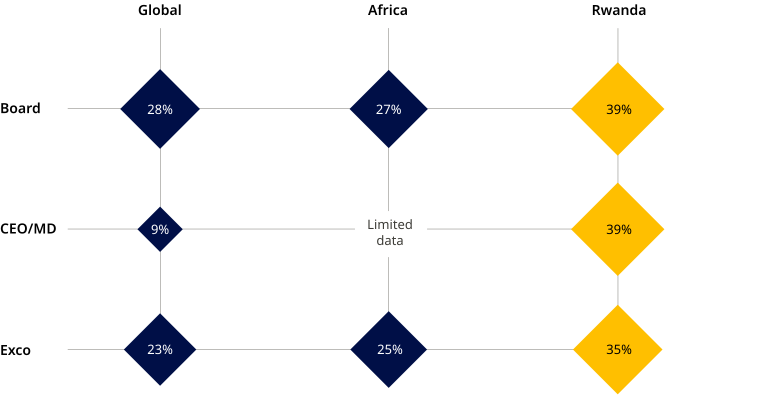
Rwanda’s financial services sector has made significant progress toward the country’s national gender equity goal. In financial services, women now account for 51% of the industry’s workforce, 39% of board seats, chief executive and managing director roles, and 35% of executive committee (Exco) positions. These figures compare favorably with available global and regional benchmarks.
But new research shows that the bigger challenge is not among the top tier but rather involves the slow pace of women’s progress through the leadership pipeline.
Our latest Women In Financial Services Rwanda study is the first rigorous, evidence-based assessment of women’s participation, career progression, and leadership representation across Rwanda’s financial services sector. Developed in partnership with the National Bank of Rwanda, Access to Finance Rwanda, and the Women in Finance Rwanda Foundation, it draws on data from 1,554 professionals across 52 financial institutions.
Conducted by Oliver Wyman and Mercer, the report aims to identify key successes and continuing barriers to equity across the sector, using the collected data in addition to focus groups and interviews with sector leaders.
Women’s leadership advances in Rwanda’s financial sector
Women are well represented at the most senior levels of Rwanda’s financial services sector compared with global and African benchmarks, reflecting progress in senior appointments aligned with broader national targets for gender inclusion. However, that representation breaks down further down the leadership pipeline.
Our research reveals how the pathway narrows through middle leadership. While women account for 56% of non-managerial employees, their representation falls to 43% in middle management, 36% in senior management, and 35% at Exco level.
Middle management is where future executives build the commercial experience, networks, and visibility needed for senior roles. When the pipeline narrows before those stages are reached, sustained representation at the top becomes harder to achieve organically.
The data also shows that women progress more slowly than men, receiving 30% fewer promotions overall, and are more likely to leave the sector earlier in their careers, accounting for 64% of non-managerial exits. While balancing work and family was the top reason given by women exiting the industry, lack of recognition and opportunities, the impact of maternity leave, exhaustion, and perceived bias were also frequently cited by respondents.
How data can advance women in Rwanda’s financial services sector
While women’s advancement is already recognized as a key priority for Rwanda’s financial institutions, that commitment must be backed by accountability and practical interventions.
Institutions need up-to-date, gender-disaggregated data on recruitment, retention, pay, promotions, exits, training participation, and access to key roles to see clearly where progress is taking place, where barriers persist, and where resources can have the greatest impact.
Practical actions may include improving the transparency of promotion processes, creating structured development pathways into strategic and revenue-generating roles, expanding mentorship and sponsorship access, supporting employees seeking professional qualifications, and strengthening policies that help balance career and caregiving responsibilities.
Regulators, industry associations, market catalysts, financial institutions, and development partners also have a role to play in turning evidence into sustained action. Access to shared data, common reporting approaches, capacity-building initiatives, and opportunities to exchange cross-organizational best practices could help institutions move faster and more effectively, addressing imbalances in real time and reducing the risk that gender inclusion is treated as an isolated human resources initiative.
The Women In Financial Services Rwanda Study provides the foundation for that evidence base. Its value now depends on how the sector uses it to build workplaces and leadership pathways where women can stay, grow, and lead.
