


Digital assets and AI agents are reshaping wholesale banking. Tokenized deposits and stablecoins are being used more broadly in regulated financial markets, while AI agents are beginning to act on behalf of people and organizations.
Transactions can become faster and more programmable, but the processes used to establish identity, authority, and compliance remain closely tied to individual institutions and accounts. This means institutions cannot always rely on trusted evidence from other recognized sources even when it seems to meet regulatory obligations. For instance, a financial institution may have already verified a company's identity and authority to transact. Yet when that company moves between providers, some of the same checks may need to be repeated, even though the underlying information has not changed.
An open working group, convened by the Global Legal Entity Identifier Foundation (GLEIF) and Oliver Wyman, has brought together more than 40 experts from financial services, regulation, digital identity, and technology to work on the SIMFONIA initiative, which informed the report "Building the modular trust layer for digital finance". The effort is exploring how evidence of identity, authority, and regulatory status could become portable and independently verifiable, allowing trusted information to be reused across institutions while preserving accountability.
For financial institutions, the initiative raises questions about how trust and compliance functions may evolve. For regulators, it raises questions about when institutions can rely on information verified by other recognized sources while maintaining existing safeguards.
Digital finance is changing how financial institutions manage trust
Banks, custodians, and payment providers will continue to play a central role in establishing trust. What could change is how they perform these functions and which information they can obtain from recognized external sources.
In a more modular market, institutions could use independently verifiable evidence from recognized sources rather than repeating every check themselves, where regulatory requirements permit. They could also issue reusable evidence where they are the authoritative source.
This creates strategic choices about which capabilities to retain internally, where to rely on external providers, and how to adapt existing compliance and risk processes. Institutions would remain responsible for determining whether external evidence meets their requirements and whether a transaction should proceed.
Agentic payments introduce an additional challenge. When an AI agent initiates a transaction, verifying the customer's identity is not enough. Institutions also need to establish what authority has been delegated to the agent and whether the proposed transaction falls within that authority.
The trust layer — the infrastructure that enables trusted information to be verified and linked to financial transactions — can carry and verify evidence. It does not determine market access, hold assets, apply institutional policies, or settle transactions. Those responsibilities remain with the relevant market participants.
Industry clarity is key to making portable verification work
The central regulatory question comes down to whether institutions can perform their regulatory tasks when relying on modular, verifiable, and portable identity information. This requires industry clarity on recognized sources, conditions for reliance, and responsibility, while preserving legal certainty, financial crime controls, investor protection, and resilience.
Cross-border transactions add complexity. Evidence issued under one jurisdiction's trust framework may be technically verifiable in another, but that does not necessarily make it acceptable for regulatory purposes.
Existing regulatory frameworks may already allow different ways of demonstrating compliance. Dialogue between supervisors and financial institutions, supported by targeted testing, could help clarify when new approaches to verification meet existing requirements.
Developments in digital identity such as GLEIF's verifiable Legal Entity Identifier, EUDI, and Hong Kong’s iAM Smart could support the reuse of trusted evidence across institutions. However, institutions remain responsible for determining whether that evidence satisfies their regulatory obligations.
The timing of these checks also matters. In digital asset markets, settlement is often final, depending on the asset, ledger, and legal framework. Establishing identity, authority, and relevant compliance status before value moves therefore becomes particularly important, alongside continued monitoring and enforcement.
The four scenarios SIMFONIA sees shaping financial markets
SIMFONIA identifies four market scenarios that can coexist across jurisdictions and asset classes:
- An integrated platform that combines key functions within a single provider
- A two-tier market that separates higher-assurance regulated activity from broader shared infrastructure
- A fragmented market with trust arrangements that remain insufficiently interoperable
- A modular market that allows specialized providers to supply reusable trust functions across institutional boundaries
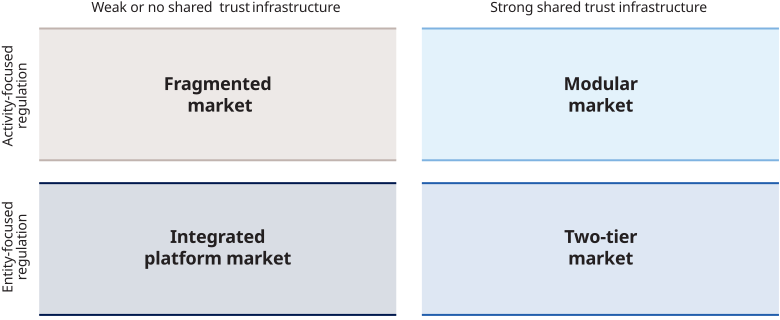
SIMFONIA favors the modular market because it could distribute the benefits of innovation more broadly. By allowing institutions to draw on shared infrastructure and specialized trust services, it could reduce repeated verification and support faster, lower-cost transactions. This would also require clear rules for recognition, reliance, and accountability.
The outcome is not predetermined. Technology, economics, liability, and governance will influence how markets develop. Sequencing matters, too: Where regulation of individual activities advances before shared infrastructure, assurance may remain fragmented. Where infrastructure develops first or alongside regulation, broader reliance on trusted evidence becomes possible.
Hong Kong illustrates how some of these foundations can develop. Its government-backed digital identity system, iAM Smart, launched in 2020. In 2021, the Hong Kong Monetary Authority confirmed that banks could use it for remote onboarding while retaining responsibility for customer due diligence. Data-sharing infrastructure followed, and stablecoin issuance became subject to licensing in 2025. These developments do not establish a fully modular market, but they illustrate how digital identity infrastructure and regulatory recognition can develop progressively.
Three practical steps to help financial markets move forward
Many of the components needed for shared trust infrastructure already exist in advanced jurisdictions. While SIMFONIA does not propose a finished architecture, questions remain around cross-border recognition, issuer trust, liability, and sustainable economics. The report identifies three practical steps to move forward.
- Establish clarity on using trusted information. Financial institutions could work with supervisors to confirm when information from recognized sources can be relied upon, starting with a specific use case in one market.
- Test how trust works across borders. Financial institutions in two financial centers could explore whether information verified in one jurisdiction can be accepted in another, and clarify who is responsible when that information is used.
- Create demand for reusable information. By committing to accept trusted information from recognized sources, financial institutions could encourage providers to invest in making that information available across the market.
Together, these steps could help address some of the barriers to wider adoption and support a more connected, efficient financial system.
The next chapter of digital finance will be shaped by how trust is established and shared across financial markets. Many of the building blocks already exist. The opportunity now lies in bringing them together through greater collaboration between financial institutions, regulators, and technology providers. This could support a more connected, efficient, and competitive financial system while preserving existing safeguards and accountability.
