


Across industries and business sizes, enterprises are humming with AI activity: proofs of concept, local automations, broad productivity tool rollouts. However, these varied deployment patterns often lack a repeatable path from idea to production to measurable value, leading to questions about the impact of so much effort. According to the Oliver Wyman Forum’s 2026 CEO Agenda report, 67% of CEOS say their organizations are still primarily planning or piloting AI rather than deploying at scale.
AI governance should be the bridge from pilot to production, helping organizations adopt AI at the technology’s pace and safely scale what works. But most organizations’ programs today are contributing to the problem. Too often, these programs solely focus on protecting against the risk of AI deployment, and deployment itself becomes the casualty. Good-faith teams seeking to build useful AI solutions for valuable work encounter a maze of policies, forms, review committees, manual evidence requests, and unclear data access, with wait times at every step.
At its worst, this approach to governance can create incentives that increase certain risks. As a chief analytics officer at a large healthcare payer told Oliver Wyman, “Our governance processes add so much burden that they decrease compliance and increase shadow AI.”
In this article, we introduce a governance model to help organizations scale AI and maximize their business impact, along with five shifts needed to put the model into practice.
How embedded AI governance helps organizations scale AI safely
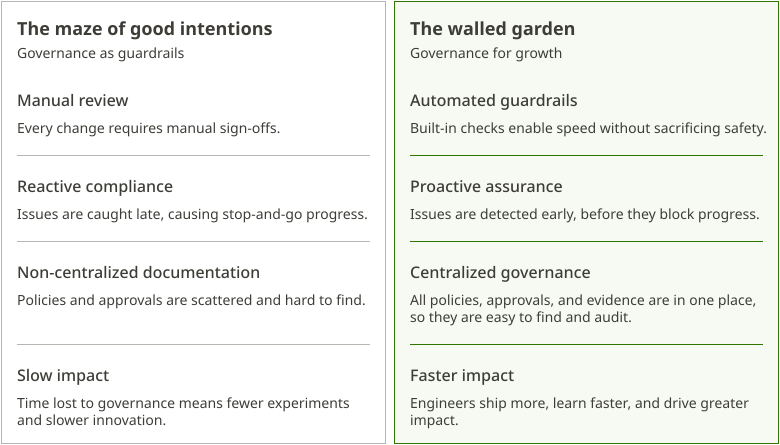
To help teams move quickly and safely, enterprises need a “walled garden” approach to AI governance, where built-in guardrails enable innovation within a controlled environment. Governance is embedded in development and deployment, automated where possible, and centrally managed (Exhibit 1).
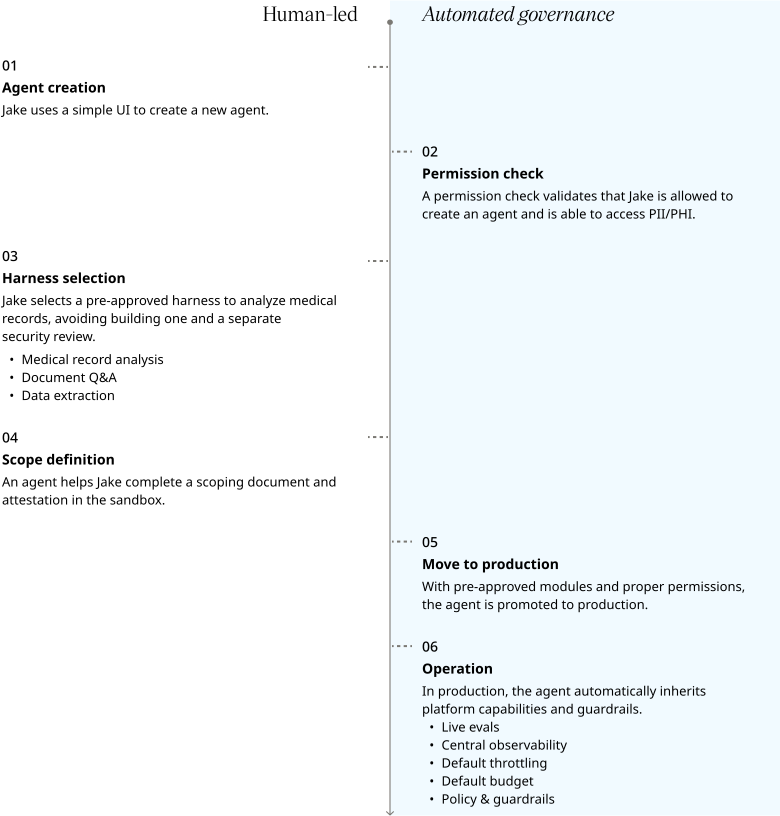
To see how this works in practice, consider the user journey at a healthcare payer that successfully built the technical foundations and operating model for embedded AI governance (Exhibit 2). An employee named Jake has an idea: He wants to create an agent that assembles evidence for prior authorization from medical records. First, the agent creation platform automatically confirms that Jake has the necessary training, PII/PHI data access, and permissions to make the relevant system changes for his use case. Then, from preapproved agent harnesses, Jake chooses one suited for medical records analysis because of its ability to handle personal health information and data provenance, as well as its connections to clinical search tools.
When Jake is working on his use case, an AI agent in the same environment helps him complete a scoping and attestation document with build specifications such as data access permissions, the business unit for billing, and service level agreements. Because the agent handles PHI and informs coverage decisions, the platform routes its evaluation results for targeted human review, and clinical reviewers retain the final decision on every request. When the use case moves to production, it inherits observability, budgetary, and policy controls from a centralized platform.
Zooming out, this embedded governance model delivers greater efficiency and demonstrable value, which in turn enable scale. Provisioning development environments is dramatically faster now because it involves combining modules rather than following a bespoke process. Risk and compliance teams of the same size can support a far greater number of AI use cases than before, each at greater scale. Deployed use cases also achieve their desired impact within budget; processes targeted by use cases, such as contract reviews, are completed in seconds rather than hours. Establishing the platform to enable this embedded approach to compliance requires up-front investment, but once established, we have seen it handle more than 80% of use cases automatically.
Today, this governance model is feasible for simpler agents within predefined archetypes; more complex agents can benefit from automated guardrails but also need more extensive risk coverage. Nevertheless, the long-term aim for enterprises should be a mature, strategic approach to AI governance across all use cases, with full agent lifecycle automation, continuous evaluations while agents are in production, and agents provisioning and retiring other agents as needed. Only organizations that commit to building the prerequisite governance platform today will achieve this level of maturity and realize the gains it enables from agentic AI at scale.
Five shifts to implement effective AI governance
To unlock greater returns on AI investment, enterprises should pursue five operating shifts in their AI governance models.
1. Automate mechanical tasks, amplify human accountability
Map governance work against two categories: tasks that can be reduced to mechanical processes and those that depend on accountability. Use software to automate the slow, mechanical parts such as routing, evidence collection, standard testing, usage monitoring, and audit trails. Reserve ownership of risk appetite, exception handling, residual risk decisions, regulatory escalation, and business outcomes for human experts.
To escalate governance reviews to humans only when necessary and cut through delays otherwise, use an automated tool to route AI use cases by risk level. Score them on the AI’s ability to make changes to systems, the potential effects of those actions inside and outside the organization, and the potential value the use case could bring to core business functions.
Based on this approach, low-risk, well-understood use cases — an internal case summarization assistant, for instance — can move quickly toward approval. Higher-risk cases, like a customer-facing agent that could misstate consequential policies, will be more deeply scrutinized. With this smart routing, weeks of triage can be compressed to days.
2. Make approved AI deployment paths easy to find and use
Users and builders are more likely to make compliance their default if it is the easiest course of action, reducing the temptation to work around controls or just drop projects. To that end, furnish teams with end-to-end approved tooling that accelerates their work. This includes agentic harnesses that provide AI models with vetted capabilities to interact with their environments; code modules to automate digital infrastructure configuration; and governed APIs to speed up integrations within security, access, and usage controls. In the example at the healthcare payer above, Jake can get started on his agent quickly because he knows the setup and templates — they are the same ones he has used before, in a familiar environment.
3. Embed AI governance controls into the workflow
Much as tools should be easy to find and use, controls should be embedded throughout the AI delivery lifecycle so compliance happens with minimal friction. The development environment can provide builders with approved tooling while identity and entitlement systems govern what data they and their AI systems can access and what actions they can take.
Before release, deployment pipelines should automatically run required performance evaluations and policy checks. When a use case is deployed in the organization, runtime controls should constrain users’ and AI systems’ access to tools and data to what the use case requires, monitor system behavior, and trigger escalation for review when thresholds are breached. Material changes to the models, data, or other systems and tools the use case relies on should trigger retesting. Throughout this lifecycle, where requirements can be expressed deterministically, policy-as-code can translate them into machine-enforceable controls.
4. Manage for value in addition to permission
Connect risk review with value measurement from the start so governance considers both whether a use case is permissible and whether it is valuable. Measures include expected savings or revenue, adoption needed to realize those benefits, and the financial and operational burden to run the use case over time. These all help establish the conditions under which the use case should be expanded, redesigned, or retired.
Jake’s agent that assembles medical evidence for prior authorization would be a valuable proposition to his organization because it could streamline essential workflows for the business. This means requests associated with building his agent would receive priority in reviews and extra attention to creating reusable, scalable modules.
5. Govern AI as a live system, not a one-time approval
Once a use case is in production, continually assess whether it is being used as intended, whether its risk profile remains acceptable, and whether the value case still holds. This requires usage monitoring, performance and quality checks, incident reporting, escalation triggers, periodic recertification, change reviews, and defined retirement criteria. If evaluation results exceed a set threshold, they should trigger a defined process and tooling to rapidly identify and resolve the failure.
Setting the AI governance agenda from the top down
To gauge their organization’s governance maturity, executives should be prepared to ask their technology and risk leaders the following questions:
- How does the organization assess AI risk?
- To what extent is AI risk assessment delivered “as a service” — a standardized, embedded capability?
- What are the governance program’s key measures of success?
- Which high-priority AI use case could demonstrate the effectiveness of the governance model?
As AI governance matures, business leaders will gain a powerful view of their organization’s AI portfolio, including projects in development, deployed use cases, emerging risks, usage, costs, and value.