


M&A and offshore delivery fueled the first wave of consolidation among US certified public accounting (CPA) firms. Private equity (PE) investors bought firms, combined them into larger platforms, and drove down delivery costs. A fragmented market offered plenty of acquisition targets, helping fuel expansion. Today, that formula is getting harder to repeat.
As competition intensifies and acquisition valuations rise, buying more firms alone won't guarantee stronger returns. Investors need to make those acquisitions work harder by integrating operations, improving productivity, and finding new sources of organic growth. At the same time, rising offshore costs and advances in AI are challenging delivery models and adding pressure on CPA platforms to rethink how they operate.
The surge in acquisitions makes this challenge even more apparent. Annual tuck-in deal volume has grown almost six-fold since 2020, but that growth hasn't translated into consistent performance. Among the top 50 firms, revenue per partner ranges from approximately $1.25 million to $7 million, highlighting the gap between building scale and delivering stronger returns.
The next wave of value creation will come from making the platforms work better as a whole. To drive stronger productivity and organic growth, firms should integrate acquisitions more effectively, rethink how work gets done, sharpen pricing discipline, and align partner incentives.
On paper, many firms are doing the right things. In practice, old habits are proving harder to break. Findings from Oliver Wyman interviews with more than 350 CPA partners and senior leaders reveal a disconnect between ambition and execution.
For investors, the opportunity is to close those gaps and make bigger platforms into better businesses. We’ve identified five necessary steps that will move the business toward those goals.
1. Integrate acquired CPA firms into one operating business
Shared ownership and a common name aren’t enough. Leadership, talent, technology, pricing, and incentives all have to pull in the same direction. Without that, a platform can still operate like a collection of separate firms long after the deals close.
Traditionally, CPA partners have had significant control over their client relationships, staffing, and business decisions. While autonomy has advantages, it can make it harder to operate as one firm after an acquisition. Our research respondents pointed to sharper communication, clearer career paths, and stronger cultural integration as the biggest opportunities for improvement.
Integration can’t stop with systems. Firms need to establish clear expectations early around who makes decisions, how people advance, how work flows across the platform, and how partners work together within a larger organization.
For investors, better integration should translate into stronger platform performance. Higher productivity, more consistent quality, and stronger revenue per partner can show that acquisitions are making the business stronger. That’s especially important in audit, where quality is becoming an increasingly visible test of whether integration and new delivery models are working, and regulators are watching PE-backed audit practices closely.
2. Rethink CPA workflows, service mix, and pricing with AI
AI is making inroads, but mostly at the edges. About 80% of respondents say AI has replaced less than 15% of tasks, with much of that concentrated in data extraction, document review, knowledge searches, and administrative work. More specialized work — touching areas like advisory judgment, complex tax, and audit risk — remains largely untouched.
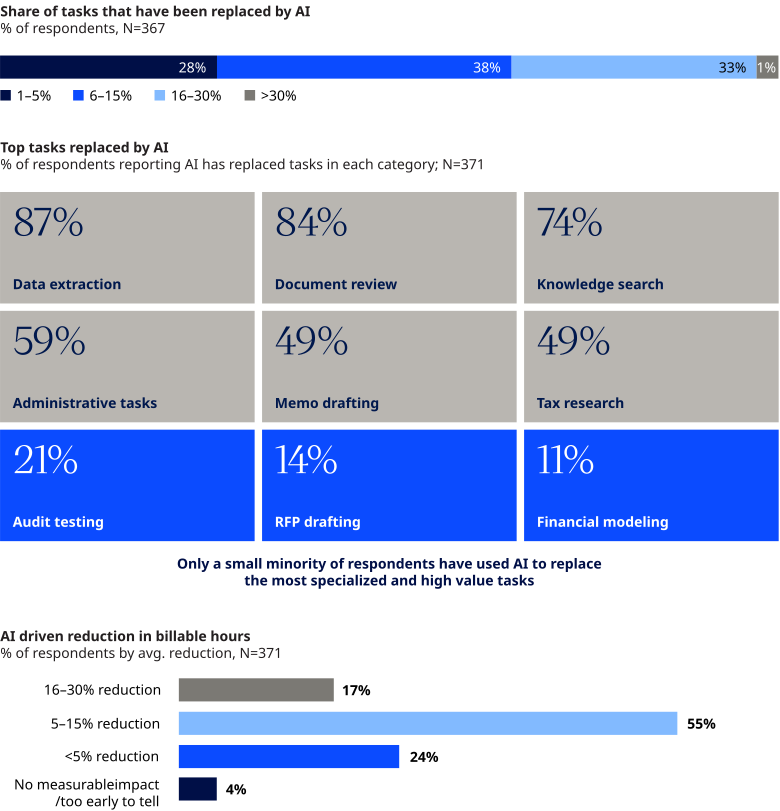
The bigger opportunity goes beyond automating individual tasks. AI gives firms a chance to rethink their workflows in a world where the scarcity and cost profile of key inputs look different than they did in the recent past. This includes reevaluating which tasks can be automated, which can move to different resources, and where experienced professionals add the most value.
In some areas, AI could help firms strengthen their offerings and protect pricing and margins. In others, adoption may become table stakes for remaining competitive, even as it accelerates commoditization and pricing pressure.
For investors, that makes service mix an increasingly important part of the value-creation strategy. Where should the platform continue investing, and which services could become harder to differentiate as AI advances?
Over time, AI could also reshape the traditional CPA labor pyramid and the way firms charge for work. Our research shows that 56% of respondents expect AI to reduce reliance on hourly billing, while 50% anticipate a shift toward value- or outcome-based pricing and 48% foresee greater use of fixed-fee models. To capture AI-driven productivity gains without giving those savings back through lower fees, firms should rethink pricing alongside delivery.
3. Combine AI and offshore delivery to improve CPA productivity
AI and offshore delivery shouldn’t be separate strategies. Weigh the capabilities and costs of onshore labor, offshore labor, and AI to determine the best approach for each task.
There’s plenty of room for improvement, but the challenges go beyond operations. More than half of survey respondents say their firms use offshore resources on fewer than 15% of engagements. Partner incentives, quality concerns, and onshore utilization targets have made the status quo more attractive than shifting to lower-cost delivery models for some.
AI could hit the same wall. If partners are rewarded for revenue and utilization rather than stronger margins, there’s little incentive to change, no matter how good the technology gets.
The goal should be a smarter mix — AI where it works, offshore where it makes sense, and experienced professionals where judgment counts. Getting that mix right will enable the staffing model to look different, too. But the first step is organizing around the work itself, rather than the teams already in place.
4. Incentivize partners to price smarter and sell more
Lead engagement partners still have considerable control over the prices they charge. But when rewards favor revenue over margin, partners have less reason to prioritize cost-effective delivery.
More than 90% of firms report having standardized pricing guidelines and formal exception governance. However, at the median firm, at least 20% of engagements still fall outside standard pricing. Getting partners to apply those standards consistently in their day-to-day decisions is still a challenge.
The same dynamic plays out in cross-sell. Partners may hesitate to bring another service line into a client account if the revenue, and the credit, goes elsewhere. Incentives shape behavior.
PE-backed firms getting cross-sell right take a different approach. They plan for it, and they pay partners to do it.
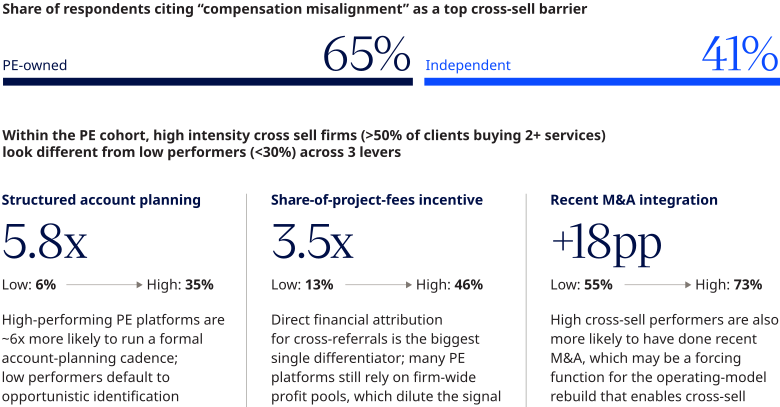
Compared with firms with weaker cross-sell outcomes, those with strong outcomes are nearly six times as likely to have a formalized account planning process and 3.5 times as likely to directly reward partners for bringing in other services. Both practices are closely linked to stronger performance, giving firms a more consistent way to grow existing client relationships.
For investors, the takeaway is to look past the policy manual. Pricing rules, cross-sell targets, and growth plans only go so far if partner economics keep rewarding old behavior.
5. Build a differentiated CPA platform that the next buyer will value
What investors need from a CPA platform changes over the course of the investment. Scale alone doesn’t set firms apart, either. Nearly 80% of respondents see industry specialization as an important part of their strategy, with about 70% citing higher win rates, 60% stronger brand credibility, and 55% greater pricing power as benefits.
For investors, that puts a premium on identifying where a platform can credibly lead rather than trying to compete equally across every market.
For investors entering the market, start with the foundation. Look beyond market fragmentation to whether the firm has a clear path to differentiation via leadership, partner alignment, systems, data, quality controls, and service mix to grow as one business.
For recent investors, the early years are about putting that model in place. The first 12 to 18 months are a critical window to strengthen pricing, build cross-sell into the business, take a fresh approach to delivery, and make the “where to play” investments to ensure the firm can truly stand out. Those changes become harder once the organization settles back into old routines.
For investors nearing exit, results need to tell the story. Organic growth, stronger pricing, higher productivity, more cross-sell, better audit quality, and higher revenue per partner should show how the business improved during the hold period and built a differentiated position that the next buyer can continue to grow.
Each stage raises the bar. New investors need to see the potential for a strong platform. Recent investors need to build it, and those nearing exit need to prove what changed. CPA consolidation still has room to run. The first phase created scale. The next is about proving what that scale enables and building a stronger business with value that’s clear to the next buyer.