


Agentic AI has moved from developer curiosity to a significant line item that most large technology functions are now expected to defend in front of a board. But for many in those functions, the instinct is to treat agentic AI’s shift to a much larger playing field as if it were still a procurement issue: select the platform, buy the seats, count the lines of code.
As a result, agentic AI could become a faster route to defects and incidents rather than the total rewrite of an organization’s operating model, delivery platform, talent model, governance, unit economics, and vendor dependencies that successful adoption requires. Scaling agentic AI must be less about tool selection and more about a transformation of how an organization operates; that shift will decide whether the technology ends up delivering value or compounding existing weaknesses.
Scaling successfully can pay off, although not as much as some vendors contend. Our 2026 Parallel Surveys of CEOs and Tech Leaders on Agentic AI and IT, found that 84% of 130 chief information and chief technology officers reported productivity gain of between 0% and 20%. That’s an order of magnitude below many headline claims from vendors, and the top of that range far from assured; falling short can also be costly.
The more consequential number for technology leaders is often not the gain itself but the spread around it. Our research found that the difference between a disciplined adoption of agentic AI and a rushed, reactive implementation could be as much as 10% to 15% of the addressable cost base each year.
Scaling AI means building infrastructure in the proper order
What often thwarts technology functions is the speed at which agentic AI spews code and new data. Agentic AI runs at super-fast clock speed, accelerating the operating rhythm IT organizations must adopt to keep up with AI agents as they generate, act, spend, and fail far faster than traditional enterprise processes respond.
A frontier model rebases its capability roughly every six months, while an enterprise IT decision still sits on a three-to-five-year horizon. An exploit can be working in hours, while a patch can take weeks. Without the right framework and guardrails in place, a tech department can easily find itself wading through reams of code and potential defects and incidents.
This is where sequencing becomes the key to successful AI adoption and scaling. Sequenced well, agentic AI converts a mature platform into measurable unit-cost improvement; sequenced badly, it converts an inefficient delivery system into more code, more incidents, and a remediation queue that consumes the gain.
Agentic AI ambition may be outrunning funding
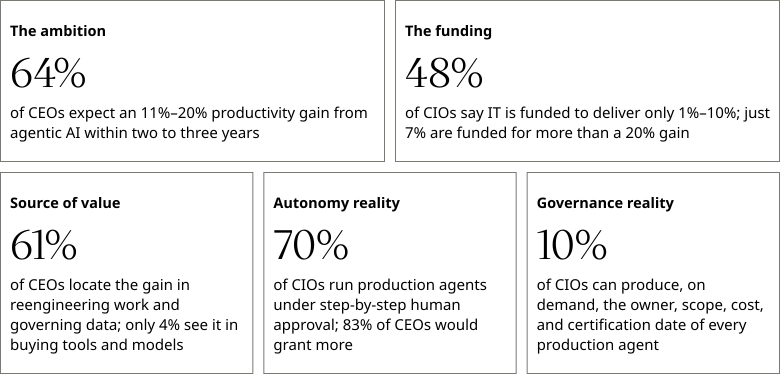
In our 2026 surveys, responses from 70 chief executives and board executive committee members from large companies revealed that top management expectations for returns on agentic AI seemed to be outpacing the funding available to their technology functions. While 64% of CEOs interviewed expect a productivity gain of 11% to 20% over the next two to three years, almost half of the CIOs and CTOs say current IT funding is sufficient to deliver only a 1% to 10% gain. Just 7% reported funding sufficient to deliver a return above 20%.
Only 29% of CEOs have ring-fenced funding for the platform, data, and change work that makes agents productive, while 60% have simply raised overall AI spending without specifying how it will be used. In other words, most organizations are choosing to fund agents while underfunding the conditions those agents depend on for success. That decision can lead to the kind of productivity ambition that causes operational incidents instead of gains.
CIOs remain cautious on agent autonomy, with 70% requiring human approval at each step. Yet control is still surprisingly weak: Only 10% can describe, when requested, core governance information for every production agent.
Agentic AI delivers value only with strong operating models
Decisions on the operating model determine whether value is added or defects compounded. AI must be considered a potential amplifier of both the strengths and weaknesses of an organization’s delivery system. Strong platforms, clean workflows, and substantive engineering controls are more likely to convert agents into value. On the other hand, agentic AI superimposed on an inefficient operating model can leave an IT department busy cleaning up agent mistakes.
Given the funding gap described by CIOs and CTOs, that is a real possibility for many large enterprises. One possible consequence is that that several agentic AI projects will be canceled before implementation because of cost creep, unclear value, and weak risk controls. Organizations that treat operating models as the main program, rather than as procurement around agentic AI, are the ones that will sit outside that statistic.
Agentic value hinges on reengineering work, not automating tasks
On a positive note, executives agree on where the real gains can be realized: Sixty-one percent of CEOs said they come from reengineering how the work is done and governing data, while only 4% pointed to buying and deploying the best tools.
The larger opportunity is to restructure the system around the tasks — providing what we call a semantic harness by simplifying processes, agreeing on shared context, and giving agents a defined framework of vocabulary, skills, memory, and guardrails. The binding constraint sits inside the enterprise: Only an organization can structure its own information, data, knowledge, and processes for agentic work, yet only 27% of CIOs bought or built a governance platform before their first agent existed, and 60% are now retrofitting governance onto an already sizable portfolio.
A mature internal developer platform is what makes the work repeatable, giving agents approved development paths, bounded access to data, and traceability by default. That organizational learning gap is what separates enterprises that scale from those that remain stuck in pilots or end up cancelling projects.
How to scale agentic AI from pilot to enterprise value
Capturing the value requires treating expansion as a sequenced change program rather than a rollout. Before any solution arrives, enterprises should establish a delivery baseline and develop local champions so that gains are measured against evidence rather than vendor claims.
Enterprises should start small with a contained part of the application landscape and a few teams to build momentum. They should reengineer the processes before introducing agents into them. Next, they should build the semantic harness on a mature platform before scaling adoption and implement FinOps — a financial management discipline that tracks, allocates, and optimizes cloud and AI spending — with token-level visibility and chargeback from day one, rather than incurring a large charge after the portfolio has grown.
Finally, they should match the delivery method to the work. Exploratory code can be improvised, but production code should be specification-driven, with the person who deploys agent-written code remaining clearly accountable for it. Organizations that skip steps in this sequence do not move faster; they simply move the cost downstream into incidents and rework.
The shift to AI must not weaken the software engineering bench
Our surveys point to a clear conclusion: Agentic AI cannot succeed without a shift from a labor model of IT to a supervision model. Sixty-eight percent of CIOs named finding and reskilling talent as their binding constraint.
While an enterprise can hand over production work to agents, its workforce must retain the understanding needed to evaluate what they produce. The workforce should therefore focus increasingly on intent, architecture, quality standards, and supervision as agents take on more execution.
But the productivity gain from the transfer of work is uneven: Less experienced developers can show larger gains in raw output, but disciplined senior engineers are the ones who convert agent output into shipped, maintainable software. That conversion, and not the volume of code, is where the value sits.
External labor-market data also highlight the shift: Stanford's Digital Economy Lab, using ADP payroll data, reports employment among 22- to 25-year-olds in AI-exposed occupations falling by about 16% relative to older peers in the same roles, even as software employment overall is projected to keep growing. Our surveys supports that conclusion: Junior hiring held steady in 58% of organizations we interviewed over the last 18 months, and 17% said their tech payrolls had increased, while 23% reported a deliberate downsizing.
But the pendulum cannot swing too far. An organization that stops backfilling junior roles today may inadvertently dismantle its talent bench from which the next generation of supervising engineers must come.
A roadmap to scaling agentic AI across the enterprise
Agentic AI has become table stakes for enterprises. The real question facing technology leaders is whether they are prepared to rebuild the organization so it can capture agentic AI’s value, or whether they will tack the technology on in fragments that compound weaknesses and flaws.
That work starts with the operating model, runs through disciplined sequencing, and depends on having the supervisory talent in place. Allowing fragmented adoption to shape the organization by default is the surest way to reliably destroy agentic AI’s value.
The organizations that answer these questions first and best will set the pace and metrics for competitors that follow.


