


As AI changes how travelers discover, compare, and book trips, travel companies face a strategic question: Who will control the traveler relationship, and how could that reshape travel distribution?
Generative AI is becoming a more prominent part of the traveler journey. According to Phocuswright data and Oliver Wyman analysis, AI use for researching and selecting travel options increased 2.8 times in the 12 months ending mid-2025.
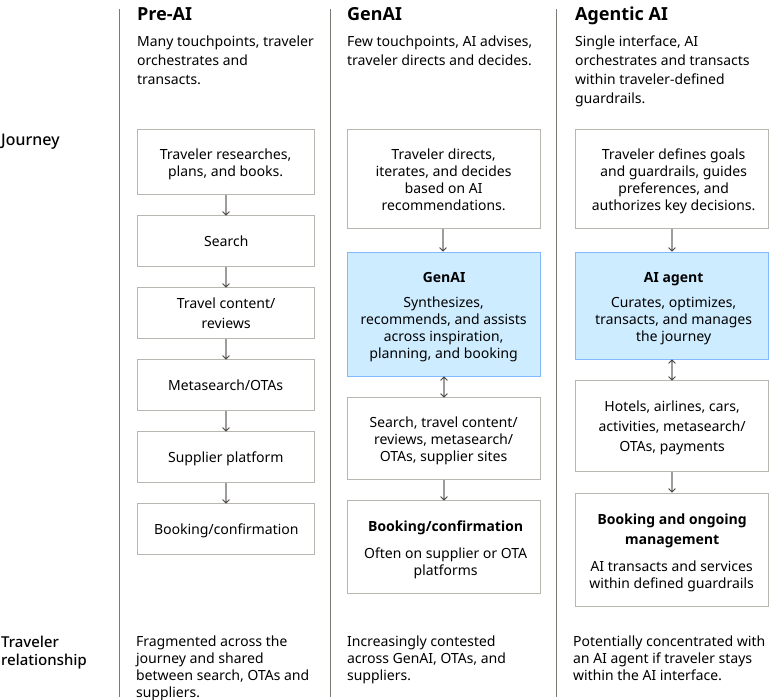
Travel planning has traditionally involved moving between search engines, review sites, online travel agencies (OTAs), airline and hotel websites, and payment platforms. AI is beginning to bring more of these activities into a single interface. The implications extend beyond traveler convenience. AI could influence which travel companies customers encounter, which options they consider, and where bookings ultimately flow.
For travel leaders, the challenge is to understand how AI travel distribution is likely to reshape customer relationships, distribution economics, and competitive advantage.
How AI travel agents are changing trip planning and booking
In the past, travelers who opted against using a human travel agent took on the responsibility of researching destinations, comparing options, reviewing accommodations, and coordinating bookings across multiple providers.
AI travel agents could increasingly take over these activities. Instead of conducting several searches, a traveler might specify a budget, destination preferences, flight restrictions, and hotel requirements. An AI agent could then compare options, assemble an itinerary, and potentially complete transactions within those parameters. The traveler would move from doing the research and planning to setting preferences, restrictions, and goals and approving the output.
However, greater automation does not necessarily mean travelers are willing to give up control. In the Oliver Wyman Forum's April 2026 Global Voices research, only 7% of consumers said they would allow an AI travel assistant to handle everything and notify them of the result. Another 17% preferred to make all decisions without AI involvement, and 17% wanted AI to provide information without suggesting or making decisions.
These findings suggest that AI success is likely to depend on understanding which decisions travelers are comfortable delegating. A routine booking and a long-awaited family vacation will necessitate different levels of human involvement, and attempts to push beyond boundaries set by travelers on AI involvement may not be welcome.
Control over AI interface could reshape travel distribution
As AI takes on more of the traveler journey, the number of visible touchpoints with travelers could decline. This creates different opportunities for travel companies. For instance, if an OTA controls the AI interface, it could strengthen its position as the traveler's gateway to suppliers. If an airline or hotel company controls that interface, it could reinforce its direct relationship with travelers.
A different competitive dynamic emerges when travelers begin their journeys with general-purpose AI platforms. In that scenario, activities such as understanding traveler priorities, recommending options, and potentially facilitating transactions could move outside traditional travel channels.
For travel companies, being available for AI travel booking may prove insufficient. They must ensure that AI travel interfaces cannot only discover their products and services but also price them and understand what makes each offering different from the others. This capability matters because an AI platform could influence a booking decision without completing the transaction itself by recommending certain products and services.
While travel suppliers might still fulfill bookings, other platforms are likely to be increasingly influencing which options travelers consider. Thus, the emerging competition is about which entities shape travel decisions that ultimately lead to transactions, as well as which processes the purchases
Three ways AI could reshape the economics of travel distribution
Changes in traveler interfaces are likely to affect how companies acquire customers and manage distribution costs. Three economic considerations deserve attention:
- Paid marketing costs. Some spending currently directed toward search engines and metasearch platforms may shift as AI becomes a more significant channel for travel discovery.
- AI referral and access fees. If AI platforms become meaningful sources of qualified travel demand, new commercial models could emerge around visibility, referrals, access, and transactions.
- OTA commissions and supplier distribution costs. AI-mediated discovery could influence how demand moves between intermediaries and suppliers, potentially affecting existing distribution arrangements.
These commercial models are still developing, and their eventual economic impact remains uncertain.
Nevertheless, travel companies need to consider how control of the AI interface could influence demand and booking flows. The company that fulfills a booking may not be the same company that influences the traveler's decision. This distinction could become increasingly important when evaluating distribution partnerships and strategies for acquiring travel customers.
How loyalty and personalization could give travel brands an AI advantage
The growth of general-purpose AI does not eliminate the advantages of established travel companies. Existing travel customer relationships can provide a foundation for trust.
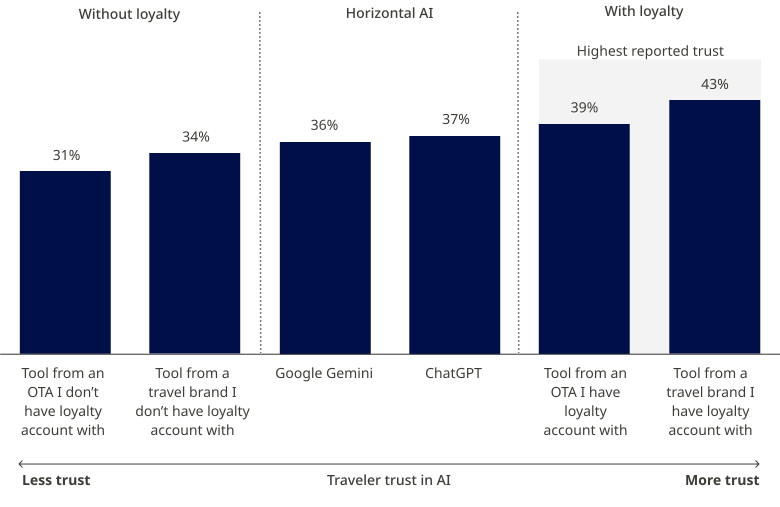
Our survey found that travelers reported eight to nine percentage points higher trust in AI tools from OTAs or travel brands with which they had an existing loyalty relationship, compared with those with which they did not.
General-purpose AI tools, including ChatGPT and Gemini, attracted higher reported trust than travel-company AI tools without a loyalty relationship attached, but lower trust than travel-company AI tools supported by one. These findings suggest that loyalty could remain an important competitive asset as AI becomes more integrated into travel planning and booking.
Travel companies may also have access to permissioned first-party information, including previous bookings, stated preferences, travel patterns, and service interactions. This information can help companies understand not only what travelers are looking for today, but also how they typically travel. Emerging applications such as digital twins could eventually simulate individual traveler responses to offers, communications, and journey changes before they are introduced to the market.
However, the competitive advantage may not belong to the company with the most customer data, but rather to companies that use trusted information to create experiences travelers find genuinely useful.
Three AI strategies for the future of travel distribution
AI travel distribution presents strategic choices that extend beyond technology adoption.
Travel leaders need to determine how to maintain meaningful customer relationships, prepare for new distribution models, and participate in emerging AI ecosystems.
Three priorities stand out:
- Deepen the traveler relationship. Use AI, loyalty programs, and first-party data to make inspiration, planning, booking, and servicing more relevant to individual travelers.
- Prepare for AI-mediated distribution. Ensure that content, inventory, rates, policies, booking capabilities, and servicing functions can be discovered, understood, and used by AI interfaces.
- Decide where to own and where to participate. Determine which traveler-facing AI experiences to develop directly and where participation through third-party platforms makes more sense.
For many large travel companies, the answer may involve building their own traveler-facing AI experiences and participating in external ecosystems. These decisions should account for distribution economics, access to customer data, and ownership of the traveler relationship.
AI is not simply introducing another way to plan a trip. It could change which companies influence travel decisions and how value is distributed across industry. The strategic question is no longer only how travelers will use AI but who will shape their experience and ultimately control the traveler relationship as the journey evolves.