


The global telecom sector is facing an AI profitability paradox. While AI use cases are multiplying and operators report meaningful savings, these gains are difficult to see in the profit and loss statements. As boards and investors demand clearer returns, scrutiny is intensifying and early signs of AI fatigue are emerging.
Our research examines the hard truths of scaling AI in telecom for CEOs, boards, and investors. It draws on four sources: Interviews with telecom executives covering AI deployment, value capture, governance, and scaling costs; the 2026 Oliver Wyman Forum and New York Stock Exchange CEO Agenda survey; a five-year financial benchmark of 30 leading listed telecom groups; and analyst research. Oliver Wyman’s sector model combines these inputs to estimate AI’s net impact on the telecom cost base, considering the share of activities exposed to AI, productivity gains from scaled use cases and operator ambitions, and the full costs of deployment and adoption.
Two hard truths about scaling AI in telecom
Our research reveals two hard truths for telecom operators.
1. Telecom AI adoption grows, but financial impact remains limited
Operators have rapidly expanded AI portfolios, from 30 to 300 use cases, and report meaningful savings in customer care, network, and technology. Among technology, media, and telecom CEOs, 23% report AI cost savings above 10%.
But the gains remain fragmented and have not translated into a visible step change in earnings before interest, taxes, depreciation, and amortization (EBITDA), free cash flow, or revenue growth. Average telecom-sector EBITDA growth has remained modest over the last two years, and telecom executives are also cautious about AI’s future impact on revenues, expecting AI to lift core revenue by only 1% to 2% over the next three years.
2. AI governance and data readiness remain telecom challenges
Efforts to scale AI are exposing gaps in target setting, value steering, end-to-end process redesign, data and technology foundations, and human-agent accountability. Few operators can do more than automate individual tasks, while financial governance and reusable enterprise capabilities remain patchy. No operator yet measures AI economics in full, with the benefits mostly reported on a gross basis. Only 22% of CEOs interviewed explicitly described finance or controlling functions as a formal validator of AI benefits, and the same percentage showed clear evidence of redesigning processes end-to-end.
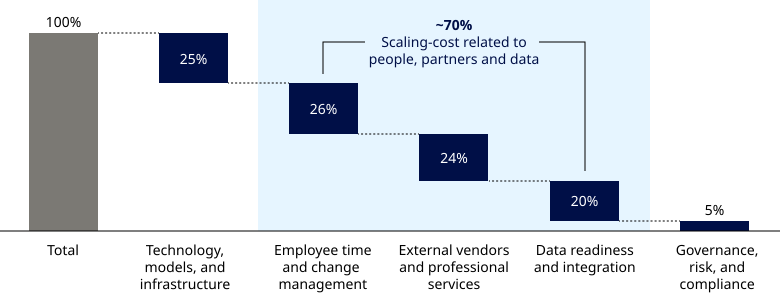
The foundations are also uneven. About 67% of respondents reported material gaps in data readiness, legacy integration, or core technology. Approximately 70% of the cost of scaling comes from people, partners, and data rather than core AI technology. And no operator has fully codified an enterprise-wide human-agent operating model.
Four strategic priorities to turn telecom AI adoption into value
To move beyond isolated AI gains, telecom operators must fundamentally rethink how they capture economic value, scale AI across the enterprise, and strengthen their competitive position. Four strategic priorities will be critical to help operators build their own AI value equation and translate AI investments into sustainable financial performance:
1. Sharpen the focus on economic outcomes and net cash benefit
While the first generation of AI programs was measured through use cases, adoption, and productivity, leaders should now set enterprise and functional targets linked to net cost-to-serve, capital intensity, free cash flow, and return on capital employed (ROCE). They should fully load costs and decide upfront how released capacity will translate into lower spend or deliberate reinvestment.
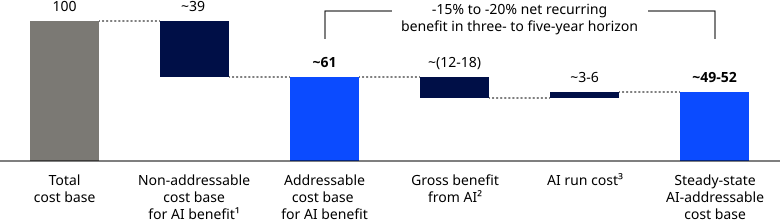
We estimate that AI could reduce addressable net cost-to-serve by 15% to 20% over the next three to five years, while fundamentally reshaping the cost base by function, with technology and IT the only function in which costs are unlikely to drop. AI could create about 1 to 2 percentage points of capital expenditure (capex) intensity headroom.
Telecom operators will have to explicitly manage the resulting J-curve: investing upfront, absorbing near-term headwinds, then locking in structural benefits.
2. Industrialize and scale the AI operating model around three clocks
Transforming across the enterprise requires a different operating model from deploying isolated use cases. Operators should build a cross-functional engine linking strategy, shared enablement, and execution close to the business. That means concentrating resources on a few end-to-end processes instead of spreading them across a broad catalog of use cases.
Speed matters, but the transformation should run on three clocks, with management tracking each timeframe separately: technical deployment, which can take anywhere from weeks to a year; economic validation, which for most operators lasts six to twelve months; and structural conversion, which typically takes years.
Culture will dictate the pace of change far more than access to tools. Approximately 55% of operators already provide AI tools to at least three-quarters of their employees, while change management alone accounts for 26% of scaling cost.
3. Strengthen the telecom competitive moat to retain AI telecom value
Cost efficiency is necessary but unlikely to create durable advantages, particularly where benefits are passed through to customers. in the form of lower prices. AI increases competitive pressure because it makes it easier to compare prices and switch providers, raising the bar for customer experience, and allowing disintermediation and new models. models. This means operators need to work much harder to use AI to strengthen their own competitive advantages.
They can do this by using proprietary customer and network data to deliver better personalization, proactive service, and differentiated network performance. They can also preserve influence over the customer interface as AI agents increasingly compare and transact on customers’ behalf.
The moat lies in assets and experiences competitors cannot quickly replicate. Several operators, however, risk being stuck in the middle.
4. Manage AI scaling risks, rising costs, and workforce challenges
The first three priorities are about creating value; the fourth is about not losing it. Scaling AI introduces new failure modes through consumption-based AI spend, dependency on model, cloud, and platform providers, workforce disruption, and loss of critical human capability. Operators need AI financial operations (finops), modular architectures with credible exit paths, reusable controls, an enterprise control layer for agents, and role-level workforce transition plans.
Recurring AI run costs are the fastest-growing line in the transformation. Leaders forecast 20% to 30% growth in tools, licenses, and token costs over two years. A 15% to 20% net reduction in addressable costs does not automatically translate into an equal reduction in headcount. However, 43% of TMT leaders expect workforce reductions above 5% over the next one to two years.
How AI could reshape telecom enterprise value
Overall, we see more upside than downside for the sector, and a positive impact on enterprise value. AI will not earn telecom operators an “AI premium" multiple, but it can strengthen the traditional telecom valuation across revenue, cost, and capital. Enterprise value will still be driven by recurring free cash flow and ROCE.
Based on expert views, interviews, early AI results, and our model, we estimate that an average telecom operator could achieve a 15% to 20% net cost reduction on addressable spend by 2030.
After sharing back 60% of the value with customers, that could generate 3 to 4 percentage points of EBITDA margin improvement, 3 to 5 percentage points of incremental free cash flow as a share of revenue, 1 to 2 percentage points of capex intensity reduction, and approximately 1 percentage point in ROCE lift.
But this only works if operators translate productivity into structural cost and capital-efficiency gains. They must also invest enough in their moat to avoid passing all benefits to customers through lower prices.

Recent years have shown that operators on average, have not been able to translate their efficiency programs into tangible cash flow and ROCE gains. The telecom industry has long tended to pass a large share of its benefits to customers at the expense of margin. But the average telecom operator does not exist. Some have been able to create equity value. Others, meanwhile, have not. Artificial intelligence will not change that. Some operators will be able to build their own winning AI equations, while others will fail to do so and will see their value erode.
Our objective with this study is to give telecom operators the ingredients to build their own value equation and, in doing so, escape the AI profitability paradox.
