


Legacy systems and fragmented processes are more than operational headaches for business-to-business (B2B) telecom operators — they are profit killers.
Margins shrink as sprawling product catalogs, siloed IT stacks, and manual workflows consume up to one-third of operating expenses. There’s a need for companies to accelerate their modernization plans, compressing timelines from several years to 24 months. Doing so will help companies reclaim profitability, bolster service delivery, and outpace competitors.
Modernizing decades-old billing and network software traditionally spans five to seven years. But some operators halved this timeline by leveraging automation, artificial intelligence (AI), and digital agents to replace legacy systems, reducing costs and accelerating delivery of new services. This speed is critical to retaining corporate customers amid intensifying competition. IT modernization should be a strategic priority, and companies should start with systems that yield the greatest business value relative to their complexity and integration needs. For instance, improving customer experience, revenue growth, or regulatory compliance should take precedence if modernization is feasible within acceptable risk.
A margin crisis hiding in plain sight in B2B connectivity
B2B connectivity remains the industry's growth frontier, yet legacy inefficiencies threaten profitability. Paradoxically, rising revenue comes with shrinking profit margins. Product catalogs have ballooned to more than 10,000 stock keeping units (SKU), IT stacks remain fragmented from mergers, and manual order handoffs often consume 25% to 33% of operating expenses.
Customers primarily experience inefficiencies in the lead-to-cash process, which has evolved from a sprint into a complex maze filled with legal reviews, spreadsheet checks, and outdated provisioning queues. Industry standards indicate that B2B sales cycles typically range from four to seven months, extending further for complex products such as VPNs or SD-WAN bundles. By the time of activation, customers are increasingly drawn to more flexible solutions, which diminishes customer satisfaction and drives a shift toward over-the-top providers.
Five success factors driving B2B telco transformation
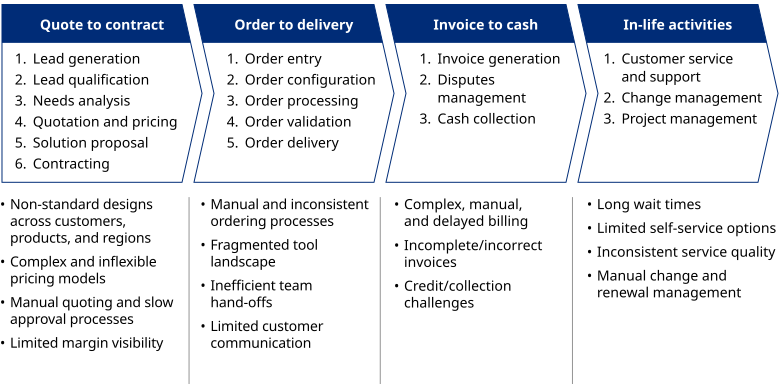
Compressing the modernization timeframe starts with a comprehensive redesign of lead-to-cash before any software build. Mapping the entire journey — awareness, quotation, contract, fulfillment, billing — and removing all exceptions creates dramatic efficiency gains. One European carrier cut 212 “pause states” from order workflows, releasing capacity equivalent to 200 full-time employees.
There are bottom-line improvements, too. A large client achieved substantial annualized gross savings within 18 months, boosting EBITDA margins and halting a prolonged decline. Redesigning order-to-cash and field-force processes further reduces EBITDA erosion and stabilizes earnings.
Five success factors distinguish this approach:
Radical process reengineering, not simple digitization
Map core business workflows — from winning new customers to resolving service issues and bringing new products to market — against a standard industry framework. Eliminate redundant variations before coding to prevent automating inefficiencies. Address fragmented data, stakeholder resistance, and crossover complexity with clear governance and stakeholder alignment.
AI-first automation infrastructure
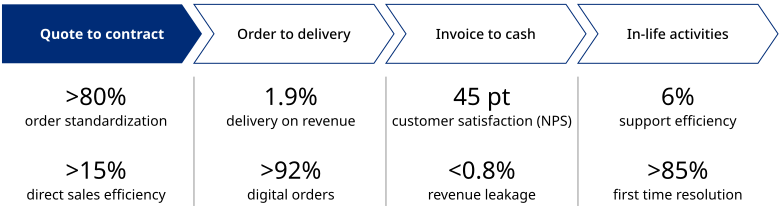
Reengineered quotation approvals can shrink from five days to under 10 minutes. AI tools like deal desks, anomaly detection engines, generative AI copilots, and digital agents improve accuracy, speed, and productivity. Together, they reduce latency, increase first-time resolution, and drive measurable business value.
Simplified product catalogs
Portfolio streamlining can significantly boost customer engagement while reducing operational complexity. In one example, the reduction of offer permutations across markets became a crucial factor in a telco group’s simplifications efforts, resulting in reallocating or retiring approximately 10% of its global workforce.
Disciplined governance and leadership accountability
Clear ownership structures with stage-gates and separate run and change profit-and-loss accounts ensure sustained momentum. Ring-fenced savings finance ongoing transformation sprints and accelerate legacy platform retirement. For example, a client's governance rigor enabled accelerated cash realization and headcount reductions.
Hybrid talent ecosystems
Combining in-house process owners with hyperscalers, software-as-a-service (SaaS) vendors, and reference architectures enables reuse of open standards and circumvents lengthy RFPs and bespoke integration challenges.
Accelerating B2B telcom innovation to stay competitive
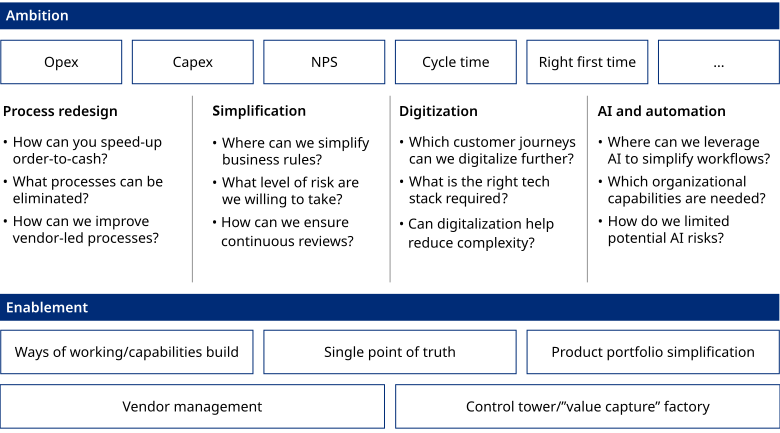
For executives, the essential question is what a 24-month overhaul means for their business. The answer: AI-driven transformation with rigorous governance is vital to stay competitive in B2B telecom. Swift actors can boost EBITDA margins four to six points, cut lead-to-cash cycles from months to weeks, and unlock capital for cloud, security, and edge investments.
Success requires clear ownership, appointing a single executive to be in charge while breaking down silos across product, sales, network, and finance. This leader secures board backing for 90-day stage-gates, funding only once cost and service milestones are met and self-funding future sprints.
Strategic sequencing focuses on highest-value bottlenecks first — quoting and contract validation — before automating provisioning and billing. This phased approach retires legacy systems and reduces operating expenses and cyber risks by 30% to 50% in two years.
Talent is also key. Successful operators deploy telecom-savvy data scientists, architects, and line managers with hyperscaler and SaaS partners providing pre-built microservices and TM Forum Open APIs. Integrated compliance and security experts help avoid regulatory pitfalls.
Managing change and measuring success in B2B telcom
Transparent communication, employee clarity on goals, and participation in process redesign build ownership and reduce resistance. Demonstrating quick wins creates momentum and credibility.
Leadership must view the 24-month transformation as a start, not a finish line. Removing bottlenecks enables dynamic pricing, swift bundling, and on-demand network slicing, gaining strategic advantage. Delays risk falling behind agile competitors.
Operators should track such key performance indicators as lead-to-cash cycle time, EBITDA margin improvements, customer satisfaction, and cost savings. These metrics link transformation efforts to outcomes, enabling course corrections and validating investments.
The future of B2B telecom growth and profitability depends on embracing this accelerated transformation with discipline and urgency.