


While the Gulf's rapid economic transformation is one of the world's most successful development stories, recent regional conflict has demonstrated how quickly geopolitics can disrupt supply chains, curb investment, and deflate confidence — even when critical infrastructure remains intact.
Our latest perspective, From Resilience to Reconfiguration: Five Geostrategic Questions for Gulf Leaders Navigating Conflict, outlines potential strategies to move away from short-term crisis responses toward durable models of leadership designed for a contested, complex, and volatile multipolar world.
Using geostrategic analysis of the current defense and security landscape, it explores the risks and opportunities Gulf leaders should consider to limit the impact of conflict and uncertainty on the region’s economies, institutions, and people. The paper assesses the outlook across three time horizons: the next 12 months, three years, and five years and beyond.
A new agenda for Gulf leaders
The paper first discusses how Gulf leaders can protect the systems that underpin societal confidence and continuity. Governments must absorb immediate shocks while ensuring decision makers share a common view of risk and response. That resilience must extend beyond defense and security to broader geostrategic elements of national governance: mobilizing organizational partnerships, protecting continuity of trade flows, deploying technology to protect against security gaps, sustaining a cross-government picture of threat, and preserving operational continuity of public services.
Next, policymakers must adapt their systems to meet the challenges of a changed environment. If the Gulf’s model was built during a period when stability could often be assumed, regional governments and businesses now need to redesign exposed dependencies, strengthen alternative routes and partnerships, and build greater redundancy into critical systems.
Finally, over the coming three to five years, Gulf leaders should prioritize policies that make their economies much harder to disrupt and much quicker to recover from future shocks. Achieving this will require strong coordination across government, business leaders, technology disruptors, and infrastructure operators – to maintain confidence even in periods of heightened uncertainty.
Five geostrategic priorities for Gulf leaders to strengthen resilience
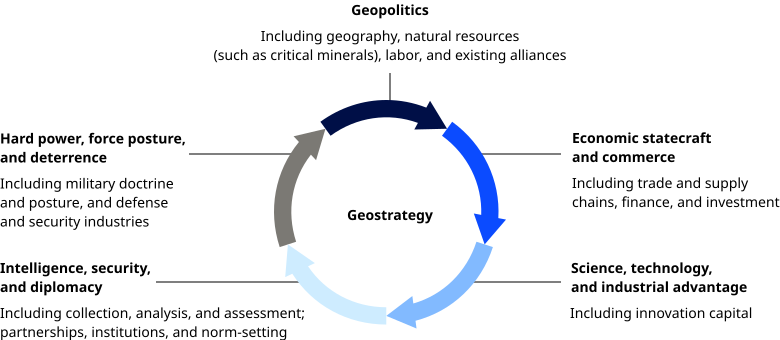
The 2026 conflict has reshaped the strategic landscape for Gulf states. Building long-term resilience will require leaders to focus on five critical priorities that span geopolitics, economic statecraft, technology and industrial advantage, intelligence, security and diplomacy, and deterrence.
1. Strengthen partnerships without creating new dependencies
Maintaining flexibility in a multipolar world means strengthening relationships that provide strategic value while avoiding overreliance on any single external partner. For Gulf states, resilience depends on partnerships that reduce vulnerability without creating new strategic dependencies.
2. Prevent economic disruption from becoming a tool for coercion
Economic statecraft and commerce will determine how well the region’s economic model can continue to function and grow through disruption. The Gulf’s role as a global platform depends on reliable flows of energy, capital, goods, people, and data. Protecting these flows is an economic priority and central to the region’s credibility.
3. Build industrial systems that adapt faster than threats
In the field of science, technology and industrial advantage, the challenge lies in how leaders can adapt faster than threats evolve. From infrastructure monitoring and cyber resilience to faster decision-making and industrial innovation, technology can shape how the region responds to crises. The priority must be to create systems that can test, scale, and deploy quickly.
4. Detect and contain disruption before it escalates
Intelligence, security, and diplomacy must play key roles in how the region detects and contains disruption. In a volatile environment, uncertainty itself can become destabilizing. Clear assessment, communication, coordination, and diplomacy can help prevent ambiguous and destabilizing situations from creating broader strategic shocks.
5. Reverse the cost asymmetry between disruption and defense
The key priority for Gulf leaders is to shift the cost of disruption. If the region can recover quickly, maintain continuity, and reduce the potential for political or economic coercion, disruption becomes less attractive to others.
Building a stronger future across the Gulf region
The most important message is not that the Gulf should prepare for permanent crisis. Rather, it should use this moment to build a stronger regional future, shaped by governments, business leaders, investors, infrastructure operators, technology providers, and institutions working in tandem.
The region’s development model has already proved that rapid transformation is possible. The next phase requires a broader reconfiguration to protect prosperity and preserve confidence.
Conflict is testing the Gulf’s operating model and demonstrating what is necessary to remain resilient. To get ahead of potential shocks, it is incumbent for leaders to move beyond absorbing disruption and start redesigning against it. This will reduce its strategic value and build a region that is better prepared for the future.
