


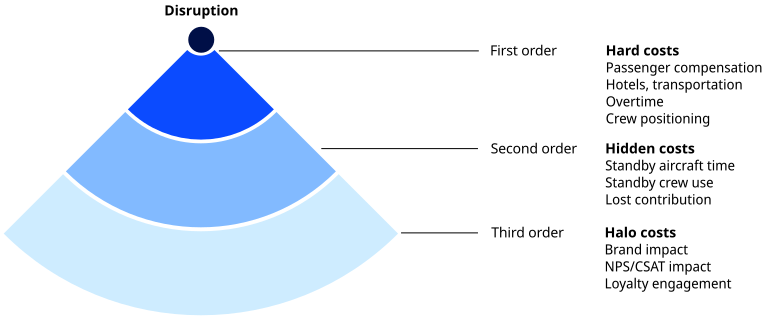
Airlines are investing heavily in optimization technology and artificial intelligence (AI) to improve their management of operational disruptions that regularly cost the industry hundreds of millions of dollars. Recent high-profile disruptions have carried price tags between $500 million and $750 million. But the cost factor is only one of the consequences for airlines of disruption, which can also include longer-term impacts such as customer alienation and the potential loss of revenue and trust.
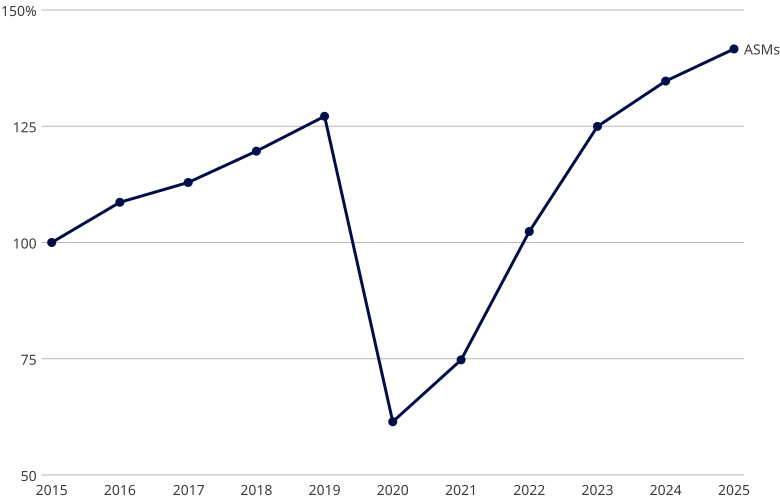
The scope of operational disruptions is connected to aviation’s large-scale growth over the last decade. In that period, the top 25 global carriers have boosted their network capacity by more than 40% on average. Now, airlines are trying to balance growth with disruption-related costs by using integrated optimization approaches that are becoming essential for serving customers, maintaining operational reliability, and ensuring financial sustainability.
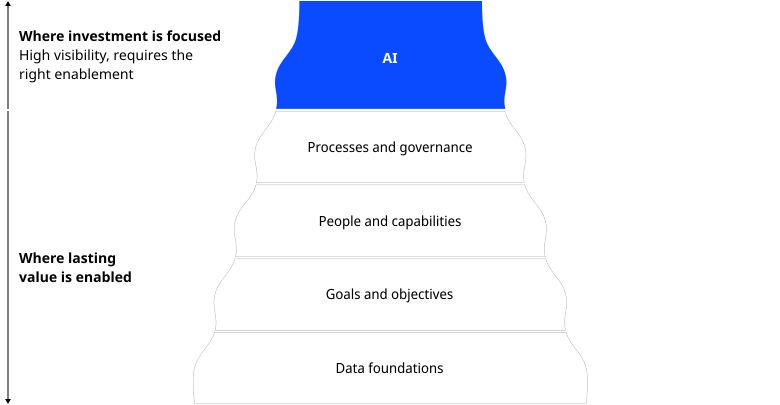
While these optimization approaches started with extensive investment in AI and optimization tools, many carriers are finding that those tools are not enough for effective disruption management. To cut costs sufficiently, optimization efforts must also include building data foundations, redefining workflows, and managing change.
How airlines can design disruption-ready operating models
Much of this pressure is felt within the operations control center (OCC), where teams manage day-to-day operations and respond swiftly to disruptions. Historically, recovery optimization has been siloed across aircraft, crew, passenger, and maintenance networks. With more advanced technology and AI now available, airlines are eager to connect these previously fragmented solutions to improve efficiency and reduce risk.
The temptation, given the pace of technological change, is to treat the drive toward integrated optimization as primarily a technology issue. But to ensure durability, the strategic energy of airline leadership should focus on thoughtful future-state design, including the operating model, workflows, and change management. This is where transformations succeed or fail.
Better disruption recovery protects revenue and customer trust
The case for improving disruption management is becoming harder to ignore as pressures only intensify and the costs of poor recoveries steadily rise. While disruption has always been part of airline operations, a single major operational event today can have a financial impact of hundreds of millions of dollars, making the case indisputable. Better recovery decisions reduce cancellations, protect revenue, limit compensation and care costs, and help preserve the planned schedule.
The customer case is just as important. More than 60% of consumers will abandon a brand after a single poor experience, and among high-income consumers, that figure climbs to 69%. Passengers may tolerate isolated delays, but they are far less forgiving when communication is poor, re-accommodation is inconsistent, recovery takes too long, or disruption appears to be within the airline’s control.
In those moments, operational reliability becomes the customer experience. That is why day-of optimization must be an enterprise priority, not just an OCC issue.
Disruption recovery depends on technology, people, and processes
But getting to day-of optimization is not always an easy trip. While technology decisions are real and consequential, they are largely solvable with the right approach and the right partner. Optimization engines and platforms are mature and continue to advance rapidly, but airlines often struggle to choose the right tools, deploy them effectively, and adapt their operations around them.
OCC workgroups often have vastly different responsibilities, cultures, and union contracts, requiring thoughtful management of team collaboration and new skill development. Airlines frequently underestimate the scale of change management needed to bring people and processes along when new technology is introduced, yet cutting-edge technology falls flat without well-defined processes to support it. Airlines also tend to rush technology implementations before fully thinking through future-state design, even though significant value can often be unlocked by refining workflows and improving how teams work together. In many cases, a process redesign can deliver benefits, even while new technology is still being implemented.
Operational priorities are equally important. The best training, processes, and tools are only effective with strong leadership and clear communication about what the airline is trying to achieve and how priorities have changed. Misalignment remains common across and even within workgroups, with daily key performance indicators (KPIs) often not tied to higher-level, defined priorities.
A precise set of enterprise-wide KPIs and targets helps frontline teams make day-of recovery decisions during disruptions, supporting wider business goals. Until airlines focus on holistic future-state design across required data, workflows, roles and responsibilities, and look at how they are managing change, technology investments will continue to fall short of expectations.
Two technology choices that shape long-term operational performance
While data, refined workflows, and managing change will determine whether airlines realize the full value of their technology investments, some technical choices carry greater long-term consequences than others. Two, in particular, have an outsized impact: building strong data foundations and knowing which decisions are difficult to reverse.
Airlines must build strong data foundations before implementing advanced tools, but many have historically underinvested in the data infrastructure needed to unlock the full potential of advanced optimization technology and AI. Greater investment is needed here before exploring more sophisticated, multifunctional OCC applications.
The benefits extend well beyond the OCC. Clean, real-time data on assets, crew, and passengers improves the decision-making that impacts customer experience and operational reliability.
Airlines also must separate one-way technology decisions from two-way ones. Large operational technology programs can take anywhere from 18 months to 10 years while still failing to deliver the desired advanced capabilities. In response, organizations often treat every decision as equally important — but a more useful discipline is distinguishing between one-way doors and two-way doors.
One-way doors are difficult and costly to reverse. The data model is a good example. How systems define core assumptions like a flight, an aircraft, or a crew member, and how that information is communicated across the operation, has to be correct from the start, because it affects every system built on top of it. Two-way doors, by contrast, can be revisited over time. Choices, such as the coding language or individual tools within a category, often matter far less than teams assume, and spending too much time deliberating over these reversible decisions just slows progress.
The most efficient way to navigate these decisions is having the right partner — one that is not simply a technology provider but also understands airline operations and the realities of disruption recovery. The best partners know where the one-way doors are, understand the operational consequences of getting them wrong, and can accelerate the foundational data work without losing sight of day-to-day operations.
That combination of technical expertise and operational understanding helps airlines avoid costly detours and move faster with confidence. Choosing well here is what frees airline leadership to focus its attention on the people, processes, and organizational changes that ultimately determine whether a transformation succeeds.
How airlines can build a better disruption recovery strategy
The airlines that get this right will not simply be the ones with better algorithms. They will be the ones who align commercial, operational, crew, customer, and maintenance priorities quickly under pressure, make trade-offs transparently, and execute recovery decisions consistently across workgroups. Technology plays an important role, but so do clear decision rights, enterprise-wide KPIs, common data foundations, and operating routines that teams trust when plans begin to unravel.
This is where a focus on people and processes matters most. Advanced tools are becoming increasingly accessible. The harder advantage of replicating is based on an organization’s ability to use them effectively in real time. Airlines that build that capability will turn operational disruption into an opportunity for greater cost control, resilience, and customer trust. Those who approach it primarily as a technology procurement exercise risk leaving the greatest value on the table.
