


Europe is focused on beefing up its defense capabilities and capacity and increasing the continent’s overall security amid rising geopolitical tensions, an ongoing Russian invasion of Ukraine, and a severely strained alliance with the United States.
Last year, European members of the North Atlantic Treaty Organization (NATO) pledged to almost double military spending, with a focus on military armament purchases and more advanced technology.
In our latest report, “Forging Partnerships to Accelerate European Defence Readiness,” together with the Milken Institute, and with contributions from Institut Jacques Delors, we analyze the challenges Europe faces as it attempts to close gaps in its defense capabilities and capacity and offer recommendations on a path forward.
Increased investment alone will not be enough to overcome the region’s serious impediments, including insufficient industrial capacity, underdeveloped financing networks, skilled labor shortage, import-dependent supply chains, and ineffective innovation strategies.
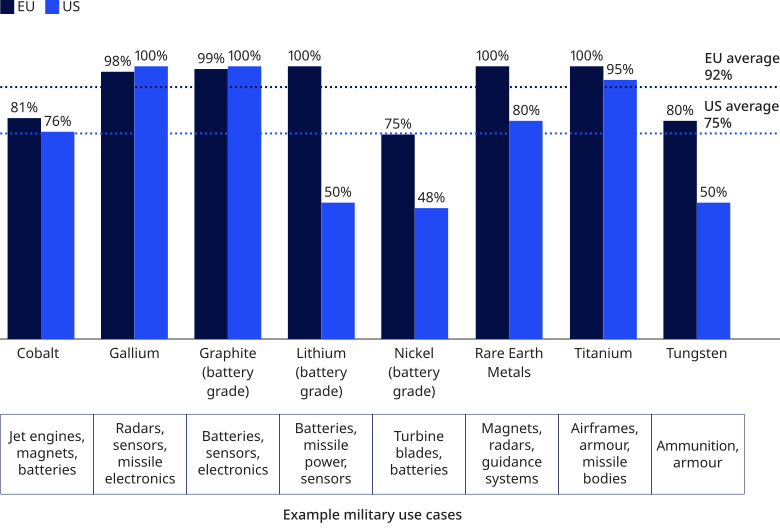
Additionally, a fragmented approach to procurement — dependent on many small to midsize suppliers — has left Europe unable to scale quickly and efficiently or mobilize common regional fleets. China’s ascent as the second-largest defense spender has also exposed vulnerabilities in European supply chains for critical raw materials and advanced electronic components — with more than 90% of these strategic products imported, and a large chunk of them from China.
NATO and EU leadership in building coalitions for Europe’s defense readiness
NATO and the European Union have been leading the effort to build regional coalitions and strategies, and untangle inefficiencies across many governments through ambitious initiatives, such as the Defense Investment Plan and ReArm Europe 2030. But individual national governments, investors, and defense contractors must also be willing to collaborate more closely if the boost in spending is to result in expanded industrial capacity, enhanced technological capabilities, and true continental cooperation.
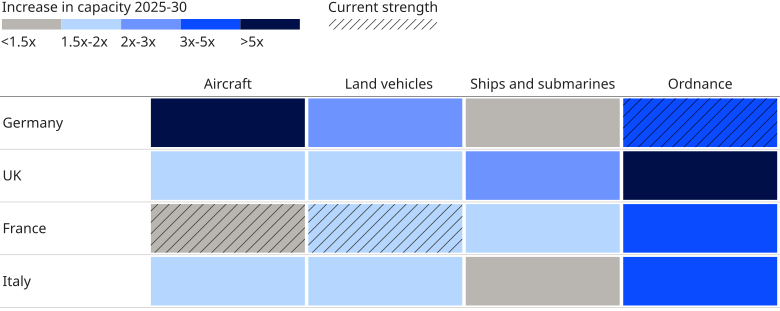
For instance, Europe needs 1.7 times its current industrial output for core platforms such as aircraft production, and faces a labor shortfall of as many as 200,000 skilled workers — 70% of its current industrial payrolls.
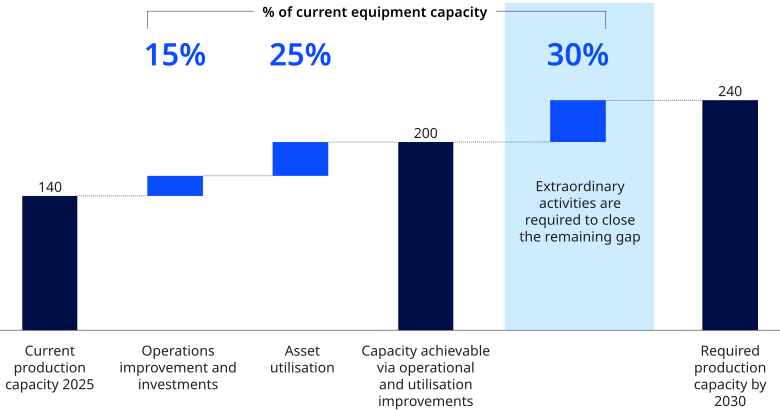
With hostilities raging in Ukraine not far from many European borders, along with recent incidents involving airspace violations and cyber activity attributed to Russia, Europeans recognize the importance of a short timetable for addressing defense needs. Recent conflicts, including the war in Ukraine, demonstrate that military advantage increasingly stems from the ability to rapidly adapt rather than platform superiority alone, spotlighting the need for a surge-ready industrial base.
Thus far, European nations are approaching the drive for readiness with differing priorities, levels of ambition, and fiscal realities. Overall alignment remains fragmented, even as most countries support a variety of multinational partnerships and joint ventures. Greater coherence, especially in aligning procurement priorities, investment flows, and capability development, will be essential to transform rising budgets into synchronized, continent-wide defense readiness.
How government, industry, and investors can advance Europe’s defense goals
Europe is not there yet. To build sustainable defense readiness, a greater level of coordination among governments, industry, and investors is required.
Policymakers must continue to build on the European Union’s defense readiness agenda, strengthening the initiatives and financial instruments that support it. By proactively including non-member states in these mechanisms, Europe can unlock greater investment, foster wider collaboration, and achieve defense readiness at a continental level.
At a national level, governments need to institutionalize innovation management through dedicated innovation leadership roles, measurable performance frameworks, and deliberate, balanced investment portfolios spanning core defense capabilities, adjacent technologies, and transformative defense applications.
Reforming procurement pathways — with clear demand signals, flexible contract models, and streamlined emergency mechanisms — will enable governments to partner more effectively with industry and investors.
For finance and investment, the priority is to unlock scalable, flexible capital that can be used to expand Europe’s defense ecosystem and supply chains. As defense investment accelerates, the finance sector has a unique opportunity to partner with governments on instruments, such as public-finance-backed “funds of funds.” Our report also suggests that exclusions that prevent public sector pension funds from investing in some defense companies and infrastructure, as well as similar bank lending rules, should be reconsidered.
Finance can also play a central role in helping smaller defense companies grow to scale and suppliers consolidate to achieve critical mass and global competitiveness, as well as connecting innovative companies with networks and resources they need to expand. By collaborating with both government and industry to finance contingent capacity, the finance community can work to build a more competitive and responsive industrial base capable of meeting Europe’s evolving security needs.
What the European defense sector must do to scale for rising demand
Finally, to meet demand surges, industry must also scale up its industrial footprint by reskilling workers, repurposing assets from adjacent sectors, and integrating commercial components by design.
The sector should align investment with the European Commission’s priority capability areas while accelerating cross-border collaboration and joint programs to reduce duplication and achieve scale. Ongoing innovation in manufacturing will be essential for Europe’s defense sector to deliver the speed, scale, and adaptability required for credible readiness.
This report was published at the European Defense Readiness Summit in Munich hosted by Oliver Wyman, with the Milken Institute, and Institut Jacques Delors.
