


Europe is rearming at a scale unseen since the Cold War, with defense spending projected to exceed a record €800 billion by 2030. National budgets are expected to grow an estimated 11% annually across the continent — more than double the historical average over the past decade.
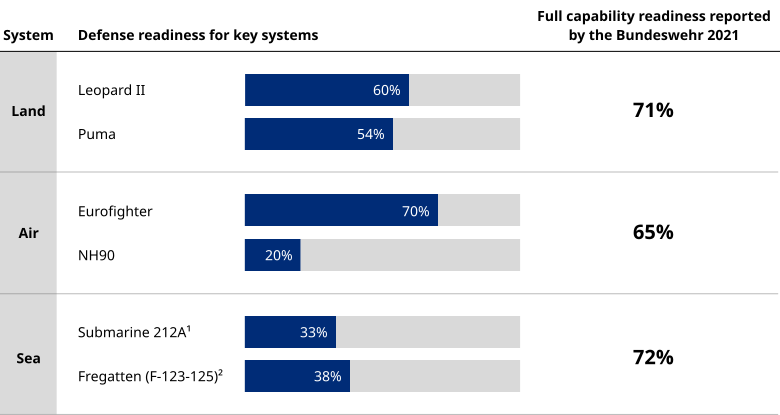
Germany provides a compelling example of the problems Europe may encounter. Here, the proposed “Bundeshaushalt 2025” (the German federal budget for 2025), raises defense spending by more than 21% to €86 billion to help the nation meet NATO readiness goals. Yet despite major procurement programs, defense readiness for key German systems has often remained below 70% (Exhibit 1), with significant year-to-year volatility. This is a systemic issue tightly linked to an underperforming maintenance, repair, and overhaul (MRO) network that poses some challenges for the planned expansion.
Our analysis projects that annual MRO expenditure for Germany could reach €13 billion to €17 billion by 2029, nearly double today’s levels. This reflects the complexity of keeping modern systems defense-ready, not merely the cost of acquiring them. Of that total, an estimated:
- €6 billion to €8 billion will be required for material consumption (spare parts and critical supplies), demanding much higher buffer stocks than commercial industries to meet unpredictable military demand.
- €7 billion to €9 billion are needed for a standing inventory, with financing costs of roughly €650 million to €850 million per year assuming an 8–10% cost of capital — a strategic burden as much as a financial one.
- One million to 1.5 million square meters of new warehousing to scale up the physical network, plus additional workshops and secure regional hubs to build resilience against disruptions and foreign interference.
Compounding these logistics challenges is a severe labor shortage. Reaching target readiness will require an additional 35,000–45,000 MRO specialists over the next five years, at a time when even the Bundeswehr itself is also short 24,000 officers and non-commissioned officers (NCOs), and training pipelines for technical roles take years to mature.
Achieving defense readiness by adapting civil MRO excellence
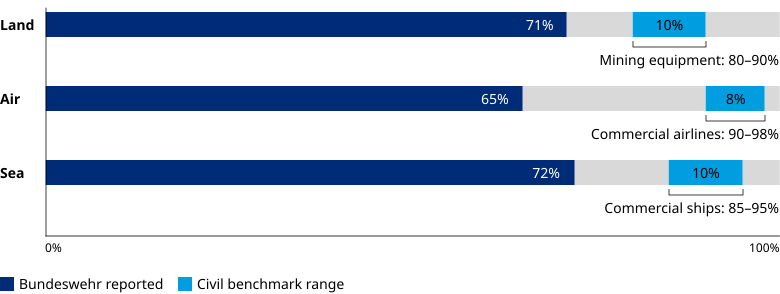
Civilian MRO, used in commercial aviation, shipping, mining, and a host of other heavy maufacturing, routinely achieves fleet availability of 80–98% (Exhibit 2) by deploying a proven playbook. This includes predictive maintenance, KPI-driven performance management, digital inventory, and agile, multi-sourced supply networks. The defense industry must copy this approach but adapt it to account for the mission unpredictability, classified logistics, public procurement constraints, and security requirements that the armed forces deal with.
Even so, moving from siloed, manual, reactive models to an integrated, digitally enabled, performance-driven approach can raise readiness by 10 to 25 percentage points (Exhibit 3) without major additional budgets.
How companies are transforming operations across the value chain
Modern organizations are undergoing a fundamental shift across several operational dimensions. Traditionally siloed, command-driven operating models are evolving into agile, end-to-end systems focused on performance. People and culture are moving from tenure-based, hierarchical structures to empowered, cross-functional teams — though hierarchy still plays a role.
Maintenance regimes are transitioning from reactive, time-based approaches to condition-based and reliability-centered strategies. Manual, paper-based processes supported by legacy IT are being replaced by digital, automated, and analytics-enabled systems.
Performance management is no longer just about output and compliance; it now emphasizes service-level availability, cost-to-serve, and value-driven KPIs. Financial models are shifting from siloed budgeting and historical cost views to a focus on asset utilization, inventory forecasting, and strategic partnerships.
Supply chain resilience is being redefined. Instead of relying solely on cost optimization and just-in-time delivery, organizations are adopting multi-sourced, risk-assessed models with tier-n visibility into tier-n suppliers that exist down-stream of the primary suppliers, and geopolitical awareness to better adapt to crises.
Addressing structural bottlenecks through continuous defense innovation
In order to truly succeed, a dual approach is essential: continuous improvement to unlock quick wins, combined with targeted transformation to break structural bottlenecks and seize the moment for lasting change. These are the imperatives for each stakeholder in defense ecosystem:
Armed forces — strengthen readiness and modernize support systems
Improve: Establish dedicated MRO excellence units, adopt secure digital maintenance and asset tracking, and benchmark readiness against civil/allied peers.
Disrupt: Pilot cross-national MRO hubs, trial availability-based (“asset-as-a-service”) contracts, create drone/software support battalions, and adopt modular plug-and-play support models.
Defense contractors and suppliers — drive efficiency and lead innovation
Improve: Increase transparency on parts/lead times, co-develop predictive and remote maintenance, and; provide upskilling support to military maintainers.
Disrupt: Co-invest in multinational spare-parts pools, lead public-private MRO innovation sandboxes, develop digital twin services, and sacle advance outcome-based contracts.
Policymakers — advance defense through bold reform efforts
Improve: Modernize and streamline MRO procurement, fund vocational programs to close the workforce gap, and mandate standardized readiness KPIs and reporting.
Disrupt: Fund state-backed, cross-border inventory pooling, legislate multinational MRO centers of excellence and regulatory sandboxes, and establish a defense “right to repair” while safeguarding security.
Modern military logistics demand digital-first transformation
Emerging drone and software-defined systems demand digital-first logistics: modular inventories, decentralized repair, integrated software sustainment, predictive analytics, and high-velocity recycling and replenishment. These requirements are distinct from traditional large-system MRO and must be resourced via dedicated teams, processes, and infrastructure built for speed and flexibility.
Transforming the Bundeswehr’s MRO supply chain is the decisive lever to convert unprecedented budgets into real, sustained defense readiness. The playbook exists in civilian MRO, the constraints are quantified, and the path is pragmatic — work smarter, faster, and together through outcome-focused partnerships and tailored adoption of civil best practices. The opportunity is clear, the tools are proven, and the time to act is now.
