


Europe faces financing needs of at least €750 billion to €800 billion per year, driven by major transformations such as the green transition, artificial intelligence (AI), and defense spending. Capital markets will play a vital role in financing these efforts since public sector spending and bank lending will not be able to meet all these demands.
Capital markets fuel the economy by raising funds and enabling effective price formation. Strong secondary-market liquidity is critical to attract primary issuers, which in turn supports investment and growth. However, European secondary markets are underdeveloped and fragmented. Relative to gross domestic product (GDP), liquidity in US capital markets is four times greater, measured by total traded notional volume.
The main driver for Europe’s liquidity gap is low investment in capital markets, especially by retail investors. Households in the European Union hold only about 17% of wealth in financial securities, compared to about 43% in the US. Increasing demand to US levels relative to GDP would deliver a three-times greater impact on liquidity than merging all existing liquidity pools.
Striking the balance between liquidity, innovation, and competition
In addition to bold demand-side action, reducing supply-side fragmentation would increase the connectivity of existing demand and help solve key challenges such as retail participation and mobilization of long-term capital.
Over the past 20 years, Europe’s equity market rules have successfully fostered innovation and competition — particularly through Markets in Financial Instruments Directive (MiFID) I and II reforms — reducing trading costs and increasing execution flexibility by encouraging new venues such as multilateral trading facilities (MTFs) and systematic internalizers (SIs). But in doing so, liquidity has become fragmented, weakening price discovery and making public markets less attractive for companies looking to raise capital.
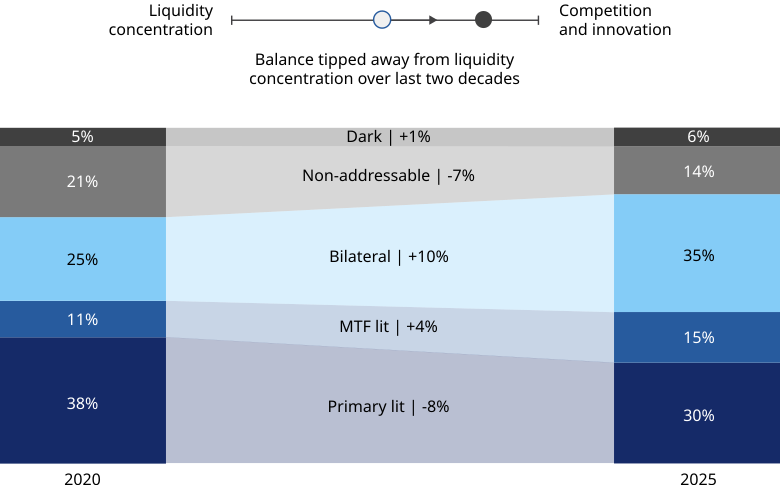
The challenge now is to rebalance. Capital market supply-side reform comes with a trade-off between concentrating liquidity, spurring innovation, and fostering competition. Europe needs to revisit this delicate balance and pivot the focus toward deeper liquidity, while carefully weighing the impacts on innovation and competition.
Different forms of fragmentation impacting liquidity in Europe
Fragmentation manifests in two ways: Liquidity on a single stock can be split across venues and execution channels (intra-market fragmentation), and across borders (cross-market fragmentation).
Intra-market is the most acute form of fragmentation. Trading in lit primary venues accounts for about 30% of total liquidity. Close to 70% of volumes are split across multilateral trading facilities (MTFs), and dark, bilateral, and non-addressable channels including SIs and over the counter. Cross-market fragmentation is marginal, at less than 2% of total.
How Europe can address market fragmentation to unlock liquidity fast
Stakeholders across Europe need to act now. The fastest way to unlock more liquidity is by reducing intra-market fragmentation. This would allow Europe to better use its existing liquidity pool in the short term. To achieve this, harmonization and level setting of regulation is required between exchanges and other execution venues and systems. Europe must also simplify other parts of market infrastructure, starting with settlement. This could involve the full adoption of TARGET2-Securities by member states and central securities depositories, or the deployment of new technologies such as distributed ledger technology.
The impact of cross-market fragmentation is limited today. But to maximize the impact of future pan-European demand, enhancing connectivity could also be considered to lower obstacles for all investors to access all European securities — either by creating a common connectivity layer or by linking venues together. However, these shifts would come with significant costs for the industry and would take a long time, often requiring complex technology integration and a major upheaval of current regulatory and operational frameworks.
