


Our current forecast shows MRO spend rising to nearly $80 billion in 2022 and approaching 2019 pre‑COVID levels by 2023. Survey respondents overwhelmingly indicated that government COVID‑19 policy remains the single most important factor shaping the pace of travel recovery, followed by customer sentiment. Interestingly, the actual health situation — case counts and hospitalization rates — ranked as a far less influential driver.
Barring a significant global resurgence of COVID‑19, we remain optimistic that all MRO segments will return to 2019 levels in the near term. However, when looking at the full 2020–2030 period, we expect the total MRO market to be roughly $160 billion — or 13% — smaller than pre‑pandemic forecasts.
Top disruptors for the MRO industry
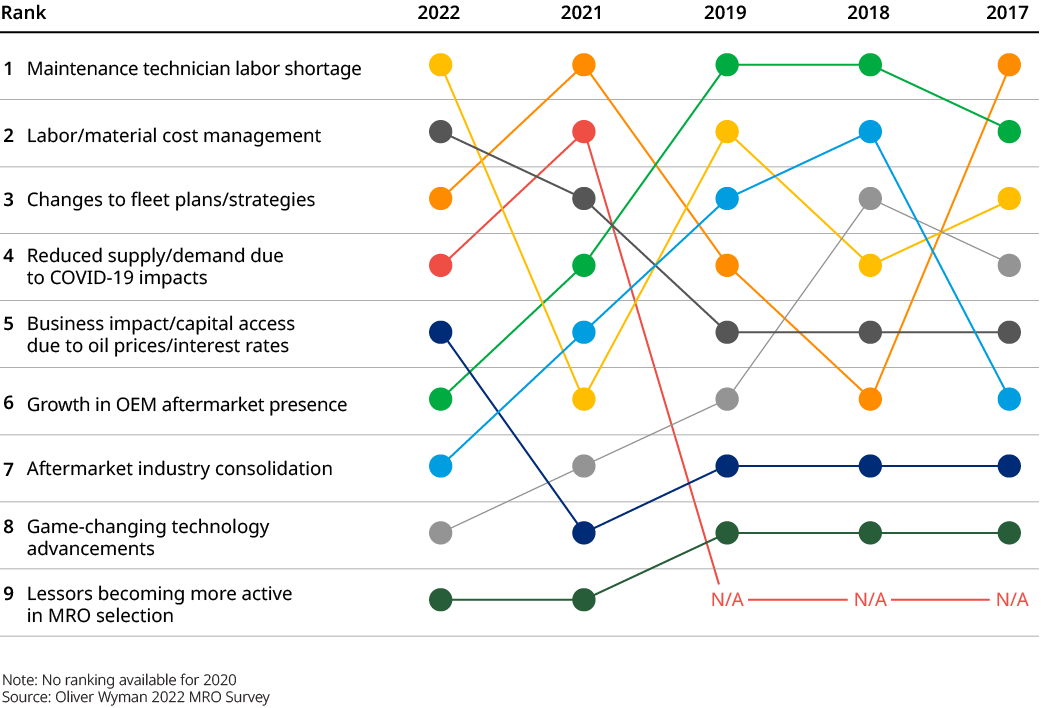
When asked about the top disruptors facing the MRO industry over the next five years, respondents identified the shortage of maintenance technicians as the most significant. After reducing workforces during the pandemic, the industry is now scrambling to rebuild capacity to meet rapidly recovering demand — and doing so in a labor market that was already tight before COVID‑19.
Labor and material cost management ranked as the second‑largest disruptor. Over the next few years, MROs will be looking for every possible operational efficiency to offset rising input costs. Changes to fleet plans and strategies also featured prominently, as the industry continues to assess the long‑term impact of the pandemic on demand and prepares for the arrival of next‑generation narrowbodies such as the A320neo and 737 MAX.
Labor shortages threaten MRO growth
Labor availability has been a concern for many years for MROs, but the pandemic, which brought about a wave of retirements, has accelerated the labor challenge. Fewer people are entering the industry, with work environments, questions about industry stability, and perceptions of aviation as a legacy industry all impacting the appeal of aviation jobs. Two-thirds of survey respondents in every region indicated that securing labor has become a challenge, with the problem most acute in North America.
More than half of survey respondents reported that the lack of labor is already beginning to constrain growth. This is notable, given that demand has yet to fully return to pre-pandemic levels. To attract talent, survey respondents pointed to apprentice programs and technical school partnerships as the most effective, but executives we interviewed are looking at a range of creative tactics to expand the talent pipeline.
Rising costs put new pressure on MRO economics
Survey respondents expect significant inflation over the next two years. Sixty percent anticipate materials costs will rise by more than 5%, and North American respondents foresee the steepest increases in labor costs, with 59% expecting labor inflation of 5% or more.
To manage these pressures, 80% of respondents plan to continue focusing on operational efficiency and renegotiating supplier agreements. Among operators, 65–70% cited greentime engines and alternative parts or repairs as important cost levers going forward. The anticipated surge in Used Serviceable Materials (USM) did not materialize in 2021, as the market effectively “seized up” amid uncertainty around fleet needs and reduced overall material demand. However, two‑thirds of respondents believe a substantial increase in USM usage is likely over the next one to three years.
The sustainability imperative MROs
Nearly 90% of survey respondents indicated that sustainability is a priority for MRO-related activities. More than three-quarters expect sustainability to become an area of high focus within the next few years and report that their companies have put in place sustainability targets.
Although the industry appears enthusiastic, most levers to improve sustainability are still in the early stages of development. The most widely used is recycling, with nearly half of respondents indicating they are recycling now. About a third are measuring GHG emissions or taking steps to reduce direct resource input needs. Potential focus areas in the future for MRO could include the use of renewable energy and co-generation for facilities, electrification of vehicles, and better waste disposal processes. A majority expect sustainability to become a required cost of doing business rather than a pricing differentiator, but sustainability may play another key role: Several executives noted in interviews that sustainability and climate risk have become important to talent recruitment and retention efforts.
About the MRO survey
In its second decade, the annual Oliver Wyman MRO survey is an industry standard that samples the attitudes and strategies of executives from across the aviation industry, as they address key trends and emerging issues in the maintenance, repair, and overhaul sector. In this year’s survey, we focused on the continuing challenges of labor shortages, cost management, and sustainability. As always, we have leveraged the latest Oliver Wyman Global Fleet and MRO Forecast to provide additional color.
More than 150 global aviation professionals responded to this year’s survey. We also conducted hour-long interviews with more than 30 senior MRO leaders worldwide to provide additional insights. Survey and interview participants were drawn from a cross-section of airline operators, airline and independent MROs, original equipment manufacturers (OEMs), and others. Approximately half of the respondents were senior executives (C-suite or vice presidents), and 70% were director-level or above. Over 60% of respondents’ companies are headquartered outside of North America.
