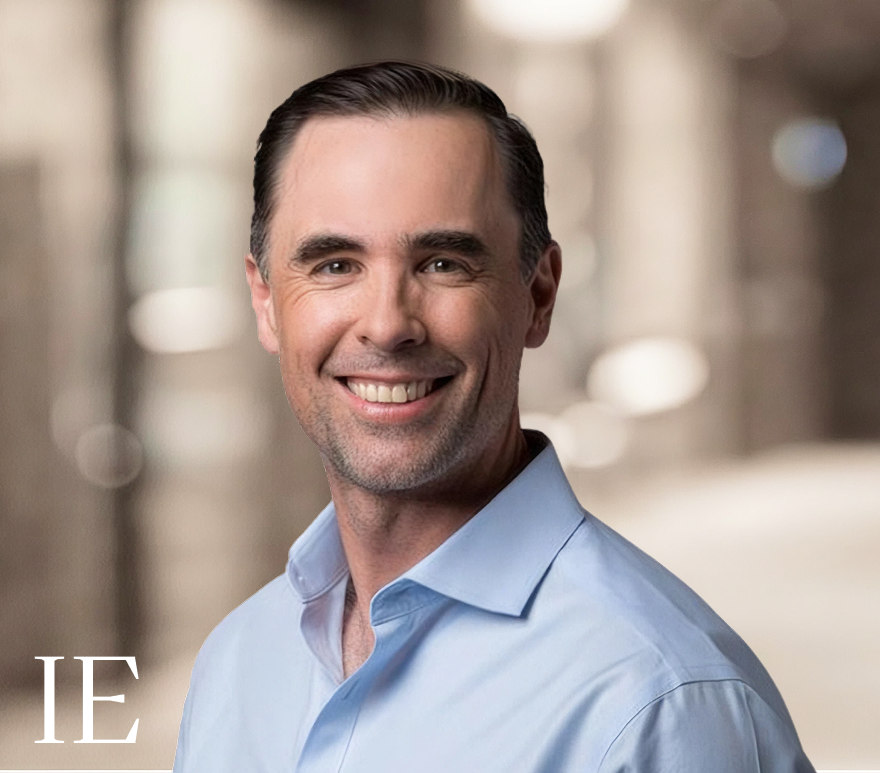
Hiten Patel:
Hello, and welcome to today’s episode of the Innovators’ Exchange, where I’m delighted to welcome Liam Healy to the show. Welcome to the show, Liam.
Liam Healy:
Thanks for having me. Good afternoon.
Hiten:
Why don’t you start by introducing yourself and your role as CEO of FE fundinfo? It’d be great to learn a little bit more about that.
Liam:
Well, first off, thanks for having me. Super excited to be a part. I’ve listened to a bunch of the episodes. You’ve just had incredible people join and just fantastic information.
So, Liam Healy, CEO of FE fundinfo. In August, I’ll be coming up on three years. It’s a fantastic business. We sit at the crossroads of financial data and technology for the investment management community, specifically serving over 1,000 investment managers, 80 of the top 100 globally, and over 3,000 wealth managers — so the distributors of the created investment products for the industry. So, yeah, super, super cool business.
Hiten:
Thanks for coming on. We’re going to get a lot more into where the market is headed and some of the views. But before we do that, I always like to get guests to tell a little bit more about their backstory. My favorite line is, " You weren’t born a CEO, or at least didn’t think you were. Start out by talking about some of your earlier career, education and stepping through some of the roles in the early days.
Liam:
I’ve got an interesting background, I think. So, I’m American, living in London for the last eight years. I grew up in Baltimore, Baltimore City. From there, I went to a liberal arts school, a small school just outside of Baltimore, Towson State University. I was in athletics there. So my career was to stay eligible so that I could continue playing.
Hiten:
What was the sport?
Liam:
Baseball.
Hiten:
Oh, wow.
Liam:
So after that, uniquely, I had an incredible — very blessed — opportunity to play eight years professionally in the States. So from ’98 to 2006, I played for the Kansas City Royals, Baltimore Orioles, and then retired in 2006.
Hiten:
Thrower? Hitter? I’ve got the wrong terminology.
Liam:
No, you got it. It’s similar to cricket, but different. So that was fun. That was incredible. What I quickly found out in 2006 is that they don’t teach any business acumen in baseball. And so the transition from 2006 to 2007, when I went to the Corporate Executive Board, which is now part of Gartner, was a hard transition. So that year, I spent a lot of time just studying and praying. My brothers are both in the industry and have been for a long time, but I was catching up with a peer set that was quite far ahead of me.
Hiten:
At what point did you know that you needed to prepare for a transition to corporate life? At what point did you kind of know there was going to need to be a second thing?
Liam:
I knew before they released me. Look, I was never a great ballplayer. I was a good teammate, and I could hold the culture in a locker room, and I could call a good game. And so it kept me around for quite a while.
But the transition — I coached in my last season. Transitioning out, I coached, and so I started to figure out that I actually love teaching and coaching people how to do great things. I get way more from that than doing great things myself.
And so, in that transition, I started to say, well, how do I widen the aperture? When I think about transitioning out of baseball, because I don’t think I can do this my entire life, what will that look like? So 2006 was really the year I spent time reading Harvard Business Review and studying up and using my brothers as sounding boards, and then got a great opportunity with CEB [Corporate Executive Board].
Hiten:
And with the things you’ve just described for me, like calling a game, strategy, holding down the locker room culture, training and teaching things — I mean, these all sound like corporate hallmarks. Maybe I’ve read too many sports books about the crossover, but how well did it stand you in good stead as you made that transition? Were these things that you could draw upon and kind of set you apart?
Liam:
My wife and I, our family, are quite faith-based, principles-based, values-based people. At the time of the transition, you only realize how hard it is. You don’t realize the lessons you’ve learned from — I mean, I think athletics is a fantastic playground for learning teamwork, discipline, humility at every turn.
I had a great coach who said, “There are two types of people in the world: those who are humble and those who are about to be.” And so you learn a tremendous amount about leadership, that work ethic that gets instilled, but you have to realize that, and it takes time. You have to step away from it and then see where you can apply it. During my time at Corporate Executive Board, which was really, for me, like getting an MBA [Master of Business Administration], because from being in the industry, you’re just surrounded by so many smart people and incredible clients.
And if you’re curious enough, if you take the time and go seek it out, you can learn a ton. And then I learned over time that if I just applied the lessons that I had learned in the course of my life and through athletics, I could shift the learning curve.
There are lots of things I’m imperfect at. I do have quite a good memory, and so I could spend the time learning what we were teaching as a think tank and a repurposer of best practices for the industry. I could make some of that my own, and I did.
After a few years there, CRM [customer relationship management] had just come on the scene, and SaaS [software as a service] was becoming a thing, and a real thing. And that’s when I made the shift. I looked for a small company locally. That’s when I found Vocus.
I went to Vocus and spent — I was just surrounded by incredible mentors and great people that invested in me, gave me a ton of opportunities. And so I built a team, and then I built teams of teams, and then I was running a division when GTCR bought Cision and Vocus at the same time, took both private, and brought them both together.
And that was when the transition of, again, mentorship. We’ve just been — for me, you look at my career, and I think sometimes, wow, I’m more blessed than I think anyone should be. I kept getting put with people who just looked after me and gave me the best of what they had.
Rick Rudman from Vocus, when he transitioned out, and I got to meet Peter Granat, who’s now running SAI Global, we spent time together. And I just asked, and I still do, asked a ton of dumb questions and was incredibly curious about how he got to where he got to. And he shared quite a bit with me. And he’s still a mentor today.
He helped me when I got into FE fundinfo. I asked him some questions: What am I going to need to know? I spent about a year in that tutelage as they brought the two groups together. And then again, I took the opportunity to say, “Well, let’s go find an industry that’s new. What’s an industry where market challenges are forcing transformation, great leadership and capital behind it?”
And that’s when I found BoardEffect. And I didn’t know governance was a thing. When I found BoardEffect, it was board portals for directors, technology for directors. What does that really mean? My wife’s a member of the council and an attorney. So when I came home and told her a bit about it, she’s like, “You know what I do for a living, right?”
And it was just a really interesting opportunity. And again, just fantastic leaders. Todd Gibby at that group was fantastic. Level Equity, which invested in that group, was fantastic and helped foster my growth there.
And then we were a bit of a — Brian Stafford may say different from Diligent — but I think we were a bit of a thorn in Diligent’s side. I think we had done a really good job growing the business, and we were a natural fit to come together.
And so when Diligent acquired us at BoardEffect, we weren’t sure how it would go — the big player in the space and the smaller player in the space, but nimble and running fast as a frontier-type group and making some great investments and an incredible leadership team.
One of the first things Brian did — and this spoke really loudly about the quality of an individual he is — Brian took me for a coffee down the road in Washington, DC, and asked me, “What do you want to do? You’ve had an interesting career, but what do you want to do?” And I told him, I was like, “I want to do what you do.”
And so he said, “Great. I’ve got plenty of opportunity for you to learn these things.” And so that’s when he first said, “Look, we’re going to start looking internationally, organically and inorganically. We’ve got to grow outside of the US. Why don’t we look at some opportunities?”
And so it ended up becoming: would I do something in North America? Would I go outside of North America? God led us to come to London. And so we started coming back and forth, and we looked at some acquisitions, and we found a great acquisition and a couple of others.
And Brian said, “Why don’t you move there?” He’s like, “Look, let me weigh the pros and cons.” He’s incredibly objective about it, what it would do for me in my career. He’s quite altruistic and looks out for others more than himself often. And that opportunity, I think, was a launching pad for where I am today.
And so then, yeah, we spent the next six, eight years building out Diligent. Fantastic business. We moved eight years ago, in August or September this year.
Hiten:
Easy decision to make, the relocation of the family? You’ve given me a very wholesome American story you told me, right? When people switch from the big cities like New York, I was like, okay, you’re a globalist, you kind of joined up. But from the kind of Baltimore, Kansas, that you’ve described, was it a bigger bridge to cross? Was it a tough call to make?
Liam:
It was, because we were moving away from family. The international stage, from an opportunity, from a business standpoint, was opportunistic and easy mentally. But the physical move of coming over and knowing we’d be away from family, and the sacrifices that my wife has made to do it, have been second to none.
But we did it. Her business was incredibly supportive. We made that leap, and we’re still in the same place we have been for eight years. Both our daughters were born here. So a seven- and a four-year-old, incredible girls. And, yeah, we’ve just been incredibly fortunate.
And this city has been incredibly open to receiving us because, when I came, I was probably the ugly American. I was like, “Why is no one in the office at 7:30? Where did everybody go at 5:35? Why is everyone away in August?”
No characterization, but it was actually more of a reflection on me. I think I probably didn’t have enough balance in my life. And it was a really good forcing mechanism for me to say, “Well, this isn’t going to work if I run it this way. So I have to become a bit more multicultural.”
And so, yeah, we started on the journey for the UK and building out the UK and building out the continent, and acquired in Germany, which was an incredible learning experience, and across the continent. We continued to build out South Africa and the Middle East, continued to build out Australia and Asia-Pac. We had just launched, about a year before I left, we had made a big investment in Japan, which is going quite well for that business now.
And so it was really being thrust into a multicultural world, but realizing, gosh, I’ve got to leverage curiosity because my answers aren’t the answers to everything. And so it was fantastic. It was a great ride.
Hiten:
And then what takes you from that to FE fundinfo?
Liam:
FE fundinfo. After the markets reset, I thought to myself, I’ve learned so much, and I can continue to learn here, but am I at the cusp of now trying to do what Brian had done?
And so I prayed on it quite a bit. And within 48 hours, I got a call from Hg, which was quite divine intervention, if you will. And I had a great conversation and learned more about the business without knowing what it was.
And my immediate knee-jerk reaction was, I don’t come from the investment management industry. I’ve learned governance, risk, compliance and audit. I understand all the transferability. I’ve done leadership. I’ve done leadership at scale, done organic and inorganic. I get all that, but I’m not an investment management guy. I don’t know if I’m the droid you’re looking for.
And over the course of a series of conversations with them, I just got to learn how good a steward or a sponsor Hg is.
And I’ve been very, very fortunate to have incredible sponsors, from Level Equity to Insight and Clearlake and Blackstone and GTCR, and now Hg. It really is the quality of people that has made my experiences grow. And so it made me explore more: what does this business really do?
And when I looked at it, it matched many of the criteria in every decision I’ve made, where a market is going through an incredible transformation. It has industry-leading-type offerings with a deep client base, and it’s got a sponsor with capital that is willing to invest in what the future could look like.
And I said, “If a group like Hg is willing to make a bet on me, I should make a bet on myself, and I’ll figure out the rest later.” It seems to have worked out till now.
And so, yeah, I took the leap of faith. And we have an incredible chair, David Blumer, who is an industry titan, having been at BlackRock for as long as he has. Started off more as a chair and mentor, and has become a bit of a friend, in which capital allocation decisions am I thinking about? What are the biggest things? What problems am I really trying to solve here? He’s been a great calming source for me. So it’s gone really well.
Hiten:
And I hear you talk, there’s this magnetic draw of you being able to pull people around you, invest in you. It’s that generosity of your ideas or your being that seems to pull in the right people at the right time. And it’s quite magical to hear it and quite refreshing, because often the story and the arc is, “Hey, from the age of X, I was absolutely obsessed with this industry. Until I’ve nailed it, I am going to be there.”
You talked about humility. You talked about curiosity. First impressions when you walk into this space, when you start to look, I guess, financial services, very specifically, the European wealth and investment management market. When you stood there looking at it, asking these humble questions at first, what are you seeing?
Liam:
It was daunting at first. The big jump, first off, to become a first-time CEO comes with all its own challenges, let alone having to take on an industry, a new industry, and get to the source of it, get to the root of it. I anchor on — I carry around with me our family values and our sets of values, and I kind of go back to those at the core for everything that I do.
One of the first things we did in the first hundred days was a listening tour. So I was like, look, I’ve got to learn a lot. There’s no better way to learn it than to go talk to all of our employees. So travel to just about every office we have. Spend time with great partners like yourselves. I spent lots of time with Oliver Wyman and other industry analysts and our consulting partners.
I spent a lot of time with our clients and our sponsors, and I started to ask the question: what is it we do? What is it we think we do? What do our clients think we do? What does the industry think we do? And what is the truth?
And we distilled that after about a hundred days, and I was cautiously optimistic that, wow, this has been one of the greatest moves that I could ever make, because we sit on a vast amount of information, a vast amount of data. We have incredible client support. We have incredible industry support. And we’re in the motion of putting it all together for it to be a true north. What really is that true north, and how do we scream it from the rooftops?
And so now, going through that exercise, I dialed back into my athletics roots, which is iteration. It’s batting practice every day from 6:30 to 7:30 in the morning. It’s taking a thousand swings a day. It’s refining your game and then putting it down, getting a break, and then coming back to it.
And I think that through that generative or iterative process, it allowed me to simplify what is quite complex in my own mind. It’s a version of the truth, I guess, where it is a product feedback loop, and it just happens to be an investment product.
And so you’ve got the creators of the products in a vast ecosystem that need distributors of a product in a vast ecosystem. And we are quite fortunate to have those connected and to sit at the center of that all in a highly regulated, zero-tolerance industry, where if you get that right, regardless of emerging technologies, which I know we’ll probably touch on, you’re an incredible partner. You’re a very trusted partner to that ecosystem.
And so that’s what we’ve been building over the last three years. And we’re not perfect, but where we double down and where we try to get it right for our clients and walk with them, I think we do a pretty good job.
Hiten:
That’s awesome. Let’s get into the market that you play. And with all that in mind, I think everything you’re about to say for me carries extra weight, recognizing that kind of humility, that integrity that you’ve brought.
And I remember we were just talking before the start of recording that one of the reasons we want to do this show is there’s so much industry commentary out there about some of these spaces — the wealth and asset management ecosystem, AI [artificial intelligence], the future of data, all of those topics — but actually from someone who’s in the seat, leading, driving, doing, rather than kind of just speculating.
So let’s just start with the industry context. When you look at the state of the market today, talk me through what some of the key shifts are that are top of your mind?
Liam:
It’s everything that I know that our listeners will have researched and looked into and be facing on a day-in, day-out basis. And certainly, you’re close to it with all the research and analysis that you do.
But on one side, with the investment managers, the creators of products, they’re under incredible pressure from an efficiency standpoint, from a cost standpoint, under incredible pressure on the cost of compliance and regulatory change, under incredible pressure to create growth and what that means.
I think the consolidation of the industry will continue over a period of time. But with all that, doing it in a — I’m from outside the industry, so I can say this — fairly antiquated model. Target operating models are just changing rapidly, and especially with the emergence of AI, on how to reimagine what the future state will look like. It’s been under incredible pressure. And so the shift to ETFs [exchange-traded funds] and passives, and looking for how we continue our journey, creates pressure.
And on the other side of that, where you have investors that — and I think Kunal said it best on one of the episodes — they just want some security. They want to know what the outcomes for the rest of their life look like, and they want to be able to trust the intermediaries or the advice that they take to help get them there.
That advice group, the advisors and the wealth managers and even institutional, they’re rooted in a fragmented ecosystem of that advice journey that just makes the admin take up more of the value-added time that investors require, which will, in my opinion, only be amplified by the diversification of share classes and alternatives and private market offerings and more tailored solutions that are coming in. That advice group needs to be even more educated than they already are. And that’s just hard. All of that with investor fee pressure.
And so when we think about connecting that, when we get to the golden thread for us being data — right financial data, whether it’s proprietary data, whether it’s public data, it’s the mix of data and information. So data, documentation, et cetera, and regulatory context are coming from so many different sources within the ecosystem.
If you sit on that, there should be a way — this is where I ask the naive questions to my own ExCo [executive committee], but I speak with many of our clients’ ExCos — where shouldn’t this just be easier?
And I think that target operating model across the industry that’s changing on both sides of the network, or many sides of the network, is being forced into that reimagining. That reimagining of: how will we solve this problem, not by doing what we did a little bit better? How do we solve it differently? And then I think that creates tremendous opportunity.
Hiten:
When you describe some of the constituents of the ecosystem there, you’ve got the fund managers, the wealth managers, the platforms, lots of change going on. In your mind, when you’re listening and what people are telling you, there’s always going to be some shifts and changes.
And for me, the elephant in the room is that some stuff might get commoditized; some stuff becomes increasingly more valuable that we don’t see today. How do you see that panning out? Where are there going to be the future important bits that people may not be fully paying attention to now? Which bits should, if it becomes simpler, just become kind of expected and standard table stakes?
Liam:
I think, for the longest time, the value added will shift. And for the longest time, just one person’s perspective, is we do because we’ve always done, and we’ve always done it a certain way.
Fund managers have their data reside in many different places. They create a product, they get it signed off by the board, and they register and file a certain way. They have to fulfill all of their obligations to the regulators. It’s done a certain way. Much of that is administrative toil.
And I don’t know that that’s — which creates, by the way, it creates length in the time to market for a product, keeping a product in market, all of which comes at a cost, if not opportunity cost, to increase assets under management.
But on the other side, where you have wealth managers, all things being equal, wouldn’t you like to just spend more time with more clients as opposed to the AML [anti-money laundering] and the KYC [know your customer] and your reporting obligations and your Consumer Duty checklist? All of which are incredibly important in the regulatory nature to protect investors. But is that the value added?
I would argue that, I think in the future state, especially with the proliferation of AI and what generative AI and agentic AI will mean, there will be a forcing mechanism of these new reimagined target operating models to use the right tools for the right job.
And which models, routing of which models you’re going to use, whether it’s proprietary models or whether they’re external models. How are you paying for the cost of computing? Does it make more sense to just use human capital to do certain things? Are there fixed- or variable-cost technologies to do certain jobs?
The analogy I use at home is, like, there are lots of tools in this toolbox. I get increasingly frustrated when I don’t use the right tool for the right job. And I find there’s an opportunity for us to rethink: what’s the problem we’re solving, and use the right tools for the right job.
Hiten:
Do you know what? That’s the first “right tool for the right job” and not necessarily “go along with the technology inflation for the sake of technology inflation.”
You even mention in your triaging, “Hey, is this a job that human capital is the best version?” Going back to home life, it always reminds me when I go to some people’s house who are so fascinated by the fact that they can get Alexa and apps and turn a light on or off. It’s just like, well, I mean, you could just turn the light on or off. It was pretty good.
But I think the same thing here in the industry, actually hearing you speak, resonates with: actually, right tool, right job, and not everything necessarily needs to be token-driven if you haven’t fully understood the cost and the maturity of the tool.
Liam:
I’m not sure everybody knows the costs of where tokens will go. There are imminent IPOs [initial public offerings] that will change that somehow when it comes to liquidity.
But I do, again, and maybe this is a simplistic view, but where capital — two things won’t change. Well, actually, four things won’t change. And I like prime numbers, so I’d like to make it three.
But I think there’s — look, groups are focused on profitable growth. Groups are focused on an incredibly exciting employee experience because the cost of talent in the new world is so high. You have to be able to enable the people that you have to make them more productive, but you also have to be able to attract great talent. And the outputs for your clients have to be amazing. So your clients have to say great things.
In that world, I think, and where capital allocation and gross margins and all of that matter, I think it’s incredibly important, at least for FE fundinfo, the way that we think about it is: what problem are we solving? How specifically do we solve that with and for our clients? Why is that unique in the market? Why can’t they just do this themselves or with other great, worthy partners in the industry? And what’s the value?
If we get that right, it’s both good for our clients, where we meet their aspirations for change through an incredibly complex time, but also good for FE fundinfo, as many of our partners in the industry are thinking about.
But I think we’ve taken quite a pragmatic approach to thinking about which tools we are going to use for which job. And guess what? Human capital and productivity are real things. And if we can enable that to do the right jobs, there’s a value add there.
Hiten:
Let’s go there, because one of the things I was keen to hear from you was your own journey around AI and how that’s changing things, shaping things, maybe some wrong turns, some learnings.
I think, again, we talked ahead of the recording of this. Everyone’s got a view and an opinion and wants to project onto how it’s going to shape certain bits of the market. You’re in there on the front line, working it out. What can you tell us about where you’ve got to, what you’ve learned, and where you may take things further?
Liam:
My ExCo and the teams below them are fantastic, and our CTO [chief technology officer] has been on this journey for quite a while.
We have three swim lanes on how we think about AI and producing the right outcomes. The first is in our products for our clients. So, breaking it down as to: what is this target operating model? How does it work for our clients? What work are they doing? Where does the toil reside? How do we take some of that slack out without there being a complete whitewash? So, what value can we add there?
The second is in the client experience. Why, from a scope of work all the way through to delivery and support, can it not just be easier to provide an incredible client experience? And so we think about how we use it behind the scenes as a cost of goods, for lack of better terms, but how do we put it behind the scenes where we’re enabling our people to use it on behalf of clients?
And the final one is across our enterprise AI, which is a productivity uplift for all our people. It may feel idealistic, soapbox, altruistic, but I do believe that every person in our business needs to know how to leverage what AI means for them in their world.
They signed up for a job description. They think they do a job. They ultimately end up doing many different jobs in some cases. But how is the toil in their work reducing while they’re spending more time on value-add projects, not just for themselves in the business, but also for clients?
And for them, an incredible sandbox or a safety net for them to learn the skills that — I would love it if every single employee at FE fundinfo screamed from the rooftops how great we were and stayed forever. Probably impractical.
They need these skills when they go somewhere else. And so it increases their value as an individual contributor, as a leader in the future, and they will have had real practical work in it.
And so, across each of those areas, learnings across the product stack, I think since February, I think everybody’s been saying it’s got to be AI for everything. And so I think our step-back learning early days were, no, we have to look for the real practical use cases that clients will use it for, what they already subscribe to FE fundinfo for, to drive a real outcome for them. And then it’s not a massive over-allocation of cost for our clients, but they just get a better experience and get more of what they want.
A great example of that is, if you produce KIDs [Key Information Documents] and PRIIPs [Packaged Retail and Insurance-based Investment Products], and EETs [European ESG Templates] and EMTs [European MiFID Templates] and fact sheets and all of these different documents at any given time, the compliance checks, the capacity within the firms that we work with isn’t enough to be able to do but more of a spot check of 5% to 7% — and I think that’s high — on the compliance of these documents.
Why can technology not be able to, in real time, look across that and spot anomalies to give them more assurance on the compliance documents across everything that they do?
And so that’s a real practical use case. It just adds a ton of value to our clients’ lives, but they expect us to help them be compliant. And so we’re looking for those use cases in specific fund narrative writing. You do it in so many different places; it’s got to be consistent.
Across our client experience, the depth of one of the things I learned in the first hundred days is, wow, across our 1,200-plus people, we have a vast amount of regulatory domain expertise. How do we use AI as a central tool to get them the right information at the right time to increase their productivity?
They’re great at what they do. They understand what anomalies look like. They work with clients on both sides of the network. So they work with FNZ and Morningstar and Refinitiv and Bloomberg. They’re working with all of the big distributors, and they’re working with all of our great clients on the fund management side to connect the dots, to show them where that information is.
We should be able to amplify that by giving them the right information faster at their fingertips. On the final piece, one big example is we’ve been an early adopter of Cognition through Devin, through Cognition, and Claude Code.
And so 100% of our engineering team is first-line code and quality assurance, leveraging the technologies that Devin and Claude Code can bring to the table.
I would aspire for that group to be AI-contextual coding in a world where no one has to know how to write code anymore. And when you think about the productivity that that brings to an engineer, as long as they understand the regulatory context, how much more productive can they be?
And so we’ve seen our engineering team spending more time with product than they’ve ever spent, so that they can get closer to the client to understand what the problem really is, and let us come up with the coolest, fastest ways to generate new ways to solve that problem.
And so the cost of maintenance on that has gone down. We’ve seen incredible benefits. We take in about 18 million data points a month across all different static, dynamic NAV [net asset value], regulatory documentation, et cetera. That has grown at 30% to 40% year over year, and we’ve been able to do that at little to no increase in headcount.
And so when you think about the productivity of our teams, it’s real. And they feel that. They show up happier, if you will, because they have these tools at their fingertips. But it is an interesting journey, and we’re learning more every day at the rate it’s moving.
Hiten:
That’s amazing. Thank you for sharing. I feel like when you started the conversation, you talked about that curiosity, that humility. You’re bringing that to bear in how you approach the AI opportunity, and not always some of the answers that come back might be counterintuitive. So I think hearing you just talk it through is kind of refreshing and kind of important.
A question I have off the back of that — I don’t know how much of it you consume, but given so much out there, people commenting on this is the impact of AI, where it’s headed. There’s a whole West Coast gospel out there from some of the West Coast software types.
What do you think is most misunderstood when you see what everyone is talking about and professing versus what you describe, which is, I’m on the front line, I’m working this out, I’m being humble, I’m working it out?
What are some of the bigger dislocations? What’s the bit that most irks you when you read a lot of the commentary versus when you’re actually driving change?
Liam:
It’s moving fast, and I think it’s coming more to light now. There’s a cost to it. There’s a cost to implementing, deploying and intertwining the depth that you would like to apply generative AI and agentic AI across a stack on behalf of your clients. It comes at a cost.
And so I think getting a line of understanding and thinking quite pragmatically about what is the right tool for the right job, and not throwing the baby out with the bathwater — what matters, at least in one person’s opinion, is outcomes.
The toil behind the scenes, how slick it is on the front line — what our clients expect is an outcome. And when we work with them, we take the time to dissect: what does that outcome really mean? And quite complex in this industry, given all of the regulatory nature. But when I see there’s “SaaS is the SaaS apocalypse” and “SaaS is dead,” I do think it’s throwing the baby out with the bathwater.
The evolution from notebooks to spreadsheets, and spreadsheets to SaaS, and SaaS to AI, and AI to quantum computing — I am sure that will throw a challenge in there. But moving along with it at the pace and understanding the technology, the costs behind it, and how you’re going to deploy it effectively to reach the outcome, I think, is what we need to be speaking more about. So I don’t know that it’s misunderstood. I think we’re not talking about the root enough, which is great outcomes for clients.
Hiten:
It’s almost like it’s not sexy enough for all the clickbait. It’s kind of all the AI — I click on it. That’s why it gets all the attention.
Last one on this section before we wrap up on the market. Talk to me about your vision for FE fundinfo five or so years down the line, 2030-plus. What remains constant? What may change? What may evolve? What may it look like?
Liam:
2030 is a long way away in the dog years of AI. The way that we think about it is we want to continue being a trusted partner in the ecosystem for the investment management community, both for the fund managers and through to wealth management.
Some of the constants that I believe aren’t going to change are the efficiency with which the fund managers need to work is going to be front and center, but the reimagining of that has to happen.
The compliance is not going to go away, and rightfully so. And so the tripartite-type thinking of regulator and creator of investment product and third-party audit is important, and that needs to stay intact. It can be rethought a bit.
And I do think some regulations will change in the future to open up more availability to AI, especially when you think of non-deterministic versus deterministic-type outputs for calculations, as an example.
All the way through to the wealth management side, investors just want great outcomes, and they want to understand what those outcomes are without creating any asymmetrical or disproportionate risk. So I think that won’t change.
I think the education, with the diversification of the multiple share classes coming together, the convergence of public and private markets, which I know you’ve covered in many ways, will require education, and it will require the mechanics of the infrastructure below to be able to support that.
And the new blend that is talked about being 60, 30, 10 — that 10% isn’t right for every investor. But again, it’s the right tools for the right job and understanding, especially in this market where you think about consumer duty and outcome-based goals. It’s understanding, truly spending time with clients to understand what those outcomes look like.
That won’t change. How you get there may be different avenues to get there now, depending on the risk tolerance of the investors. And so in 2030, for FE fundinfo, we are the connecting point. We’re the crossroads of those two industries, playing in a massive ecosystem.
I think what you’ll see is the largest firms in the world, both on the fund management and the wealth management side, consolidating partners. So 50 partners probably isn’t right. One’s probably impractical. So what is the ecosystem of partners they work with? We’d be blessed to earn the right to be in that landscape.
We think we are right now, and we’ll continue to focus on taking great data, helping that manufacturing engine connect to the distribution engine, driving great outcomes.
Hiten:
Amazing. Thank you for the take on the market. I listened to it with even greater kind of excitement, and it resonates, just given everything you said in the opening section, right? That humility with which you’ve approached an industry and then suddenly listened to what everyone shared, digested, and your take on where it goes. It’s truly unique. So thank you for that take.
Back to you, as Liam, as the person, for the final wrap-up. Talk to me about what the biggest challenges or the most profound learnings you’ve had through the journey are that you think listeners would benefit from hearing about?
Liam:
So I come back to — I’ve had mentors share this, and I’m quite a linear thinker. Something that was shared with me early in my career, which I’ve latched onto, is strategy, structure, people, process and technology.
And in getting that right, I do think the challenges or the opportunities that I have faced as a leader have been around marrying the strategy and the structure together. Does that feel right? Have I listened to the market? Have I listened to our employees? Where are we starting from? Where is it we think we want to go? So, from-to model, how do we get there?
But the number one thing always comes down to people. I think my team would not disagree with this: I’m quite a demanding CEO, and I’m American, so I move at a pace.
And so I had a great mentor who told me our job is to bend people, not break people. And I also had a coach way back in the day that said, “Healy, excellence doesn’t like mediocrity. It’s hard to commingle the two.”
And so walking the fine line of inspirational or fearful is hard, because you want everyone to come along for the journey, but you do have to demand a lot of your people, and you do have to surround excellence with excellence.
And I can say our 1,200-plus people rise to the challenge. They work incredibly tirelessly on behalf of our clients and for the firm. Many of them forsake family obligations and other self-interests to get the job done. And we make sure that they take good breaks and that they get good downtime, but we do subscribe to excellence.
And so it’s something I am both apologetic and unapologetic about, because I do think that that’s a burden that we as leaders wear, is that we have to be going in a direction, but we have to do that with empathy and compassion while we’re bringing along not just a firm, but an industry.
So those have been, I think, thrust — those have been examples that I have faced just about everywhere in my career.
Hiten:
It’s nice to hear you threading the sporting career into the corporate career. One of the things my team will know about, I endlessly bang on about some of those analogies.
And in our industry, like yours, you get nothing for coming second. So it’s great that we got there and you really impressed at a pitch and you gave me some great ideas, but mandates don’t get split.
And so there’s that kind of — it’s almost like cruelness or Darwinian nature of business. If you’re good enough to win, then you’ll survive and evolve. And if you’re not, then you need to go back and work that out.
Liam:
The hardest and best thing about hiring an athlete to lead is that there’s a scoreboard. And we are rooted — our entire lives, if you’ve played at any level that is competitive, you see a scoreboard, and there are winners and not winners. But what I would say is that is a drive.
I think the best leaders that have come from that sort of background recognize: what did you learn while you were playing in a season or a game? What did you take away from it? And how do you take that forward? How do you augment how you play the next game? What did you learn from that?
I had a great manager one year who kept a notebook, and that list would be 17, 18, 20 things long, depending on how we played. And after the game, relentlessly, he would go through and pick out the areas where we had just not played to our potential and say. That’s what cost us a run here, or a game in some cases.
And it’s okay to make those mistakes. You can make mistakes. Just don’t make the same mistakes over and over again. And so what did you learn from it? How do you take that forward? I think that’s been quite valuable for me.
Hiten:
Easy to listen to when that’s played back.
Liam:
Depends on how many of those mistakes you made, I guess. Never for me.
Hiten:
I wonder where you’re going to go with this one. The other question we have is: tell us something about what you do outside of work. It could be an interest, a hobby or a pursuit that kind of shapes how you lead and how you make decisions.
Liam:
I read. I read a lot. I have picked golf back up. And by that I mean I’ve gone once recently.
But I went for a while. I played quite a bit after I retired, and I played through my first few years with some of the businesses that I mentioned. And then time got too demanding, and then there’s obviously focus on family. I’m now making time to go do some of those things, and I’m picking it back up. At one point, I was fairly decent.
Hiten:
I’m feeling like a gross understatement. I’ve got this picture in my head of one of those grossly overqualified sports people who just switch from sport to sport, and you pick up a club. Is the crossover from baseball — there must be some benefits.
Liam:
Yeah. It was actually pretty easy to pick up in the early days. Then I played a bunch, so I got okay at it. And then I put it down for a while, and then I went out recently, and I was like, “Ooh, 10% were really good, 10% were really bad. I’ve got to shape up the other 80%.”
But it’s good. It’s good to get out, and it gives me time. I like to walk a course because it gives me good time to think and defrag and reprioritize, all while I’m counting all the strokes. Very efficient. My cost per stroke is fantastic. So, yeah, that’s great.
I spend a lot of time with my girls. I try to. The international travel is demanding, but I try to, when I can, I’m making those day trips to try and be home for — we do family supper every night. We think that’s an important part of kids’ growth.
I try to do bedtime reading. My wife normally wins out on that, but I try to do bedtime reading when I can and support. I try to be at as many school events as I can. So, yeah, that’s kind of how I spend my time outside the office.
Hiten:
That’s awesome. You mentioned reading. Quite a few guests have volunteered the books that they’ve recently read, which they put out there for others to look up. Not to put you on the spot, is there anything?
Liam:
Growth by Daniel Susskind was a good one. Thick read. Nexus by Harari was also a really good one on the information age. The Strangest Secret by Earl Nightingale. It’s a very short read. I probably read that two to three times a week.
A quick read, but quite interesting, quite intentional. Yeah, those are some good ones. I’ve got to see what’s on my shelf. Oh, Strong Fathers, Strong Daughters. I know you’ve got some girls.
Hiten:
Sounds like one I need to look up.
Liam:
It’s a good one. I’ll share it with you.
Hiten:
Thank you so much.
Liam:
It’s a good one.
Hiten:
Last one as we wrap up. We always invite guests to call out an individual or a company that you want to share the spotlight with, or get listeners to kind of go look up and pay attention to. I don’t know if you have something in mind.
Liam:
I did. I gave it quite a bit of thought, and I couldn’t come up with anything prolific. But there were two opposite ends of the spectrum, one that actually draws in some of my previous career as well.
The first is Chick-fil-A. Truett Cathy forgoes an incredible amount of revenue as a business at scale, as a fast-food restaurant, to not be open on Sundays. They’re a faith-based institution.
I believe that in today’s world, I do think talking about faith, talking about politics — we have a diverse… It’s just polar. And so that’s hard. And so I really am inspired by those who are unapologetic about doing it. So I think they’ve done a really good job, and they have incredible chicken sandwiches.
The second one is — so I don’t watch much sport, and I don’t work out at all. Every year, I watch the College Baseball World Series.
And I like the journey. There’s something refreshing about non-professional athletics, of watching young athletes come up, and just the passion that they have, the cultures that you see in different institutions.
And so, in the most recent College World Series, one of the teams I thought was quite inspirational was West Virginia University. Steve Sabins, who’s the head coach there, I think, is a quite demanding coach, but he drives it through values and principles.
He finds the best kids to play for the team that he wants to create. And in some cases, I think that team would even say they aren’t all of the best athletes on the field in any given game, but they’re the best team on the field. I think there’s an incredible message there. I think they’re an inspirational one.
Hiten:
That’s awesome. Well, Liam, thank you for everything that you’ve shared. This is going to be one of those episodes that sticks with me for a while. I’ve really enjoyed the conversation.
Thank you for taking the time out of the day. It’s been great to have you on.
Liam:
Thanks. Appreciate it.
This transcript was edited for clarity.