



The next few years will be pivotal for gene therapy commercialization. Scientific breakthroughs are ushering in a new wave of therapies, but commercial success will increasingly depend on manufacturers’ ability to execute at scale. Operational excellence is becoming just as important as scientific innovation.
More than 4,200 cell and gene therapies are in development globally, according to the American Society of Gene and Cell Therapy (ASGCT). As more therapies approach launch, manufacturers will compete for the attention and capacity of a finite network of qualified treatment centers and experienced clinical teams, many of which are already managing significant staffing and operational constraints. At the same time, patients and caregivers are entering treatment conversations armed with information shaped by online communities, artificial intelligence, advocacy groups, and direct-to-consumer campaigns.
Companies that can ensure treatment sites are ready to deliver therapies safely, efficiently, and at scale will increasingly gain a competitive edge. For gene therapy manufacturers, that means treating site readiness as a strategic capability.
What manufacturers can learn from three eras of site readiness
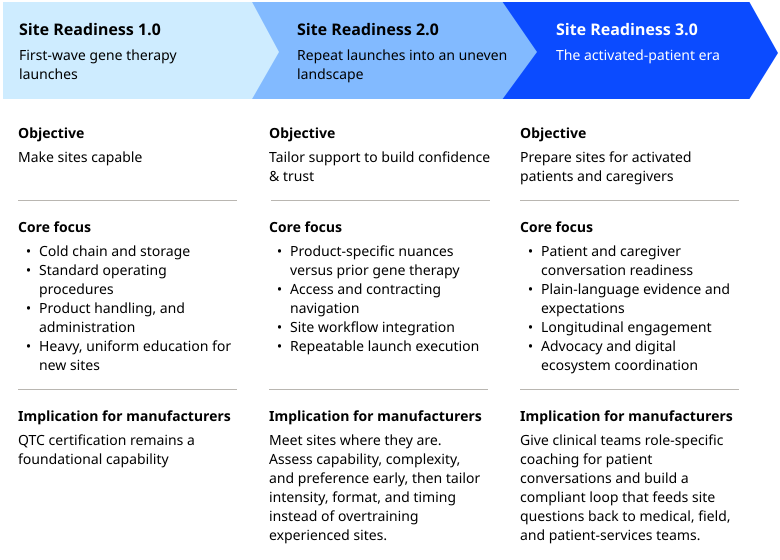
In our work with gene therapy manufacturers, we have seen site readiness challenges and manufacturer requirements evolve through three eras, each building on the capabilities required by the last. While the fundamentals that emerged in the Readiness 1.0 era still matter, today there is also a need for tailored support and preparation for a patient-centered environment.
Readiness 1.0 — Build gene therapy site capabilities
The first wave of gene therapy launches focused on building foundational capabilities, workflows, and ensuring appropriate infrastructure was in place at treatment centers. Because most sites were starting from a similar baseline, support was intensive and relatively uniform. The primary objective was to enable sites to safely deliver these first-of-their-kind therapies.
Readiness 2.0 — Customize gene therapy treatment center support
As more gene therapies have entered the market, treatment centers have gained experience, but not at the same pace. This has created an uneven landscape that persists today, especially when considering the expansion of these products into high-volume community settings. Some sites still need foundational help. Others need support around a specific operational barrier, while experienced sites may want only an explanation of how products they administer differ.
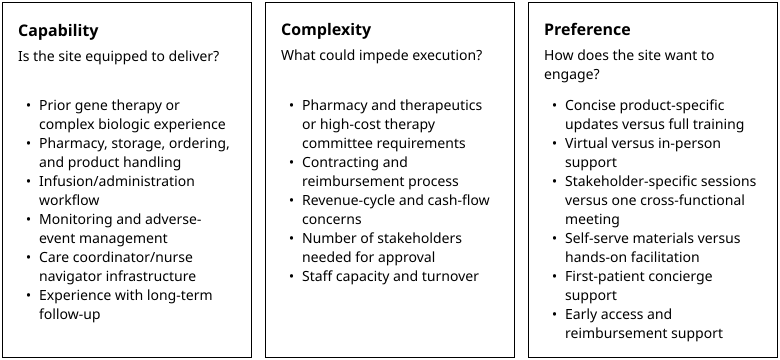
Manufacturers must meet at the sites where they are. A strong readiness program assesses each site early across three dimensions to tailor support: capability — whether the site has the experience and infrastructure to deliver the therapy; complexity — the operational, access, contracting, and staffing factors that could impede execution; and preference — how the site wants to engage with the manufacturer. The assessment should then be refreshed as access decisions, staffing constraints, and first-patient plans become clearer.
Tailoring site readiness is not only more efficient; it changes the site’s experience with the manufacturer and builds trust. Meeting a site at its level reduces the burden on already-stretched staff, can shorten time to first patient, and signals respect for how the institution actually works. Sites remember which manufacturers made a complex launch manageable and which added unnecessary work. Over time, that experience becomes a competitive asset across the portfolio.
Readiness 3.0 — Prepare treatment centers for activated patients
Patients and caregivers now enter treatment conversations in a far richer and more fragmented information environment. Online communities, advocacy groups, AI-generated answers, social media, and direct-to-consumer campaigns can shape expectations before a patient reaches a treatment center. Patients and caregivers may arrive with sophisticated questions, strong expectations, or claims that don’t match the evidence.
Sites need to be ready to explain what the evidence does and does not show, address information patients found elsewhere, and set expectations for eligibility, outcomes, uncertainty, and long-term follow-up. To support sites, manufacturers will need to evolve their educational materials for HCPs and patients to address these questions and concerns and ensure information is optimized for search engine optimization and generative engine optimization. Manufacturers need a compliant way to capture the questions sites are hearing and feed those insights back to medical, field, communications, and patient-services teams. That allows the company to respond to real concerns rather than relying only on assumptions made before launch.
How manufacturers can strengthen gene therapy site readiness
Today’s readiness program must preserve the foundational capabilities built in Readiness 1.0, apply the tailored support of Readiness 2.0, and prepare sites for the changing patient and caregiver environment of Readiness 3.0. Manufacturers should begin by defining what great site readiness looks like beyond certification and aligning leadership on the outcomes the program should drive and who owns them.
From there, they need to diagnose and segment sites based on their capabilities, complexity, and support needs, refreshing those assessments as access decisions and first-patient plans take shape.
At the same time, manufacturers must also equip sites for the activated patient with tools that help clinical teams respond to emerging questions and narratives within appropriate compliance guardrails. When done well, site readiness should be built as a portfolio capability, with a common franchise approach that can be adapted by product and by site, so that each launch builds on the experience and relationships established through the last.