



Health system profitability is under sustained pressure. Rising labor and supply costs, workforce shortages, shifting payer mix, site-neutral payment policies, capital constraints, and uncertainty around public reimbursement are making traditional claims-based revenue increasingly insufficient to diversify their long-term financial performance.
As leaders look beyond care delivery to generate more sustainable profitability, clinical research stands out because it builds on assets many health systems already own: patients, physicians, longitudinal data, specialized clinical environments, and trusted care relationships.
Academic medical centers (AMCs) have long understood the value of clinical research. AMCs can attract physicians, expand patient access to innovative therapies, bolster institutional reputation, and advance scientific discovery. Industry-sponsored trials and research funding, through formal structures and alliances with industry, can also generate meaningful revenue for these enterprises.
Yet industry-sponsored clinical trials and research remain largely underleveraged. Many organizations still manage research as a fragmented and non-commercialized academic activity rather than a capability that is compensated financially. The traditional dynamics of supporting this work increasingly leave revenue and profit contributions, sponsor relationships, and strategic capabilities on the table while ceding significant turf to third-party research organizations, allowing them to expand.
Competition in clinical trial site management is intensifying
The US market for industry-sponsored clinical trial site management totaled nearly $17 billion in 2024. AMCs and non-academic hospitals remain the largest segment, accounting for 48% of the market. But research intermediaries and specialized site management organizations (SMOs) are gaining ground. SMOs, which handle the administrative, regulatory, and recruiting logistics at medical research clinics, increased their share from 24% in 2019 to 28% in 2024 and are projected to reach 31% by 2029, barring a material shift in mix towards health systems.
Increased competition from SMOs is fueled in part by private equity activity, driven by the thesis of optimizing inefficiencies in site management — SMOs have grown at a 12% compound annual rate over the past five years, compared with 7% for hospitals and 8% for AMCs. The opportunity for AMCs is to recapture the value that’s shifting out of their profit pool by actively addressing those inefficiencies through intentional operational investment.
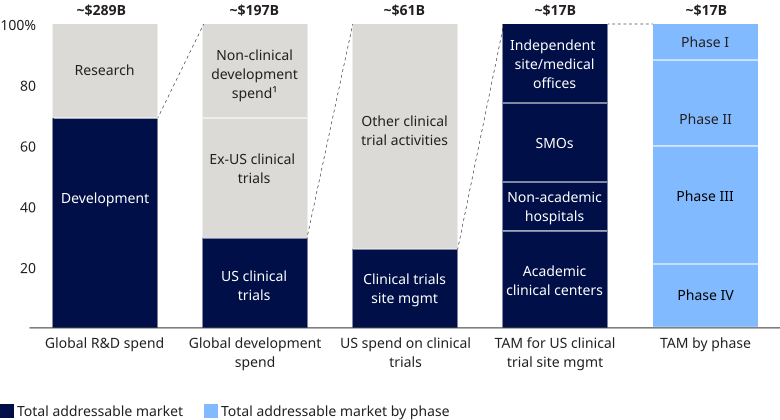
That growth signals a change in what sponsors value and what health system-based clinical trial enterprises are not currently providing in the drug development environment. Pharmaceutical and biotechnology companies need sites that can quickly identify patients, start studies efficiently, enroll predictably, and execute consistently across locations. Sponsors are increasingly willing to work with organizations that can deliver those capabilities at scale.
The economics are significant. Scaled SMOs routinely generate EBITDA margins of 35% to 45%, exceeding those of most health system service lines.
Health systems own many of the assets sponsors want
Despite the growth of SMOs, health systems control many of the assets that matter most for clinical trial research:
- Longitudinal patient data through electronic health records. Those data can support predictive feasibility assessment, helping identify eligible patients before studies launch and improving recruitment performance.
- Trusted relationships with patients across the continuum of care. This creates opportunities to improve enrollment, engagement, and retention — areas that remain among the biggest challenges in clinical development.
- Access to complex patient populations and specialized care settings that are essential for many advanced therapeutic areas.
The challenge is organizing these assets into a coherent commercial platform that creates tighter linkages up and down their operating model. Doing so will better enable health systems to deliver speed, scale, and accountability that is differentiated from commercial SMOs and can command a premium from biopharma sponsors.
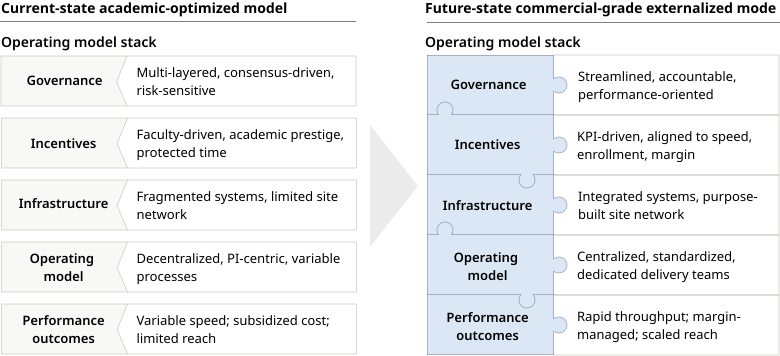
There isn’t a one-size-fits-all approach for health systems aiming to boost revenue and profitability, and to expand their clinical research functions to meet the market’s needs. Those that want to compete more aggressively should consider an integrated research venture (IRV) model. Doing so requires creating a dedicated operating entity designed to manage clinical research as an enterprise business.
An IRV operates as a hub-and-spoke, with the AMC serving as the hub — providing governance, scientific leadership, regulatory oversight, and access to complex patient populations. Community hospitals, physician practices, clinics, and other care settings act as spokes — expanding geographic reach and patient access via localized or hybridized trial formats.
A centralized commercial organization manages sponsor engagement, business development, feasibility, contracting, study startup, recruitment, technology, and quality across the network. Unlike the traditional AMC model, where individual principal investigators own sponsor relationships, an IRV institutionalizes commercial engagement through a centralized team that proactively engages with biopharma. This shifts the model from investigator-led to institution-led, creating a more consistent sponsor experience, while enabling the health system to manage performance and scale research across the network.
For organizations that are not ready to build an IRV, partnering with an SMO or an integrated research organization (IRO) can provide a lower-risk path forward. While SMOs primarily support site operations and administrative functions, IROs take a more integrated approach, embedding research into the health system's clinical workflows, infrastructure, and patient care processes. These partners can provide operating expertise, commercial infrastructure, and sponsor relationships with lower upfront capital commitment.
A framework for health system leaders
Executives need a solid plan in place before launching an IRV or opting to partner with research intermediaries. That includes assessing opportunities across three horizons:
- Near term: Understand the true economic contribution of clinical research today — not just grant revenue, but the full picture of direct trial income and downstream care uplift. Benchmark startup timelines, enrollment performance, and sponsor retention against external standards. Then, honestly assess internal capabilities and critical gaps to determine the right execution path — whether to independently build an IRV or partner with an SMO or IRO to get there.
- Medium term: Define the venture’s strategy and operating model – establishing a clear view on therapeutic-area sequencing, sponsor value proposition, and economic flows. Translate that strategy into a phased operating model that standardizes governance and workflows across feasibility, contracting, and study startup, and clarifies which capabilities to build internally versus source externally. Design physician, practice, and enterprise incentives that make trial participation attractive, low-friction, and additive to the academic research mission.
- Long term: Reposition the health system’s relationship with pharma from a site that participates in trials to a preferred, commercially sophisticated network partner that sponsors compete to access. That positioning is built through consistent execution, expanded therapeutic scope, and a commercial model that makes doing business with the health system straightforward.
The question health system leaders need to address now is whether they can organize their operations with the speed, consistency, and accountability that sponsors increasingly expect. Organizations that combine scientific credibility with commercial-grade execution will be better positioned to win sponsor relationships, capture a larger share of clinical trial spending, and build a consistent source for revenue growth.