



Pharmaceutical executives have managed through patent cliffs before. What’s coming next is different — not only in scale, but in the strategic weaknesses it exposes in how companies build and manage their growth portfolios.
Between 2026 and 2032, the 12 largest pharmaceutical companies globally by sales face roughly $400 billion in revenue exposure to loss of exclusivity (LOE) — nearly three times the prior seven-year period. Blockbusters such as Keytruda, Dupixent, Ozempic, and Rinvoq will lose exclusivity in rapid succession, contributing to what we estimate will be a $94 billion gap between historical growth expectations for the industry and current consensus forecasts.
This is not a failure of innovation. Scientific progress remains strong, and the industry continues to produce drugs that show promise in treating or curing a wide range of conditions. The challenges are more structural and strategic. Too many companies tend to the health of their pipelines only after they become financially urgent, leaving leadership teams with a narrow set of expensive and reactive options. True portfolio health requires a new way of thinking and new ways of working.
Pharma portfolio management is still too reactive for growth
In our work with pharmaceutical companies — and reinforced by a survey we recently conducted with senior executives — we see the same pattern repeatedly: portfolio strategy is treated as a periodic planning exercise rather than a continuous operating discipline. Asset teams optimize individual programs, business development teams pursue external opportunities, and therapeutic areas compete internally for capital. Few organizations consistently make enterprise-level tradeoffs early enough to reshape their portfolio before financial pressures mount.
The response to this portfolio loop is typically the same, too. Companies turn to external sources of innovation, acquiring later-stage or commercial-stage assets that can deliver near-term revenue. Our analysis shows that since 2021, more than 60% of annual deal activity for the largest pharmaceutical companies has centered on transactions whose lead asset was commercial-stage or in Phase III clinical development.
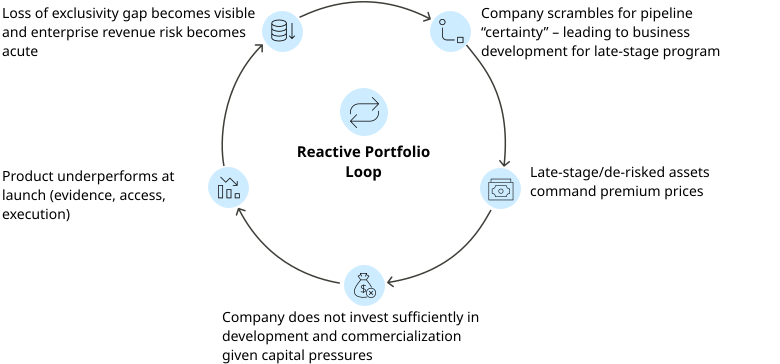
The strategy makes sense on paper. Boards and investors reward visible growth, which these deals aim to deliver, but the economics are increasingly difficult to justify. Between 2010 and 2024, roughly 68% of deals failed to meet revenue forecasts for the lead asset, and executives are frustrated: 85% of leaders surveyed report dissatisfaction with at least one aspect of their portfolio.
Three structural barriers to sustainable portfolio strategy
If late-stage deal-making is not the answer, how can pharma companies adapt and enable truly sustainable long-term pipelines? Three structural issues stand out that must be addressed.
- External forces: More than 90% of executives we surveyed said external pressures constrain long-term portfolio planning. Innovation cycles are compressing, competition within therapeutic areas is intensifying, and changing regulatory and pricing environments, including Most Favored Nation and Inflation Reduction Act-related policies, are increasing uncertainty and making long-term portfolio decisions more difficult.
- Organizational barriers: Most pharmaceutical companies remain highly matrixed organizations with competing scientific, commercial, and functional priorities. Internal portfolio decision-making is often not well integrated with external business development. Half of the executives we surveyed identified capital allocation across competing priorities as a major obstacle to effective portfolio management.
- Data analytics: The hardest portfolio decisions involve early-stage science, platform bets, and novel modality investments. These are also the most important areas to address and require stronger analytic capabilities. More than one-third cited difficulty both predicting future standards of care and estimating technical and regulatory probabilities of success. And 40% of executives we surveyed said they have trouble benchmarking against competitors.
Five principles for creating a resilient portfolio strategy
The companies most likely to emerge stronger from the coming LOE cycle will be the ones capable of making sharper portfolio decisions earlier than their competitors in an increasingly uncertain external environment. The ability to do that is rooted in these five tactics:
- Anchor strategy in your current state: Strong portfolio strategies begin with realism about where a company can lead. That requires hard decisions about which therapeutic areas, modalities, and scientific capabilities should get investment and where the organization is unlikely to effectively compete.
- Define portfolio guardrails and set measurable ambitions: Organizations with durable portfolio strategies establish clear and quantifiable investment guardrails before revenue pressures force reactive decisions. These guardrails should define strategic priorities, acceptable risk levels, financial thresholds, and the conditions that justify exceptions.
- Establish a portfolio health scorecard: Track progress against innovation goals and strategic vision through a set of consistent metrics. These scorecards should assess programs across multiple dimensions, including competitive differentiation, timing, capital intensity, and strategic fit. More than a reporting tool, scorecards serve as an early-warning system for leaders by identifying emerging risks and highlighting portfolio gaps before they become significant portfolio and growth challenges.
- Build agile, trigger-based decision-making: Treat scenario planning as a practical decision tool rather than a forecasting exercise. The goal is not to predict a single future state. It is to identify the clinical, competitive, regulatory, or geopolitical factors that would materially change investment priorities and define responses before those events occur. Artificial intelligence tools can accelerate this capability by enabling real-time monitoring of market developments, analyzing large volumes of data from multiple sources, assisting with scenario planning, and evaluating potential outcomes.
- Hardwire external validation: Seeking out and embedding perspectives from external scientific advisors, payers, and commercial stakeholders into ongoing governance ensures that decisions are continuously pressure-tested against real-world conditions and protects against internal biases.
The best defense against LOE is a better portfolio strategy
Most pharmaceutical executives already recognize the underlying issues. The harder challenge is operationalizing portfolio discipline before the next revenue gap forces action. As one vice president in our survey said, “Ruthless prioritization is needed. Many programs cannot be funded — yet culturally it is difficult to cut programs that the team is attached to.”
Some companies may create centralized portfolio strategy functions. Others may strengthen governance within existing structures. In our experience, the organizational model matters less than whether leadership teams can consistently make enterprise-level tradeoffs with speed, clarity, and accountability.
The companies that navigate the coming LOE cycle most successfully will likely be those willing to make difficult choices earlier: exiting weaker positions sooner, concentrating investment more deliberately, and resisting the instinct to rely on increasingly expensive late-stage acquisitions to solve structural growth problems. While every drug eventually loses exclusivity, companies that treat portfolio strategy as an operating system rather than a periodic planning exercise can prevent LOE from becoming an enterprise-wide growth crisis.