


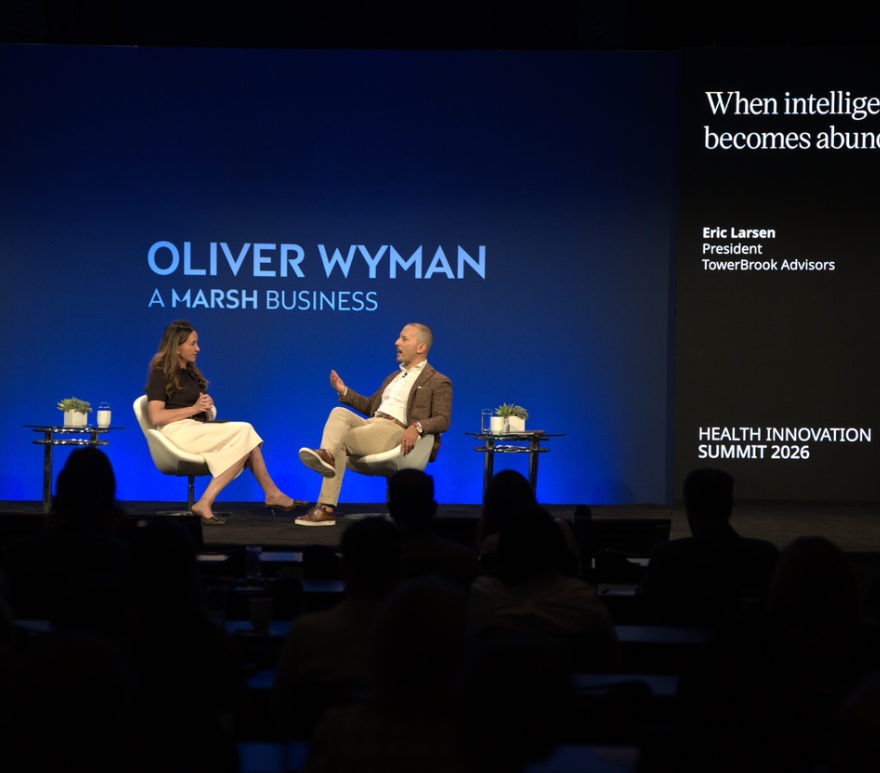
America's healthcare system may be buckling under the weight of runaway costs, declining population health, and often subpar patient experience, but experts attending Oliver Wyman’s 2026 Health Innovation Summit in Chicago agreed that artificial intelligence represented one area of cautious optimism. Across nearly every session, industry executives, investors, and clinicians described AI's sweeping potential to redesign clinical workflows, eliminate hundreds of billions of dollars in administrative friction, and unlock new models of care delivery and affordability.
AI is no longer simply on the horizon in healthcare, speakers said. It is now an operational reality with the enormous potential to automate up to $1 trillion in administrative expenses and speed up drug development at a fraction of the current cost.
But there are risks. For example, fragmented AI deployment across dozens of vendors could complicate rather than improve the patient experience. AI is also likely to be inflationary before it becomes deflationary, especially in the early years of implementation and experimentation.
The clearest message at this year’s summit was that technology alone cannot transform healthcare. The decisions that leaders make today — about organizational ownership, workforce culture, payment, and regulatory frameworks — will determine whether AI becomes a force for monumental improvement or simply creates new challenges, more work, and additional costs.
Why US healthcare costs continue to rise — and what needs to change
Never truly designed, the American healthcare system simply evolved over the past century, explained Niyum Gandhi, CFO and treasurer at Mass General Brigham. This is why access, quality, and affordability are perpetually out of balance. Every attempt to reform or improve the system over the past several decades has focused on fixing one corner of that triangle, often negatively impacting the others, he told attendees.
Employers are reaching a breaking point on healthcare costs and are running out of options. Despite years of surveys, strategies, and consulting partnerships, many employers missed their own healthcare cost forecasts several years running, according to Ellen Kelsay, president and CEO of the Business Group on Health. Costs are rising at their fastest pace in decades. Looking ahead to 2027 and 2028, employers expect these conditions to worsen. As a result, many executives, in virtually every industry, are spending a significant amount of time on a problem that is not their core business. Many of them are now asking if it is time to exit healthcare entirely, she said.
While soaring healthcare costs have long dominated the debate, the more fundamental issue is that the system was never built to make people healthy in the first place, said Mike Bennett, executive vice president and chief strategy and transformation officer at Highmark Health. It existed to treat their illnesses, the root causes of which healthcare organizations have largely failed to address. As populations age and chronic disease rates climb, the industry continues to absorb rising costs without improving the health of the people they serve. Unless that changes, the financial pressures driving up premiums and out-of-pocket expenses will continue to escalate. "We've got to refocus the system on how we actually get the individual healthy," Bennett said.
Ghandi said his organization has taken a step in that direction by launching an AI-enabled virtual primary care solution. The system uses a large language model integrated with patients' medical records to improve access in a market where 41% of residents lack adequate primary care. He said the deployment moved far faster than traditional organizational change would have allowed.
Four ways AI could transform the future of global healthcare
Over decades, the global healthcare sector quietly built the world's largest untapped data reservoir. According to Eric Larsen, president of TowerBrook Advisors, the industry generates roughly 30% of the world’s digital information. Yet 90% of that data is locked in unstructured formats (clinical notes, imaging reports, discharge summaries, recorded phone calls) that traditional IT systems cannot process. AI could change that. Larsen described the technology as “an unprecedented disruptive force,” and explained that no industry is more exposed to disruption than healthcare.
He suggested that AI will reshape the industry in four distinct waves:
1. Administrative automation: Roughly $1 trillion in annual spending is consumed by the friction between payers and providers. Prior authorizations, claims disputes, billing cycles, and coding audits have created an “entire industrial complex” built on paperwork. Larsen believes the overwhelming majority of it can be automated.
2. Medical superintelligence: An AI-powered system is capable of understanding cardiology, oncology, psychiatry, and primary care in a way no human physician can. Medical knowledge, he noted, now doubles every 14 days (down from every 73 days in 2019, and every 50 years in 1950).
3. Synthetic and computational biology: A pharmaceutical company might spend a decade or more, and about $1.9 billion, to bring a new drug to market. AI could compress that to one-tenth the time and one-twentieth the cost, Larsen suggested.
4. Consumer empowerment: This could be the most immediate disruption. Consumers are beginning to use AI to interpret lab-test results, review their insurance benefits, check network coverage, understand copays, and schedule appointments. These are tasks that previously required navigating a labyrinthine phone tree.
“It still mystifies me that there are certain people in healthcare who do not believe this is the most consequential thing we’ve ever seen,” Larsen told attendees.
Deirdre Baggot, a partner at Oliver Wyman, pushed back on the pace of AI implementation. She noted that it is important to ensure that the focus remains on the moral and ethical obligation to patients. The glacial pace at which healthcare has advanced has been intentional. “First, do no harm," she said.
AI needs to become a top priority for the health sector
For most CEOs, AI is a priority. However, it is often one of many priorities on a long list, explained Oliver Wyman’s Jim Fields. It doesn’t always feel like there’s a sense of urgency.
J.D. Hickey, M.D., president and CEO of BlueCross BlueShield of Tennessee, explained that the insurer realized the implications of adopting AI when hospital systems began flooding his staff with AI-generated appeals. “We had hospital systems that were submitting, in an hour, the volume they had previously been submitting in a month or even a quarter,” he recalled. “This technology, which we were approaching with some amount of abstract excitement, suddenly became real and frightening. We realized it could overwhelm us if we didn’t move fast.”
That sudden spike in reconsideration and appeal volume illustrated an operational and technological mismatch. In response, the Blues plan shifted responsibility for AI from the tech team to business leaders, who were assigned AI engineers empowered to build and adapt solutions for their own workflows. A centralized approval gate was no longer required. The plan focused on making low-cost AI tools accessible to every employee, pairing that access with formal and informal training, and driving a cultural expectation that engagement is not optional.
Why healthcare AI success depends on leadership and strategy
While AI carries extraordinary promise, summit speakers were clear-eyed about the risks: fragmented deployment, short-term unchecked inflation, and the danger of losing sight of the moral obligation to patients.
The organizations making the most meaningful progress are those treating AI not as a technology project but as a leadership and cultural initiative. They are embedding AI across business functions, investing in workforce readiness, and keeping the patient at the center. Whether AI ultimately fixes a system that was never designed to work will depend far less on the technology itself than on the motivation and discipline of the leaders deciding how to use it.