



Health system chief financial officers (CFO) are in a tricky spot. There’s unrelenting pressure to scale deployment of artificial intelligence (AI) across nearly every corner of the enterprise — administrative, clinical, human resources, procurement, revenue cycle, and more. As they weigh those requests, CFOs are increasingly asking: Where is the measurable financial impact?
Healthcare is not alone in this regard. Leaders across all sectors of the economy are trying to figure out if their investments in AI are paying off. Only 27% of chief executives said returns meet or exceed expectations, according to a survey of 415 public company CEOs conducted by the Oliver Wyman Forum and the New York Stock Exchange. More than half said it was still too early to tell.
Healthcare CFOs are rightfully cautious as they consider signing off on spending, especially as margin compression intensifies. Previous attempts to automate workflows often got low uptake, showed little to no value, and were abandoned.
AI needs operational redesign to deliver value
A key consideration with AI is that automating a task alone rarely creates measurable financial return. Removing friction does not matter if the targeted activity was not the true bottleneck. For example, reducing physician documentation time creates little value for the health system if appointment availability, imaging capacity, or operating room access are the primary constraints on throughput. Improving labor productivity only creates value if work, staffing, scheduling, or throughput are redesigned around the newly available capacity. Likewise, predictive modeling only helps if it is accompanied by timely and effective interventions that are embedded in workflows.
To truly get value out of their AI investments, health systems need to redesign how they deploy labor, utilize capacity, and retain patients.
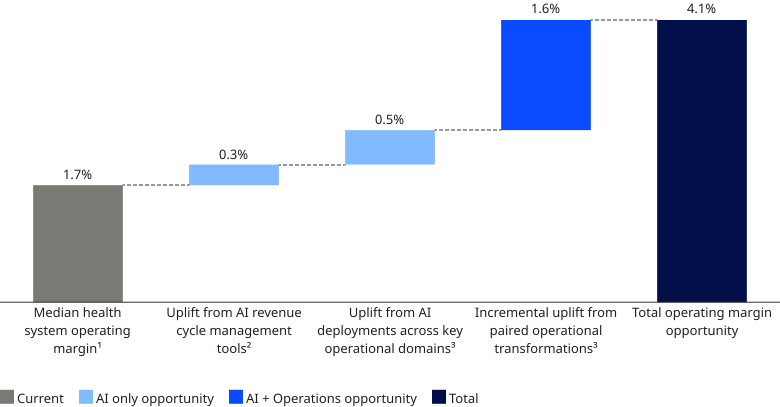
Our analysis shows that AI alone typically delivers modest margin improvements across key operational domains. The greatest financial returns come when AI is paired with operational redesign — often doubling or tripling the potential margin uplift. Across labor and capital-intensive areas such as clinician productivity, patient flow, front-door access, and patient retention, redesigning how resources are deployed is what converts AI-enabled productivity into measurable financial performance.
The six operational domains in Exhibit 1 illustrate where health systems can generate the greatest value by combining AI with operational transformation.
Operational domains where AI can expand health system returns on labor
Health systems face a structural labor problem: rising wage pressure, persistent staffing shortages, growing administrative burden, and limited clinician capacity with an emerging wave of retiring physicians and nurses. AI’s most immediate opportunity is not replacing labor outright but increasing productive output of scarce labor resources.
But in many organizations, time savings simply disappear into existing workflows. Documentation gets easier, inboxes move faster, and administrative friction declines, yet staffing models, scheduling templates, care pathways, and throughput expectations remain unchanged or even worsen as clinicians are inundated with more messages and alerts from the various new AI tools. To realize larger returns, organizations need to harness the new capacity AI creates. Three areas stand out:
Clinician empowerment: AI-enabled risk stratification, asynchronous engagement, automated follow-up, and decision support can allow clinicians to safely manage larger and more complex patient populations. This is fundamentally a care model redesign challenge. Organizations must restructure teams, expand virtual and asynchronous care pathways, shift work across clinicians and support staff, and ensure downstream specialty and diagnostic capacity can absorb the additional demand created upstream.
Administrative labor efficiency: Administrative functions are often the clearest near-term opportunity for AI deployments. AI can automate scheduling, registration, billing workflows, prior authorization support, and other repetitive tasks. To achieve meaningful savings, organizations must actively redesign roles, consolidate workflows, and reduce labor demand.
Clinical labor efficiency: Ambient documentation and inbox automation can significantly reduce administrative burden for clinicians. Many organizations first experience these gains through improved clinician experience: lower burnout, better retention, and greater satisfaction. Larger economic opportunities emerge when health systems build on that foundation and deliberately convert newly available clinical time into measurable operational outcomes like additional visit capacity, reduced reliance on contract labor, improved throughput, or avoided hiring.
To realize these gains, health systems first need clarity on their true operational constraints. That could be physician capacity, imaging technicians, operating room turnover, specialty access, scheduling staff, or care management resources.
Operational domains where AI can expand health system return on capital
Health systems operate capital-intensive infrastructure, including inpatient beds, operating rooms, imaging equipment, infusion capacity, and specialty care networks that require effective patient flow to maximize utilization and return on investment. Many organizations already have significant fixed infrastructure in place but struggle to fully utilize it because of fragmented operations, inconsistent patient flow, poor coordination, and patient outflow.
Similar to labor, AI alone rarely creates meaningful financial return. Better forecasts, improved scheduling recommendations, or predictive insights do not automatically improve margins unless organizations operationalize them. The financial value emerges when health systems redesign capacity management, patient access, referral coordination, and throughput operations around the new visibility AI creates. Three domains are impacted:
Front-door access: Conversational scheduling, digital navigation, and AI-enabled triage can improve conversion of inbound demand into booked visits and reduce leakage from abandoned scheduling journeys. To achieve significant gains, organizations need to pair AI-enabled access with centralized scheduling, expanded virtual capacity, better referral coordination, and more active management of supply and demand.
Throughput and patient flow: AI can improve discharge coordination, demand forecasting, OR scheduling, and bed management, helping health systems reduce avoidable delays and shorten length of stay. To capture meaningful financial opportunities, organizations must actively backfill newly available capacity with profitable elective procedures, reduce ED boarding, improve OR utilization, or increase patient throughput on the same fixed cost base.
Patient outflow reduction: AI can identify patients at high risk of leaving the system, automate outreach, support referral coordination, and improve follow-up navigation. But retention improves only when organizations can offer timely downstream access, coordinated scheduling, competitive convenience, and clear in-system value to patients and referring clinicians. In many markets, the economic opportunity centers around retaining profitable downstream activity that already exists within the patient population.
AI can help health systems understand how beds, operating rooms, imaging equipment, infusion chairs, and inventories are being used. Health systems must integrate these insights into throughput management, scheduling, referral governance, capacity planning, forecasting, and downstream access to absorb incremental demand. Without those operational capabilities, AI may improve awareness of bottlenecks without materially changing utilization, throughput, or patient retention.
Treating AI as an operating model transformation
AI creates the largest returns when organizations redesign workflows, management systems, and business processes around new capabilities, not when they simply automate existing tasks. CFOs and the rest of the C-suite need to embrace that logic as they move from pilots to scaling AI. The next competitive divide in healthcare may not be who deploys the most AI tools, but who redesigns operations fast enough to convert AI-enabled capacity into measurable financial performance.
As they aim to address the domains detailed in this article, CFOs should keep these factors top of mind:
- Identify monetizable constraints, including beds, primary care capacity, OR utilization, and referral leakage.
- Ensure AI initiatives connect directly to enterprise economics, not just productivity metrics.
- Act on operational changes that are necessary to capture value. That includes such things as staffing redesign, centralizing operations, standardizing clinical pathways, and improved referral governance.
- Focus on transformative moments, not simply funding software deployment.
- Create metrics that link the impact of AI investments on operating margin, contribution margin, labor intensity, and throughput.
Health systems that focus only on deploying AI tools risk realizing incremental gains at best. Those that redesign how work gets done, how capacity is managed, and how patients move through the system will be better positioned to translate AI into sustainable financial performance.