


Public health insurers had a strong Q2 2026 across most financial measures. Collective market capitalization jumped 47.0% during the quarter — more than triple the S&P 500’s gain — while reported margins improved year over year (YoY) and every carrier we track raised its full-year outlook, according to the latest edition of our Health Insurance Financial Pulse.
Our analysis of Q2 earnings also reveals that loss ratios rose in line with typical seasonal patterns, but a sharp pullback in operating expense ratios helped offset the pressure. Commercial and Medicaid membership both declined for a second consecutive quarter. This continues a trend we identified in the Summer 2026 Health Insurer Financial Pulse report, in which we found that insurers were placing greater emphasis on profitability and capital discipline as opposed to enrollment growth.
We identified five key trends driving financial performance during the second quarter:
- Average reported profit margins improved YoY, and every public carrier raised its full-year earnings outlook. The profit margin was 5.3%, down 1.2% from Q1 2026 but 1.1% higher than in Q2 2025.
- Average loss ratios rose with typical Q2 seasonality. The average reached 87.1%, up 3.3% from Q1 but slightly below the 87.9% reported in Q2 2025.
- Operating expense ratios decreased considerably. The average fell to 5.5%, down 1.8% from Q1 and 0.7% from Q2 2025.
- Commercial and Medicaid membership declined. Membership fell by roughly 565,000 and 811,000, respectively, largely due to ACA market dynamics and Medicaid eligibility contraction.
- Market capitalization rebounded sharply. The seven public healthcare companies we monitor increased by 47.0% during the quarter, far outpacing the S&P 500’s 14.9% gain.
Health insurer margins soften as cost trends improve in Q2 2026
The four largest carriers — Aetna CVS Health, Cigna, Elevance Health, and UnitedHealth Group — reported lower profit margins than in Q1 2026, yet every carrier except Elevance improved YoY, aided by favorable prior period development and final 2025 risk adjustment reconciliations by the Centers for Medicare and Medicaid Services (CMS).
Cigna’s profit margin declined from 10.8% in Q1 2026 to 9.1% in Q2 2026, but was still the strongest of the four carriers. Aetna CVS Health’s profit margin decreased from 5.9% in Q1 2026 to 4.4% in Q2 2026 but improved considerably from 1.8% in Q2 2025, driven by stronger government business performance and favorable prior year development.
Elevance’s profit margin decreased from 3.6% in Q1 2026 to 2.9% in Q2 2026, 0.6% below Q2 2025, reflecting an elevated government business medical cost trend partially offset by improved ACA performance. And UnitedHealthcare recorded a net profit margin of 4.9% in Q2 2026, down 0.7 percentage points from Q1 2026 but up 1.9 percentage points from Q2 2025, supported by favorable prior period development and its continued focus on margin over membership growth.
Medical loss ratios for the four companies rose 3.3% in Q2 2026 versus Q1 2026 to 87.4% for Aetna CVS Health, 84.5% for Cigna, 89.7% for Elevance, and 86.7% for UnitedHealthcare. This is consistent with seasonal increases in loss ratios typically seen during the year.
The unweighted Q2 2026 average loss ratio of 87.1% was 0.8% below the 87.9% reported in Q2 2025, with UnitedHealthcare (-2.7%) and Aetna CVS Health (-2.5%) posting the largest improvements, while Cigna (+1.3%) and Elevance (+0.8%) increased YoY.
Operating expense ratios decreased by 1.8% from Q1 2026 to Q2 2026 and were 0.7% below the Q2 2025 average, led by declines at Cigna (-3.1%), Elevance (-2.1%), UnitedHealthcare (-1.5%), and Aetna CVS Health (-0.7%).
Most US health insurers reported elevated but stabilizing Q2 2026 cost trends
The tone on medical cost trends shifted from volatile to stabilizing during most Q2 earnings calls. Trend remains elevated — with behavioral health, specialty pharmacy, and higher service intensity per encounter the most cited drivers — but most carriers reported experience in line with pricing assumptions.
Aetna CVS Health — Q2 MBR of 87.4% lifts full-year outlook
Aetna reported a medical benefit ratio (MBR) of 87.4% in the quarter and now expects a full-year MBR between 89.5% and 90.0%, aided by about 140 basis points from favorable prior year development and the 2025 individual exchange risk adjustment; results beat expectations even excluding those items.
Centene — Medicaid trend elevated as Marketplace improves
Centene saw a consolidated health benefits ratio (HBR) of 89.6%. The Medicaid HBR was 93.9% (full-year is expected to be around 93.5%) with behavioral health, home health, and high-cost drugs remaining the primary cost drivers. The Marketplace HBR improved to 79.2% from 90.6% in the prior year, helped by better risk adjustment positioning and lower medical trend. Centene also raised its full-year Marketplace pre-tax margin outlook to 4.5% to 5.0%, up from 3.0%.
Cigna — MCR of 84.5% slightly ahead of expectations
Cigna reported a medical care ratio (MCR) of 84.5%, slightly ahead of expectations, with full-year guidance unchanged. Medical cost trend was slightly favorable but still elevated, driven by lower outpatient trends.
Elevance — Benefit expense ratio of 89.7%, up 80 basis points YoY
Elevance reported a consolidated benefit expense ratio of 89.7% in the quarter, up 80 basis points YoY on an elevated government business medical cost trend, partly offset by improved Individual ACA performance. Both Medicaid and Medicare performance were favorable while commercial group performance was in line with expectations.
Humana — Trend in line with expectations; all-in trend in high single digits
The 2026 cost trend is running in line with expectations, with an all-in (medical plus pharmacy) trend assumption in the high single digits and Medicare Advantage membership performing in line with, or better than, guidance, with slight favorability in the inpatient trend.
Molina — Consolidated MCR of 92.2% amid a challenging cost environment
Molina reported a consolidated medical cost ratio of 92.2%. The Medicaid MCR was 92.7%, with a trend in line with expectations. The Medicare MCR of 90.7% was favorable to expectations, while the Marketplace MCR of 88.9% was negatively impacted by unfavorable prior year risk adjustment and member acuity mix. Molina reduced its full-year Marketplace outlook by $1.50 per share to a loss of $0.75. Management characterized 2026 as a difficult year for Medicaid margins, estimating the market is underfunded by around 300 basis points industry-wide.
Oscar Health — MLR of 79.2% on favorable utilization
Oscar reported an MLR of 79.2%, with year-to-date utilization moderately favorable to expectations. Oscar expects a full-year MLR of 81.5% to 82.5%, an improvement of 90 basis points at the midpoint and noted that its first 2026 morbidity report came in favorable to pricing.
UnitedHealthcare — MCR of 86.7% including favorable reserve development
United had a medical care ratio of 86.7% in Q2 2026 — including $860 million of net favorable prior period medical development — down from 89.4% in Q2 2025. Medicare trend remains high but below expectations, and is now expected to be below the initial 10% estimate. Medicaid margins are expected to stay pressured (full-year margin guidance of -1.0% to -1.7%), while the commercial trend is running modestly above 11%, driven by the Independent Dispute Resolution (IDR) arbitration activity and provider coding intensity, pushing Commercial group margin recovery to extend beyond 2027. UnitedHealth now guides to a full-year medical care ratio of 88.1%, plus or minus 25 basis points.
Commercial and Medicaid enrollment decline across major US health insurers
Total Medicaid membership for public carriers declined about 2.2%, though Medicaid enrollment remains roughly 14% higher than it was at the beginning of the pandemic. Commercial membership fell by 0.6% versus Q1 2026 — the second consecutive quarter in which both markets declined together, an unusual result tied to ACA market dynamics. Carriers are also preparing for membership reductions to emerge gradually through 2027 and 2028 as states implement work-requirement rules mandated by the One Big Beautiful Bill Act (OBBBA).
Aetna CVS Health — Membership down 700,000 YoY due to exchange exit
The carrier ended the second quarter with approximately 26 million medical members, down about 700,000 YoY, primarily driven by the exit of its individual exchange business and partially offset by growth in commercial fee-based membership
Centene — Medicaid attrition expectations increased
Centene ended the second quarter with 12.1 million Medicaid members and expects full-year Medicaid membership to decline 8% to 9%, versus 6% previously. Marketplace membership ended the quarter at 3.5 million members and is expected to decline through year-end.
Cigna — Employer growth continues; individual exchange exit planned at year-end
Cigna reported growing employer membership year-to-date, with Cigna Healthcare earnings ahead of expectations. Cigna is planning to exit its individual exchange business at the end of the year.
Elevance — Membership declines tied to ACA and Medicaid attrition
Elevance ended the quarter with approximately 44.9 million medical members, down about 500,000 sequentially, due to a non-fee-based customer transition and Individual ACA and Medicaid attrition. Elevance now expects to end 2026 with at least 1 million individual ACA members. It announced an exit from the District of Columbia Medicaid market and expects additional Medicaid market exits over the next 12 to 18 months.
Humana — Membership performing as expected, 2027 MA exits planned
New and returning memberships were performing as expected as of June. Medicare Advantage market exits planned for 2027 are expected to impact roughly 600,000 members. Humana is also expanding its Medicaid platform, including a statewide contract in Illinois set to go live in January 2027.
Molina — Marketplace footprint deliberately reduced
Molina maintained full-year membership guidance of around 5.0 million total members. Its Marketplace book stands at approximately 280,000 members and $2.5 billion in premiums. Molina expects to reduce exposure by about $1 billion for 2027 and exit the traditional Medicare Advantage Prescription Drug market to focus on Medicare for dual eligibles and integrated products.
Oscar Health — Membership up 46% YoY
Oscar ended the quarter with almost 3.0 million members, up 46% YoY and roughly flat sequentially. Oscar expects further ACA contraction as CMS eligibility and program integrity reviews pick up in the second half — CMS has flagged about one million members industry-wide for potential eligibility issues, though attrition to date has been favorable versus its assumptions.
UnitedHealthcare — Planned contraction continues
UnitedHealthcare served 48.5 million people in Q2, down about 525,000 sequentially, consistent with its planned contraction. Medicare Advantage retention was better than expected, and full-year MA enrollment is expected to decline by about 1.1 million members. The company assumes Medicaid membership attrition through the rest of 2026.
Health insurer market caps bounce back, but the gap persists
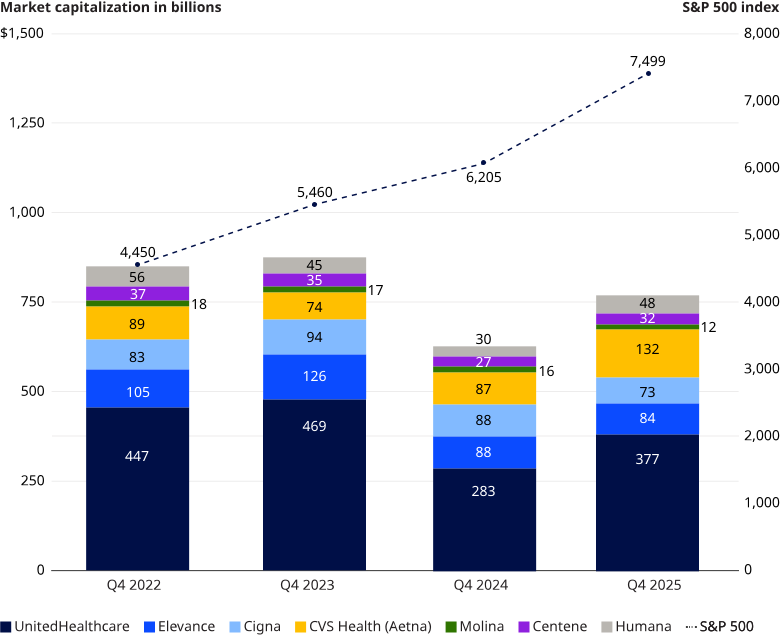
In Q2 2026, the collective market capitalization of the seven public healthcare companies we monitor rebounded considerably, largely reversing the steep Q1 2026 decline and returning to roughly year-end 2024 levels. Over the twelve months to June 30, 2026, their combined market capitalization increased by 22.4%, slightly ahead of the S&P 500’s 20.9% growth. YoY gains for Humana (+61.6%), Aetna CVS Health (+51.3%), and UnitedHealthcare (+33.4%) were partially offset by declines for Molina (-26.2%), Cigna (-17.4%), and Elevance (-4.4%).
The longer-term divergence relative to the broader market remains substantial. Between June 30, 2023, and June 30, 2026, the group’s collective market capitalization declined by 9.3%, versus a 68.5% increase in the S&P 500 index — a roughly 78 percentage-point gap over the three-year period.
Healthcare stocks jump 47% as market sentiment improves
After a poor market performance in Q1 2026, all seven public healthcare companies that we monitor rebounded substantially in the second quarter as reported financials and market sentiment improved, with collective market capitalization up 47.0% from March 31 to June 30, 2026, far outpacing the S&P 500 (+14.9%). Humana (+129.1%) and Centene (+96.9%) saw the largest increases, followed by Molina (+71.6%), UnitedHealthcare (+53.7%), Aetna CVS Health (+44.5%), and Elevance (+30.6%), while Cigna’s increase was more modest (+3.7%), reflecting its comparatively stronger performance during Q1 2026. Despite the recovery, the group was still about 9.0% below its Q1 2025 market capitalization.
Healthcare stocks declined post Q2 2026
From the end of Q2 2026 until August 11, 2026, the group’s collective market capitalization declined 4.4%, compared with a 3.1% gain in the S&P 500.
Five carriers declined in this period: Molina (-14.9%), Aetna CVS Health (-9.4%), Humana (-6.1%), UnitedHealthcare (-4.4%), and Cigna (-0.8%). Centene (+1.1%) and Elevance (+0.8%) posted small gains.
The second quarter reinforced a theme that’s been running through the industry most of the year: margins and capital are strengthening as carriers place an emphasis on financial health over membership growth. The next few quarters will further test how resilient companies are to changes, especially as OBBBA work requirements take hold and seasonal cost pressures come into play during the second half of the year.