


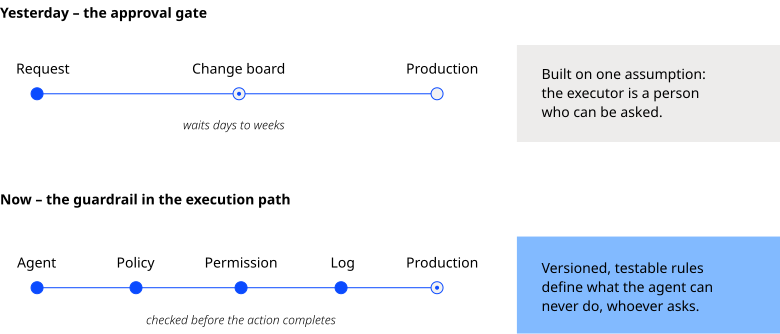
While current technology could do many of the things that agentic AI will do moving forward, it could not do them nearly as fast or with so little human input. AI agents do not need to wait for an approved change window or a ticket to be issued. Agents can take actions — even repeat them thousands of times — before a traditional governance body can respond. And for people-centric operating models, this reality — and the lack of control it suggests — creates problems.
That’s why, when scaling agentic AI, technology leaders say they worry more about the control systems around models than about the quality of the models in isolation. The goal should not be governance for its own sake but rather making the pace of agentic AI change survivable.
Yet while 84% of CEOs rate their organization as leading or on track to scale agents safely, only 9% believe their control environment is largely ready, according to the Oliver Wyman 2026 Parallel Surveys of CEOs and Tech Leaders on Agentic AI and IT. Just 3% of CEOs are very confident they could today reconstruct and stand behind what an autonomous system did on their behalf in a customer or regulatory setting, with 90% say they are somewhat confident.
Agentic AI governance for identities and shadow agents
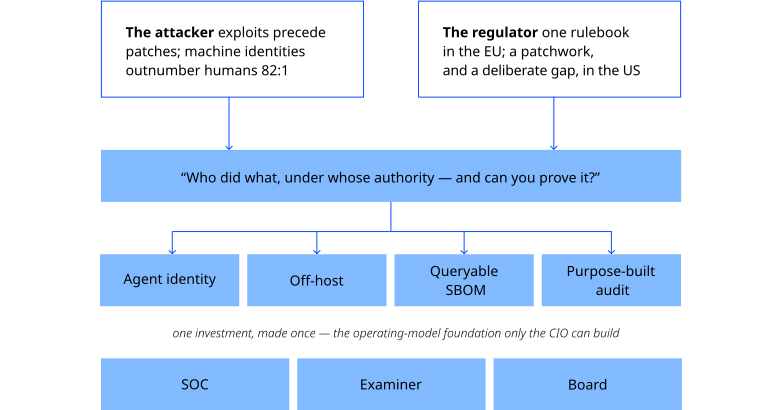
Machine identities already outnumbering human identities by more than 80 to one, illustrating why the agentic control challenge extends beyond ensuring sanctioned deployments. Yet only 24% of CIOs and other tech leaders in our 2026 survey knew their own non-human-to-human identity ratio, and 13% had not inventoried non-human identities at all.
Business teams can create agents with little more than a prompt and perhaps an API key, contributing to a proliferation of agents without scaled value. Our own data shows 45% of CIOs reporting isolated pilots with no scaled value and only 3% with enterprise-level value visible in profit and loss statements.
Traditional approval processes become the bottleneck, so the answer is guardrails enforced at the point of action, though these alone are not enough. Today’s leaders need:
- Guardrails for the agents they build
- Visibility into the agents they did not sanction
- A scalable approach for both, giving a practical way to govern the thousands of agents that may eventually operate across the enterprise
Only 10% of CIOs can produce every agent’s owner, scope, cost and last certification date on demand, and 28% have no central registry for these items at all. Although 21% have appointed a head of AI governance, 69% only are still at the stage of defining the role’s scope.1The goal is not governance for its own sake, it is implementing the right level of governance to make the pace of agentic change survivable.
Building the evidence layer for agnetic AI governance
Security threats and regulatory expectations are evolving quickly. While working exploits are increasingly found by Mythos-like models before vulnerabilitiesare disclosed and patched, regulators are taking different approaches across jurisdictions. This exposure is a top priority: just 3% of CEOs are very confident they could today reconstruct and stand behind what an autonomous system did on their behalf in a customer or regulatory setting, while 90% are only somewhat confident.
For regulators, the underlying enterprise requirement is remarkably consistent: Organizations need to show which agents acted, what they did, under whose authority, and produce the supporting evidence. For an agentic architecture, this means establishing governed identities for every agent, clear dependency trees, and audit trails designed with key security and regulatory questions in mind. Today, that layer is largely missing: One-quarter of CIOs can reconstruct what an agent changed, when, and who authorized it from a tamper-evident record, while 72% have only partial logs. The evidence layer serves two purposes: answer evidence to regulators and helping track external attacks.
Funding and accountability for agentic AI investments
More than 40% of agentic AI projects are forecast to be cancelled within two years, but it is rarely due to inadequate technology.
Two leading causes of agentic failure are unclear business value and inadequate risk controls, both resulting from partial investment decisions. Our recent CEO and CIO surveys expose the mismatch at source: 35% of CEOs expect agentic AI to deliver annual gains of 21–50%, but only 7% of CIOs say IT has sufficient funding to deliver at that level. Further, while 60% of CEOs have increased AI spend, only 29% have ring-fenced funding for the platform, data, and technology modernization prerequisites23.
Accountability matters just as much as technological choices, underscored by developments from legal proceedings. In Moffatt versus Air Canada, a Canadian tribunal rejected the idea that a company could distance itself from unreliable information provided by its customer-facing chatbot. Every agentic AI investment therefore needs both a named owner accountable for the output of agents as well as a funding discipline that determines which bets deserve capital. While agents may act autonomously, enterprise accountability cannot be delegated.
Managing agentic AI risk through governance
Operating a fleet of non-deterministic agents means accepting that leaders cannot promise perfect correctness. They can instead define a target reliability, set autonomy constraints, and ensure business risk is managed if an agent gets something wrong or goes rogue.
Leaders are already trying to set those guardrails, with 70% of CIOs capping production autonomy at the level where agents run processes with human approval. Only 1% allow largely or fully autonomous operations, while CEOs are least willing to allow agents to handle regulated processes and high-stakes decisions (59% each), followed by financial controls and reporting (57%).
Building an agent is only the beginning of the process. A pilot shows whether an agent is viable; the operating model determines whether it is viable at enterprise scale. Ensure that:
- Operations are supported by service-level objectives, decision tracing, rollback, and lifecycle management
- Risk is managed with proper testing, golden datasets, and drift detection
- Integration is approached consistently between agents and other business systems
Budgeting for agentic AI and autonomous agents
Agentic AI breaks familiar technology spending assumptions, as costs can be highly variable and the agents themselves can influence consumption. Different elements within an agentic interaction (such as branching, retries, and tool calls) drive varying levels of token consumption.
Faulty design and poor optimization can increase token consumption between five to 30times, even for a simple query. Rather than a fixed number based on per-seat planning, cost per task becomes a distribution and less predictable. Without optimization and enforced limits, an agent can consume a month’s budget in hours. This is not hypothetical: among CIOs whose agents have scaled, 54% told our survey that they had already materially exhausted an AI budget ahead of plan, yet only 22% budget run costs as a distribution with an auto-enforced cap at the P90 boundary, and 25% still work from a single point estimate.
Leaders need to tie spending with business outcomes and their profit and loss in mind. This requires enterprises to:
- Size each opportunity
- Define business ownership
- Allocate and manage necessary cost
- Set limits to avoid over-consumption
- Measure tangible value realization
Our Parallel Surveys found that 63% of CIOs already enforce per-agent budget caps and a kill-switch in the loop, while 35% still rely on dashboards alone. Overall, falling unit costs will not necessarily mean falling total bills.
Despite the rapid decline in the price of a fixed unit of AI capability, the migration towards newer models continues to drive consumption. Behind this, capital spending on global data centers is projected to approach $1.7 trillion by 2030 — even as enterprise IT budgets remain broadly flat. The risk of moving too slowly and falling behind must be balanced against the risk that agentic sprawl and runaway costs outpace organizational controls.


